



One-Person Marketing Department, 100 Content Pieces Per Week Using AI—What Is It?
It's a way of organizing work where one person uses processes and AI to turn a few original ideas into many variations for multiple channels (blog posts, social media posts, emails, short videos, images), based on the content repurposing principle. One honest note: "100 content pieces per week" is feasible in terms of production, but volume is not the same as quality. Content cloned from AI without a unique perspective will look like everyone else's, and OPCAIOS has no data showing that 100 pieces perform better than 10 good pieces. This article describes a four-step process, how to break down the volume, review checkpoints, metrics to measure, and OPCAIOS's experience.
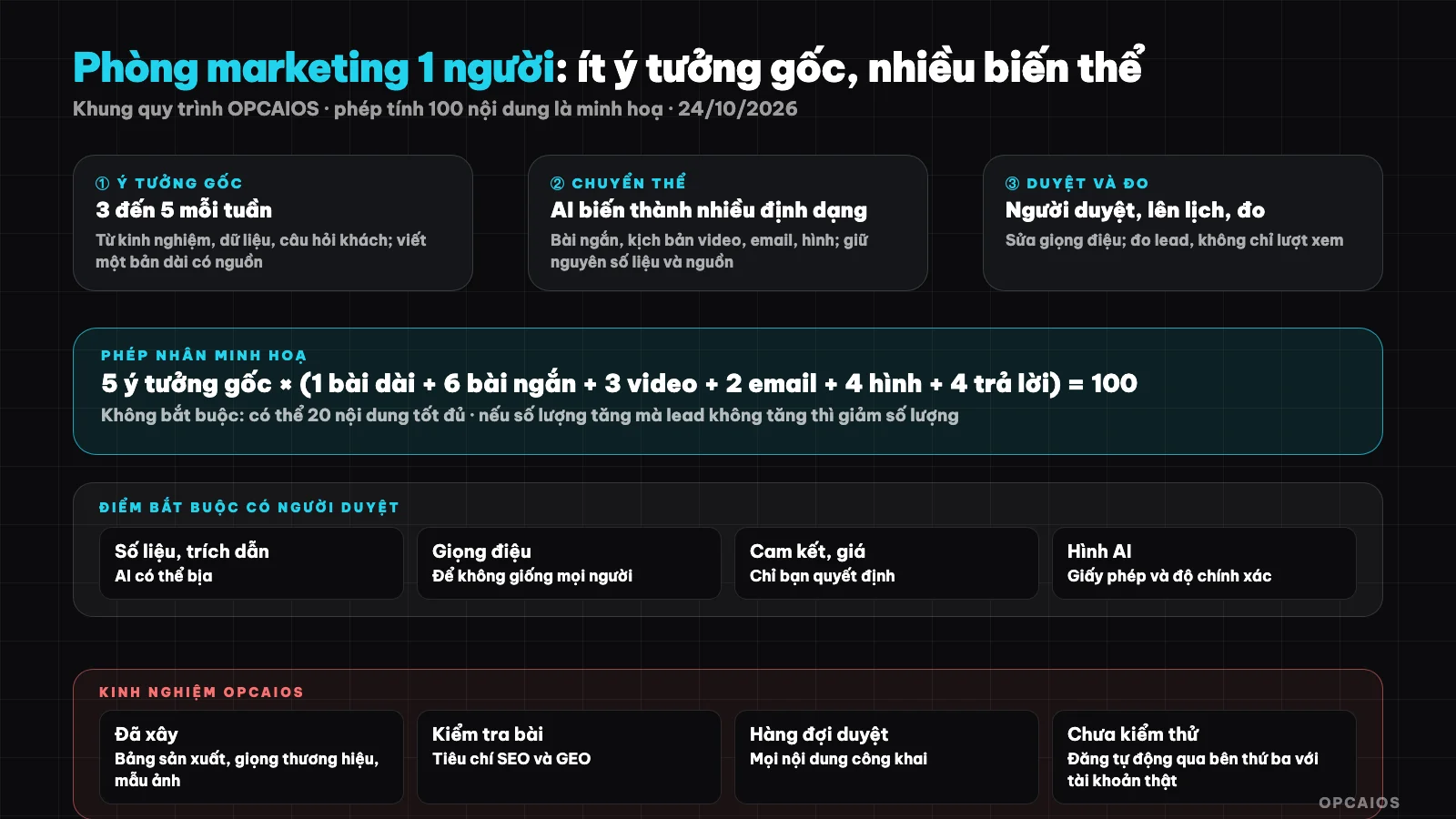
Few original ideas, many variations, always with a review and measurement step. Diagram: OPCAIOS.
What Principle Lets You Make 100 Content Pieces From a Few Ideas?
The principle is few original ideas, many variations: 3 to 5 original ideas per week, each based on a real experience, data, or viewpoint of the business owner, then transformed into many formats. The number 100 is just the result of multiplication. Each original idea becomes one long-form piece, a few social media posts, a few short video scripts, emails, and images. The table below is OPCAIOS's calculation example, not research data; a hypothetical example where each original idea takes 2 hours to write with Claude, so 5 ideas take 10 hours.
| Content Group | Per Original Idea | With 5 Original Ideas |
|---|---|---|
| Long-form pieces (blog, newsletter) | 1 | 5 |
| Social media posts (multiple channels) | 6 | 30 |
| Short video scripts | 3 | 15 |
| Emails, community messages | 2 | 10 |
| Images, carousels, quotes | 4 | 20 |
| FAQs, comment replies | 4 | 20 |
| Total | 100 |
This is an illustrative calculation, not a mandatory target; maybe 20 good pieces are enough for your needs.
What Steps Are in the Multi-Channel Content Production Process?
The process has four steps in order, and AI is heavily involved only in step three.
- Gather original ideas: from customer questions, projects you just completed, data you have. Use a notes repository as a source (see What Is Second Brain?).
- Write the long-form piece: one complete article with your perspective, sources verified (see how to write with structure in What Are SEO and GEO?).
- Adapt with AI: give Claude or ChatGPT the long-form piece along with voice guidelines, ask for variations for each channel; have AI preserve data and citations.
- Review and schedule: read each version, edit, remove generic parts, then schedule using n8n or Make.
Hypothetical example: one 1,200-word article can become 6 social media posts and 3 video scripts in just one adaptation pass with Anthropic's Claude, taking about 30 minutes. Review time—roughly 5 hours per week in this scenario—is still the most labor-intensive step for the business owner.
What Points Must Always Have Human Review?
Review is mandatory wherever a mistake could harm reputation or legal standing. First, data, proper names, and citations, because Claude, ChatGPT, and Gemini can all make things up, so you must check sources. Second, voice and positioning, because the model's default voice sounds like everyone else's, so you need to edit it to your own voice for the OPCAIOS brand or your personal Facebook. Third, customer commitments, pricing, and promotions, because only the business owner decides. Fourth, sensitive or legal content, because niche advertising needs regulatory compliance. Finally, AI-generated images need license and accuracy checks (see What Is ComfyUI? on model licenses). Hypothetical example: AI writes the course price as $50 instead of $30, and only the review step catches the mistake before the post reaches 1,000 followers; if 30% of drafts need heavy editing, then review time grows accordingly.
Tools for Each Stage
| Stage | Tool | Related Post |
|---|---|---|
| Drafting, adaptation | AI assistant | What is LLM? |
| Quick design, presentation | Gamma and design tools | What is Gamma? |
| Automate posting schedule, save drafts | n8n, Make or posting tools | What is n8n? |
| Email tool with unsubscribe option | What is email marketing? | |
| Measurement | Metrics per channel, Google Search Console | What are SEO and GEO? |
Which metrics should I measure for a content system?
Metrics fall into four groups, and business metrics matter more than views.
- Quality: percentage of content needing heavy edits, number of real feedback from customers.
- Distribution: views, saves, shares by channel.
- Business: number of leads from content, number of sales conversations originating from content.
- Time: number of hours you spend each week on the entire process.
Metrics per channel and Google Search Console are the main sources (see What are SEO and GEO?). Example: if after 4 weeks your content volume doubles but leads stay at 10 per week, or the percentage of content needing heavy edits exceeds 40%, reduce quantity and increase quality.
OPCAIOS Experience
We built several components into our website for this: a content production dashboard, a content editor with brand voice, image templates, post checks against SEO and GEO criteria, an approval queue, daily draft posts and integration for scheduling; all public content goes through an approval step. Currently we haven't tested automatic posting through third parties with real accounts, so posting is still done manually or semi-manually. We don't have data to say that 100 pieces per week performs better than fewer pieces, and we don't publish our own traffic numbers.
Frequently Asked Questions
Can one person produce 100 pieces of content per week?
In terms of production, yes, if one person has a content reuse process and AI adaptation. Example: 5 core ideas multiplied into 100 products using the breakdown table above. The real issue is quality and review time, because each piece still needs someone to read, edit, and schedule; if reviewing each piece takes 3 minutes, 100 pieces costs about 5 hours. OPCAIOS has no data showing that 100 pieces performs better than 10 good pieces, so volume should only increase when you have lead data.
Should I post 100 pieces per week?
Not necessarily. Start with the quantity you can review carefully and increase when data shows it works.
Can AI-written content be penalized?
We don't have a general conclusion about penalties; what matters is that content is useful, accurate, and sourced. See more in What are SEO and GEO?.
How do I make content that doesn't look like everyone else's?
Content stands out when it starts from the real experience, data, and views of the business owner. First, pick core ideas from customer questions and recent projects. Next, give your tone of voice rules to Claude or ChatGPT before adapting. Finally, edit by hand to remove generic parts. For example, a post about a real mistake from a 3-day project is more valuable than 10 summaries of common knowledge, because readers get your unique experience. To learn how to build a content system, take OPCAIOS's AI application training course or SOLO Content Engine.
Source: content reuse principles are common practice; the 100-content breakdown is OPCAIOS's illustration, not research data; tool knowledge comes from OPCAIOS's related posts (read 24/10/2026). Experience is OPCAIOS's.
Translated from Vietnamese with AI. Read the original.
Want to apply this in your business?
Book a free 30-minute call (Vietnam time, in English or Vietnamese).