


What is "One-Person Business Get Rich on Autopilot," and Why Is It an Illusion?
It's the promise that with AI and automation, you can build a self-running system with steady revenue without working much. The part that's true: AI and automation really do cut costs and time for many tasks. The part that's false: "automatic" rarely means "without you," and "get rich" doesn't follow. This post lists ten real traps, based on how one-person operating models actually work, without inflated numbers. The illustration is hypothetical, not a real customer: an ad promises "$5,000 monthly passive income after 30 days," but the seller doesn't disclose their own 2026 revenue. OPCAIOS is a one-person model using AI, so we write from operating experience, not from a podium.
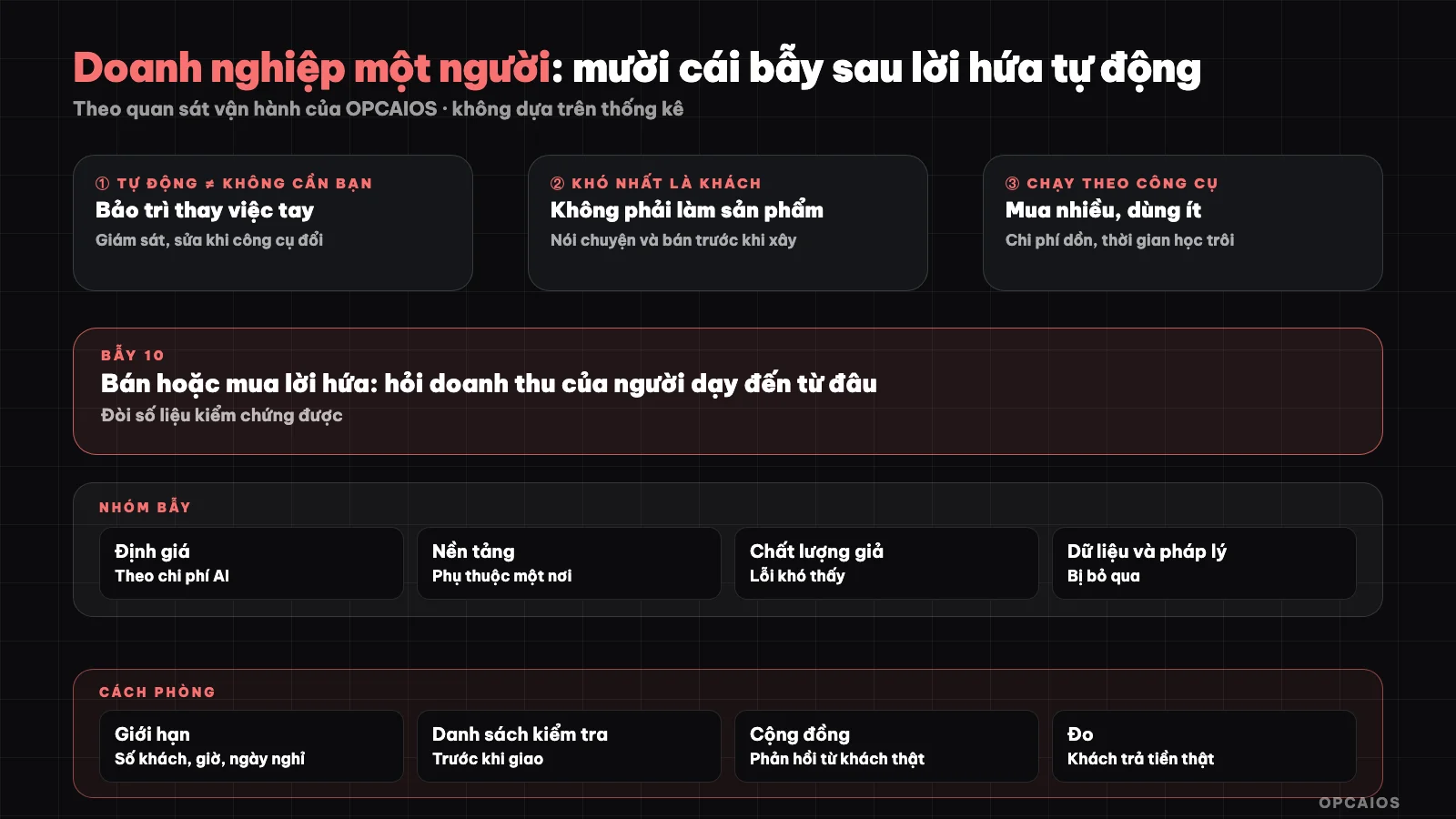
Ten traps and how to guard against them. Diagram: OPCAIOS.
Traps 1, 3, and 7: Why does an automated system still need an operator?
The operating trap is the belief that an automated system, a new AI tool, or pre-written AI content will run well on its own without oversight. In reality, each process must be built, monitored, fixed when a provider changes their interface, and updated when customers change their needs. Hypothetical example, not a real customer: a freelancer builds an email-reply process using n8n and OpenAI. Each week they spend 3 hours fixing errors when the API changes, plus $60 a month for the tool, and 20% of emails still need manual review in 2026. Three things to do in order:
- Only automate work that runs well by hand, and set a fixed weekly monitoring schedule.
- Before buying a new tool, write down the specific problem the tool solves (see Breaking the AI Tool Shopping Habit).
- Finally, fact-check the content AI writes yourself: false facts, copyright, mixed-up customer information (see 5 Mistakes When Building OPC).
Also, see 24/7 AI Agent System.
Traps 2, 4, and 10: Why is finding customers harder than building a product?
The market trap is putting all effort into making a product while customers, price, and new promises decide your revenue. AI makes products cheap and fast, so many people can build them; the advantage shifts to distribution and trust. Hypothetical example: someone builds a course in 14 days, sells it for $9 because they think AI costs are low, then gets only 5 buyers in the first month because they haven't talked to any customers. If you run Google ads with a 2% conversion rate, revenue still won't cover the work. The lesson comes down to three points:
- First, find and talk to customers before you build, even sell before you build.
- Next, price based on the outcome and trust customers get, not based on token costs. Low prices attract picky customers and squeeze margins.
- Finally, with "get rich on autopilot" courses, ask where the teacher's revenue actually comes from and demand verifiable numbers. Success examples are filtered by survivor bias (see the post on the million-dollar-a-year one-person model).
Traps 5 and 8: What are the risks of platforms, data, and legal?
System risk is the place where one outside change can stop a one-person business: platform policy, AI model vendors, data protection rules, and tax obligations. Revenue coming from just one social network like Facebook, one app store, or one AI model means one policy change could erase your whole sales channel. Hypothetical example: 80% of customers come from a Facebook page that gets locked for 7 days, so revenue nearly stops, even though each order before that was $30. Three steps to guard against it:
- Keep an email list, your own website, and at least one backup option.
- Set data rules for every AI tool, because customer data you put into Google, OpenAI, or Anthropic can leak secrets (Data Security When Using AI).
- Prepare tax and invoicing procedures early when revenue grows (Legal Checklist).
Traps 6 and 9: How Does Working Alone Lead to Burnout and Isolation?
Burnout and isolation are the human traps of the one-person model: one person doing all selling, delivery, support, accounting, with no days off and no one to check their work. Working alone for long easily leads to misjudgment, like believing in a product no one needs, or quitting too soon. Example scenario: a business owner works 12 hours a day for 180 days, with no advisor, spending 40% of time on customer support, then burns out completely. Hiring an assistant for $200 a month early on might cost far less. Three ways to reduce the risk:
- Set limits on number of customers, working hours, and fixed days off each week.
- Outsource the most draining work once you have the financial means.
- Join a community, find an advisor, and ask real customers for feedback each month.
Checklist Before Believing a Promise
| Question | Good Sign |
|---|---|
| Who is the data source? | Has independent evidence or clearly states it is self-reported |
| How much real time does it take? | Includes maintenance hours and customer finding time |
| What does the full cost include? | Has taxes, tools, time |
| Is there a downside? | Mentions both failures and risks |
| What are they selling you? | Clear, with actual refund terms |
OPCAIOS Experience
We use a lot of automation and agents, and what we learned is that every automated system needs someone watching it, every new tool takes time to learn, and finding customers doesn't get shorter because of AI. We have also bought tools we never used and had to cut back. We don't promise financial results to anyone who follows along; we can share how we do it, but we don't share guarantees.
Frequently Asked Questions
Can a one-person business get rich?
Some do, but not "automatically" and with no guarantee; the path is usually longer than the ads say.
Does AI help?
It reduces cost and time for many tasks, but it doesn't replace finding customers and making decisions.
What is the most dangerous trap?
No paying customers; everything else depends on that.
How do I avoid being tricked by a course?
Ask for proof you can check and find independent feedback.
How should I start?
One small service, real first customer, then automate. See 30-Day Roadmap and OPCAIOS AI Application Training.
Source: operational observation and common business principles; not based on specific statistics. Experience is from OPCAIOS.
Translated from Vietnamese with AI. Read the original.
Want to apply this in your business?
Book a free 30-minute call (Vietnam time, in English or Vietnamese).