



Can One Person Really Make Millions of USD Per Year Without Hiring Staff? Yes, but Rare, and the Numbers Are Almost Always Self-Reported by the Product Owner.
The most often cited example is Pieter Levels, who built Photo AI, Remote OK, Nomad List (now nomads.com) and many other products. He describes himself as "bootstrapped" and says he codes on his laptop. On his personal page levels.io (read on 25/10/2026), he wrote on 6/3/2026 that Photo AI generates $105,000 in revenue each month and $80,000 in profit each month. According to a PPC Land article on 25/5/2025 citing Lex Fridman Podcast episode 440, he said only 4 of his more than 70 projects ever made money and grew, meaning over 95% failed. This article does not sell a formula for getting rich. It breaks down verifiable common points, what cannot be transferred, and how to apply it to your own scale. OPCAIOS does not have revenue at that level and does not imply otherwise.
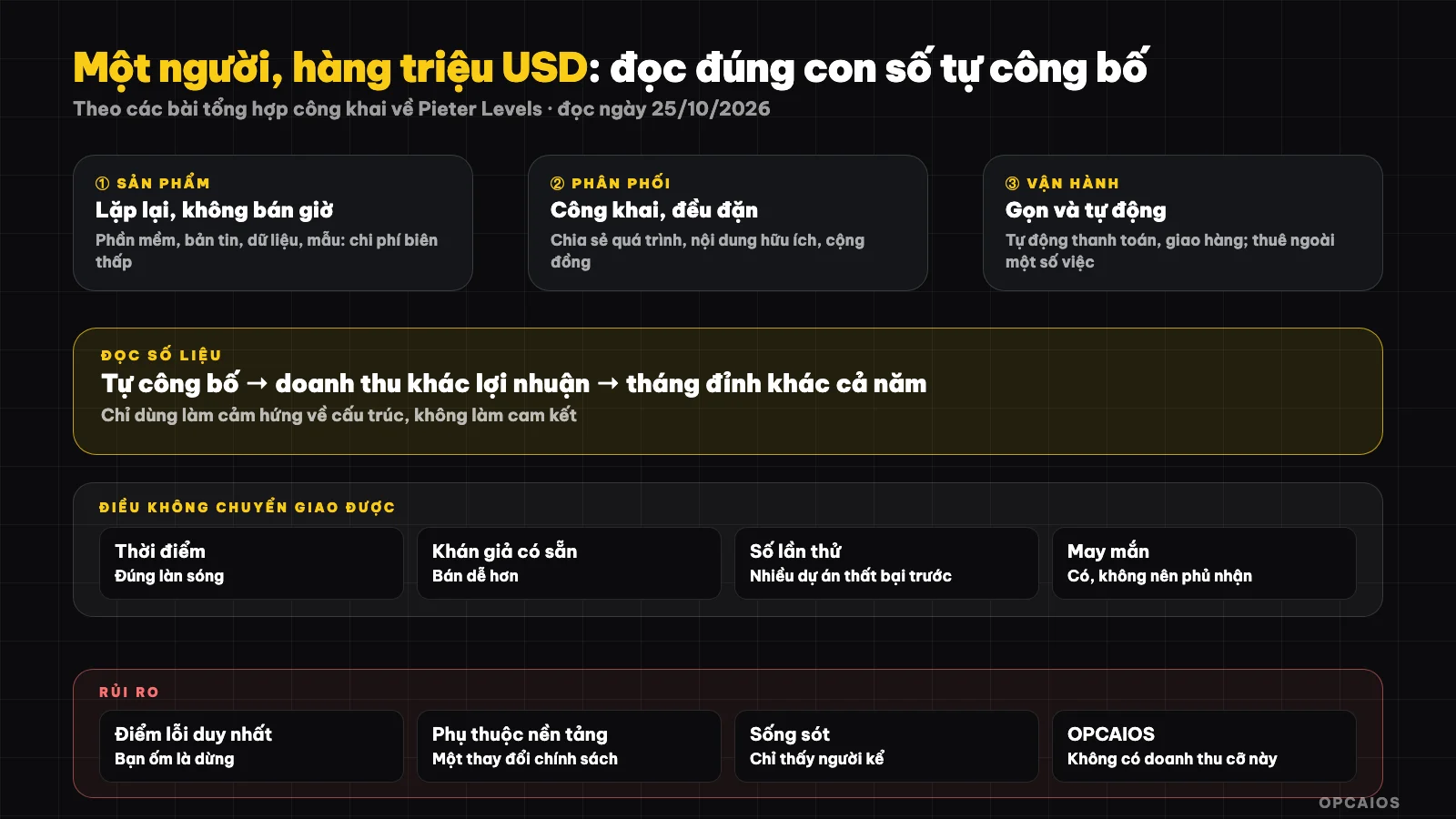
Common features of one-person models, and the limits of self-reported numbers. Diagram: OPCAIOS.
What Do Pieter Levels' Public Numbers Say?
Pieter Levels' public numbers are self-reports, readable but unaudited by anyone. For example, three data points from sources read on 25/10/2026. First, levels.io: on 6/3/2026 he wrote Photo AI "making 105,000/mo revenue and 80,000/mo profit" (about $105,000 in revenue and $80,000 in profit each month); on 5/9/2026 he wrote he gave nomads.com away for free after a decade, without stating revenue. Second, PPC Land (25/5/2025, author Luís Rijo) compiled his words from social media: Photo AI $132,000 each month, Remote OK $41,000 each month, Interior AI $40,000 each month. Third, also from PPC Land, his hit rate is around 5%. The numbers vary by time and calculation method, so they should not be added up into "annual revenue." Another news item mentions a total of around 3 million USD per year but does not cite the source; OPCAIOS considers this unverified.
How to Read the Numbers Correctly
To read one-person model revenue numbers correctly means treating each number as a self-report that needs cross-checking, not as audited fact. For example, $105,000 per month times 12 gives around 1.26 million USD, but that is only OPCAIOS's multiplication, not stated annual revenue. Filter the figures through five points:
- Self-reported: almost all numbers come from the product owner themselves on social media; news outlets and blogs repeat them, sometimes rounding or multiplying up.
- Revenue differs from profit: revenue still must subtract platform fees, GPU infrastructure, advertising, taxes.
- Best month differs from whole year: multiplying the peak month by 12 inflates it.
- Survivor bias: you see the successful person because they are telling the story; per PPC Land, he himself said over 95% of his projects failed.
- "No staff" is not the same as "independent of everyone": OPCAIOS found no official source stating headcount or outsourcing, so we do not claim it.
Real conclusion: use examples like these as inspiration for structure, not as a promise of results.
Four Common Points of an Efficient One-Person Model
1. Repeatable Products, Not Selling Hours
Large revenue without employees almost always comes from something sold many times with low marginal cost: subscription software, paid newsletters, data, courses, pre-made templates. Hourly service is limited by your time budget. See 7 low-capital OPC business ideas.
2. Product Solves a Clear Problem for a Clear Group
Successful products usually start from a narrow need that the maker themselves has. They don't build "a platform for everyone," they build a good tool for one group.
3. Public and Persistent Distribution
Public distribution is how a solo maker finds customers without a large advertising budget: share your process, post useful content and build community consistently. For example, levels.io (read on 25/10/2026) is a public log of posts about revenue, source code and product decisions, including a post "I'm Launching 12 Startups in 12 Months" posted on 1/3/2014; OPCAIOS could only read the title, not the results. A practical approach has three steps. First, choose a channel where your customer group is, such as LinkedIn or X. Next, post regularly on a fixed schedule. Finally, link each post to your own email collection page. See automated sales funnel.
4. Automated Operations and Simplification
They keep technology lean, automate payments, delivery, email, and decline work that doesn't generate revenue. AI today reduces costs further for many tasks (coding, content, support), but cannot replace finding what people want to buy. See AI system operating alone.
What Cannot Be Transferred
| Factor | Why Hard to Copy |
|---|---|
| Timing | Some successful products ride the right wave |
| Ready Audience | Someone with large following sells easier |
| Number of Tries | Many failed projects before the successful one |
| Technical Skill | Someone who codes themselves cuts costs sharply; someone who doesn't needs to hire or use AI |
| Luck | Yes, and should not be denied |
Apply to Your Scale
- Choose one customer group and one problem you understand from real experience.
- Test demand before building: sell first or take deposits for the smallest version.
- Package as a repeatable product (see What is Productized Service?).
- Share your process consistently; each useful post is an asset.
- Automate the repetitive parts but keep human touch where customers decide (n8n on VPS).
- Track real numbers: revenue, costs, profit, customer count, churn rate.
- Set goals in stages, for example first paying customer, then stable monthly, before thinking of big numbers. See 30-day roadmap to build OPC.
Risks of the No-Employee Model
The biggest risk of the no-employee model is everything depends on one person and a few platforms. These five risks below should be planned for from the start:
- Single point of failure: you get sick or burnt out and everything stops. Need documentation, automation and backup plans.
- Platform dependency: revenue sits on an app store, social network or AI vendor that can disappear after a policy change.
- Support overload: customers grow faster than your ability to reply.
- Legal and tax: large revenue brings large obligations; see Legal checklist for Solopreneur.
- Isolation: working alone long gets demotivating; need community and mentors.
OPCAIOS Experience
OPCAIOS is a small model run by one person, using AI agents and automation for website, content and operations; we do not publish revenue and don't have million-dollar revenue levels. What we observe from our own operations: the hard part is not coding or content but choosing the right work to do and staying consistent with distribution. We also see each automated system creates more maintenance work, so only automate what already runs well by hand.
Frequently Asked Questions
Can one person make millions of dollars a year?
There are examples, but they are rare and usually self-reported; they should not be considered typical results.
Does Pieter Levels really have no employees?
Pieter Levels describes himself on levels.io (accessed 25/10/2026) as saying his startups are "all bootstrapped without funding and just me coding everything on my laptop", but the site does not mention headcount, so OPCAIOS does not claim "no employees" or "no outsourcing". According to PPC Land (25/5/2025), he is described as a solo founder, without raising capital and without hiring marketing staff. On revenue, levels.io states Photo AI at $105,000 per month (6/3/2026), while PPC Land states $132,000 per month (5/2025); these are different points in time and both are self-reported figures. For example, using a single number as proof of "typical income" is wrong, because he himself said on a podcast that over 95% of his projects failed. OPCAIOS has not independently verified these numbers, and "no employees" is still different from "depends on no one": servers, payment platforms, and AI model providers are all third parties.
What is the biggest secret?
The biggest secret is not a tip but four things in common among solo person models: repeatable products, solving a clear problem for a clear group, regular public distribution, and lean operations. First, large revenue with no employees often comes from subscription software, paid newsletters, courses, or templates. For example, Photo AI, according to PPC Land (2025), sells a Pro package at $29 a month with 1,000 images. However, no secret guarantees results: timing, an existing audience, and luck cannot be transferred, and according to Levels himself as cited by PPC Land, his success rate is around 5%. OPCAIOS has no million-dollar revenue to prove it.
Can AI help?
It cuts costs for many things, but it does not replace figuring out what customers want to buy.
Where to start?
From a customer group and a specific problem you understand. To learn how to build a solo person model with AI, see OPCAIOS's AI application training course.
Sources: levels.io (accessed 25/10/2026; post on 6/3/2026 about Photo AI, 5/9/2026 about nomads.com, site does not state headcount); PPC Land, "How one Photo AI app generates 132K monthly after 70 failed startups", Luís Rijo, 25/5/2025 (ppc.land; compilation of self-reported statements and quotes from Lex Fridman Podcast #440, posted 20/8/2024, OPCAIOS has not read the original transcript so the 4 out of 70 projects ratio is secondary information). All revenue is self-reported, unaudited. One article mentions a total of 3 million dollars a year with no source, unverified. No OPCAIOS revenue figures in this post. The experience is OPCAIOS's.
Translated from Vietnamese with AI. Read the original.
Want to apply this in your business?
Book a free 30-minute call (Vietnam time, in English or Vietnamese).