


What is Flowise?
Flowise is an open-source tool to build chatbots, RAG flows, and AI agents by dragging and dropping blocks on a web interface, built on LangChain and running on Node.js. According to GitHub (API, read 04/11/2026), the FlowiseAI/Flowise repository was created on 31/03/2023, has around 55,500 stars, Apache 2.0 license, and was archived on 13/08/2026, meaning it is now read-only. The homepage flowiseai.com (read 04/11/2026) also announced that Flowise is discontinuing. This post explains what Flowise can do, pricing and licensing, how to install if you still want to try it, and most importantly, the risks of using a discontinued project along with alternative options.
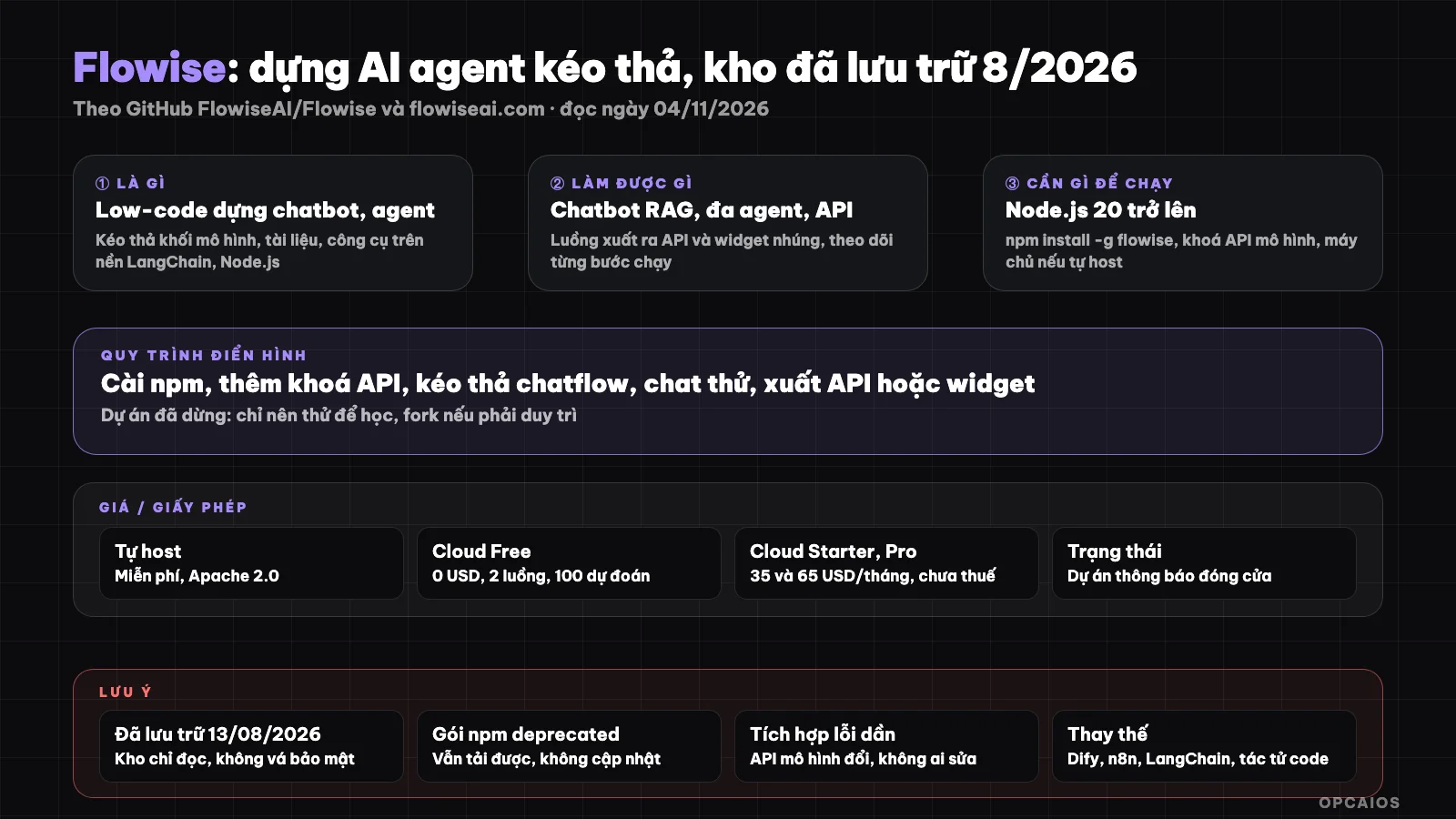
Flowise turns LangChain blocks into drag-and-drop flows, but the repository has been archived since August 2026. Diagram: OPCAIOS.
What is Flowise and who created it?
Flowise is a low-code platform to "Build AI Agents, Visually" according to the GitHub description: users drag blocks of models, documents, memory, and tools onto a canvas and connect them into chatbots or agents, without writing code. The project was developed by the FlowiseAI organization from March 2023 onwards, with a self-hosted version and a cloud version called Flowise Cloud.
According to the README (GitHub, read 04/11/2026), the repository is a monorepo consisting of server (Node backend), ui (React frontend), components (model integrations, vector databases, tools), and api-documentation (Swagger documentation). Flowise came into being right during the LangChain boom and was seen as the fastest way for non-programmers to try RAG or AI agents. With 55,500 stars and over 25,000 forks (GitHub API, read 04/11/2026), it was once one of the most popular drag-and-drop tools in this category. The big change came on 29/07/2026 when the development team announced the project was stopping.
Flowise has stopped development: what happened?
Flowise has officially stopped development. According to the sunset page on flowiseai.com (read 04/11/2026), the timeline consists of three milestones: 29/07/2026 announcement and code freeze, no new pull requests accepted; August 2026 GitHub repository transitioned to archived status, npm packages and Docker images marked as deprecated; 31/08/2026 end of life, core team left Discord and GitHub.
The reason the team gave, according to the same page, is that developers are increasingly delegating complex tasks to coding agents like Claude Code, while rigid flow-based low-code tools face difficulties as complexity increases. We are quoting this as stated by the project, without independent verification. The sunset page does not mention when the cloud service will shut down or the data export deadline; if you are using Flowise Cloud, check directly. As for the source code, Apache 2.0 allows forking and self-maintenance; the project encourages this but does not designate a replacement product. GitHub shows the repository archived on 13/08/2026, the sunset page records the plan for 10/08/2026; we use the date GitHub displays.
What can Flowise do?
Flowise allows you to build three main types of applications: question-answering chatbots on documents, agents with tools, and multi-agent flows, then export as API or embedded widget. Table from README and homepage (read 04/11/2026).
| Feature | Description |
|---|---|
| Drag-and-drop canvas | Connect blocks of models, prompts, memory, documents, tools into chatflows or agentflows |
| Assistants and RAG | Chatbot answering questions on loaded documents, connects to vector databases |
| Multi-agent | System of multiple agents working together, with human review step according to homepage |
| Execution tracing | Review each step of a flow's execution for debugging |
| API and SDK | Each flow becomes an API endpoint; chat widget embeds in websites |
| Integrations and deployment | Many models, vector databases, tools; configuration via .env; guides to self-host on AWS, Azure, GCP, Railway, Render, and other platforms |
For someone without coding knowledge, Flowise was once the easiest way to see "what a RAG flow consists of" with your eyes. That value still exists for learning, but no longer for building products long-term.
Is Flowise Free? Price, License, Limits
Flowise self-hosted is free under Apache 2.0; the cloud version once had paid plans. Since the project is archived, the pricing below is only the homepage state as of the read date and may disappear at any time.
| Item | Information (flowiseai.com, read 04/11/2026) |
|---|---|
| Self-hosted | Free, Apache 2.0, repository archived |
| Cloud Free | $0/month, 2 flows, 100 predictions/month |
| Cloud Starter | $35/month, unlimited flows, 10,000 predictions/month |
| Cloud Pro | $65/month, 50,000 predictions/month, 5 users, +$15/user/month |
| Enterprise | Contact sales; requires license variable in .env per documentation |
| Hidden costs | Model API keys, vector databases, server or VPS; GPU if running models locally |
Excludes tax, subject to change. The sunset page says Flowise is shutting down, so we recommend against signing up for new paid plans. Apache 2.0 allows commercial use, modification, and redistribution with attribution; this is a summary, not legal advice.
How to Install Flowise If You Still Want to Try?
Installing Flowise requires Node.js 20 or higher and one npm command, per the README (read 04/11/2026). The npm package is marked deprecated so you'll see a warning on install; the code still runs but no new patches.
npm install -g flowise
npx flowise start
- First, install Node.js 20 or higher, run the two commands above, open
http://localhost:3000. - Next, go to Credentials to add API keys from your model provider.
- Create a sample chatflow: model block, document block, memory block, connect them and test chat on the canvas.
- Finally, if using Docker: clone the repository, go to the
dockerdirectory, copy.env.exampleto.env, rundocker compose up -d. See What is Docker?.
The README also covers building from source with pnpm (pnpm install, pnpm build, pnpm start). We haven't tested this; the steps above follow the official documentation.
Risks of Using an Archived Project
Using Flowise after archival means you own the responsibility for security and compatibility. This is the biggest risk, larger than any feature limitation.
- No security patches: the repository is read-only, issues are locked. New vulnerabilities in Flowise or Node dependencies won't be fixed officially. Putting Flowise on the internet is something to think hard about.
- Integrations break over time: OpenAI, Anthropic, vector database APIs change; old integration blocks will break with no one to fix them.
- Old LangChain dependency: Flowise built on LangChain.js at freeze time; LangChain has moved to 1.x with many breaking changes.
- Data: flows, documents, and API keys live in Flowise's database; if using Cloud, export flows to JSON early. If you load customer documents, remember your personal data protection obligations; not legal advice.
- Prompt injection: flows that read documents and web can be hijacked by instruction injection; see What is prompt injection?.
If you already have a Flowise flow running, the safe way is to fork the repository, lock dependency versions, and plan a migration to a maintained tool.
Flowise vs Other Options
The closest replacements for Flowise are maintained low-code platforms like Dify and n8n, or switch entirely to coding with LangChain and code agents. The table is general description, not measurement.
| Tool | Position | vs Flowise |
|---|---|---|
| Dify | Build LLM apps drag-drop, has RAG, agents, API | Closest in concept, still maintained; license has own terms to read |
| n8n | Automate general workflows, has AI agent node | Broader (email, CRM, webhook), less chatbot-focused |
| Langflow | Drag-drop canvas for LangChain | Equivalent concept; we haven't checked its current state |
| LangChain + LangGraph | Python/JS library | Requires coding but full control; Flowise originally wrapped LangChain |
| Code agents (Claude Code, Codex) | AI writes apps for you | The direction the Flowise team says users are moving to |
| Open WebUI | Self-hosted chat interface with RAG | No flow canvas; fits if you only need chat over documents |
When Should You Use Flowise?
Flowise is now only suitable for learning and short-term experimentation on your personal machine, not for building new products.
| Situation | Recommendation |
|---|---|
| Want to understand RAG and agents visually | Install locally for a few sessions to learn, then switch to Dify or write code |
| Already have a Flowise workflow running for a client | Fork it, lock the version, plan the migration within a few months |
| Building a new chatbot for a website | Dify, or ask a code agent to write it on LangChain |
| Need multi-channel automation workflows | n8n |
| Considering buying a paid Cloud plan | Don't, the project has announced it's closing |
OPCAIOS's Experience
We recently added Flowise to the Repo list in the Utilities section on opcaios.org as a reference repository, with a note that it was archived on 13/08/2026 after checking via GitHub API; we haven't run it ourselves, so this section outlines the criteria we use to consider it, not an evaluation based on using it. Four criteria:
- Repository is still being updated: no, it's archived; therefore we place Flowise in the "read to learn" group, not "install to use".
- License: Apache 2.0, very permissive, can be forked.
- Hidden costs: consumes API keys and servers like any tool in this category; no licensing fees.
- Can it replace the tool we're using: we built a RAG chatbot with Dify combined with Supabase and automated with self-hosted n8n, so Flowise doesn't replace anything. The direction the Flowise team suggests, moving to code agents, aligns with how we operate opcaios.org using Claude Code, Antigravity, and Codex.
Read more: What is Dify?, What is n8n?, What is an AI agent?, 5 best workflow automation tools in 2026.
Frequently Asked Questions
Can Flowise still be used?
It still runs, but is no longer being developed. According to the sunset page at flowiseai.com (read on 04/11/2026), the code was frozen on 29/07/2026, the GitHub repository was archived in August 2026, and the lifecycle ended on 31/08/2026. npm packages and Docker images are marked deprecated but can still be downloaded. You can install it to learn or fork it to maintain yourself; don't expose an unpatched version to the internet for clients to use long-term.
Why did Flowise stop development?
According to the development team's announcement (sunset page, read on 04/11/2026), developers are increasingly delegating complex work to code agents like Claude Code, while rigid flow-based low-code tools struggle as complexity increases, so the team decided to stop. This is the reason published by the project; we haven't verified it. The announcement doesn't mention financial factors or user numbers.
Is Flowise free?
The self-hosted version is free under Apache 2.0. The Cloud version as of 04/11/2026 still shows a Free plan at 0 USD (2 workflows, 100 predictions/month), Starter at 35 USD/month, Pro at 65 USD/month, excluding taxes. Since the project is closing, we recommend not signing up for new paid plans. The real cost when self-hosting is model API keys, vector databases, and servers.
What tool should I switch to from Flowise?
It depends on your needs. Need drag-and-drop canvas and RAG chatbot: Dify is the closest actively developed choice. Need multi-channel automation with AI steps: n8n. Willing to write code: LangChain with LangGraph, or ask a code agent like Claude Code to build an application. Flowise workflows can be exported as JSON, but there's no automatic conversion tool to other platforms; you have to rebuild following the old logic.
Should someone without coding knowledge learn Flowise now?
Don't invest long-term time in a tool that's stopped. Flowise is still a visual way to understand what blocks make up a RAG workflow or agent, so installing it for a few sessions on your personal machine is enough. After that, learn the underlying concepts (LLM, RAG, agent, prompt) and an active tool like Dify or n8n, or learn how to instruct a code agent. We teach exactly this path in OPCAIOS's AI application training course.
Source: GitHub FlowiseAI/Flowise (README, API, repository archive page showing archived 13/08/2026, read 04/11/2026), flowiseai.com (homepage, pricing page, sunset page, read 04/11/2026), docs.flowiseai.com (getting started, read 04/11/2026); not read/not verified: "Future of Flowise" discussion on GitHub, Cloud service shutdown date, reasons for stopping as announced by the project; star counts and pricing may change. Experience is OPCAIOS's. This post is not legal advice.
Translated from Vietnamese with AI. Read the original.
Want to apply this in your business?
Book a free 30-minute call (Vietnam time, in English or Vietnamese).