



free-for.dev là gì?
free-for.dev là một danh sách mở trên GitHub tổng hợp các dịch vụ SaaS, PaaS, IaaS có gói miễn phí lâu dài cho lập trình viên và người làm hạ tầng, từ máy chủ đám mây, cơ sở dữ liệu, email đến công cụ AI. Theo API GitHub (đọc ngày 04/11/2026), kho ripienaar/free-for-dev được tạo ngày 18/03/2015, có 141.772 sao và 15.213 fork, lần đẩy gần nhất ngày 03/11/2026, và không khai báo giấy phép. README ghi danh sách là kết quả đóng góp của hơn 1.600 người (do dự án công bố, chưa kiểm chứng). Dùng danh sách hoàn toàn miễn phí. Bài này giải thích danh sách gồm gì, tiêu chí chọn dịch vụ, cách đọc cho đúng, rủi ro khi dựa vào gói miễn phí và cách một người làm OPC tận dụng nó.
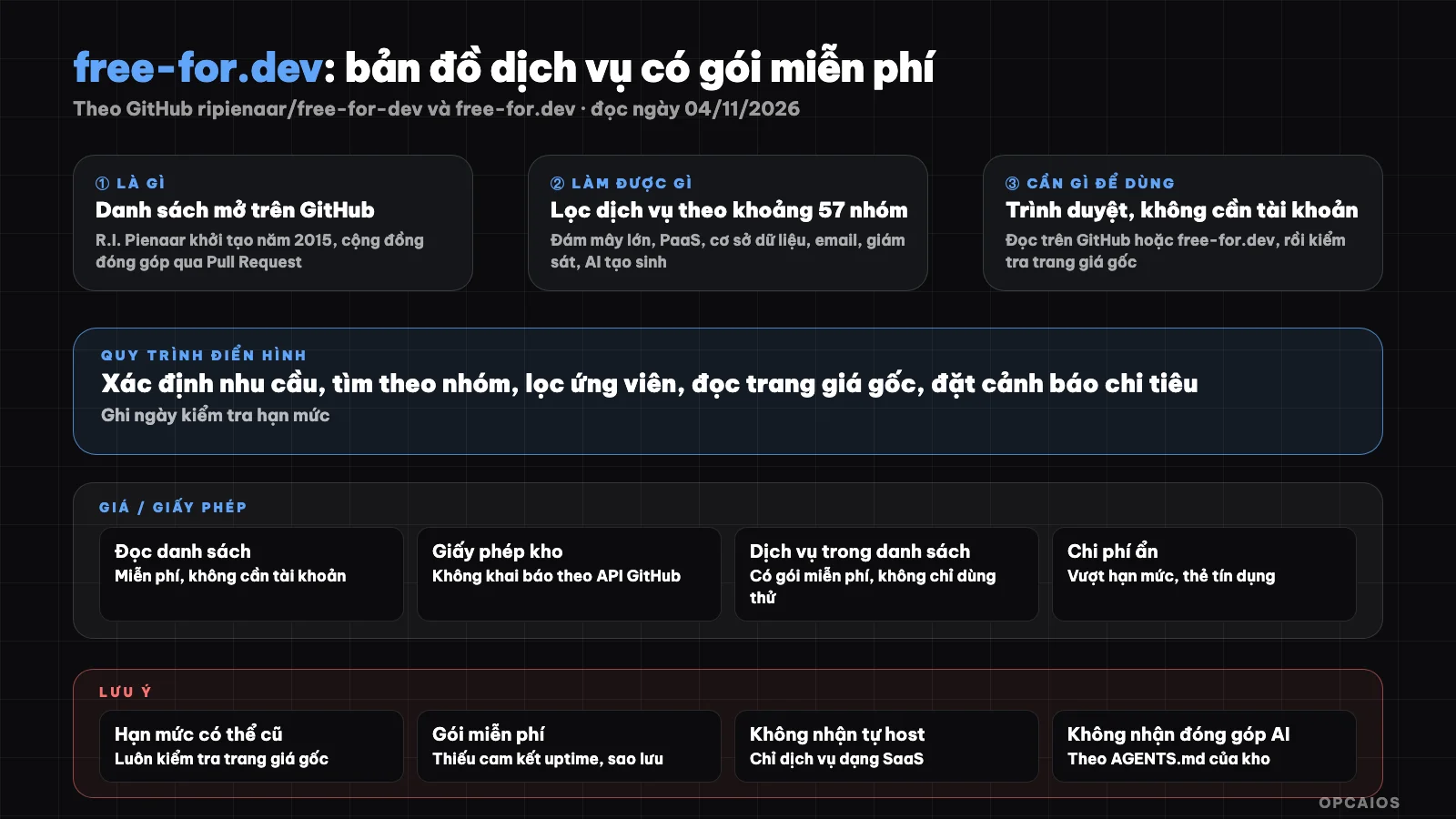
free-for.dev là bản đồ khởi đầu, trang giá chính thức của từng dịch vụ mới là nguồn cuối cùng. Sơ đồ: OPCAIOS.
free-for.dev là gì và ai duy trì?
free-for.dev là danh sách dạng "awesome list" do R.I. Pienaar (tài khoản GitHub ripienaar, kiến trúc sư hệ thống sống ở Malta theo hồ sơ GitHub) khởi tạo năm 2015 và vẫn duyệt đóng góp tới nay. Nội dung nằm trong một tệp README; trang free-for.dev hiển thị lại chính tệp đó.
Mục tiêu của danh sách, theo README trên GitHub (đọc ngày 04/11/2026), là giúp lập trình viên và tác giả mã nguồn mở đỡ mất thời gian tìm dịch vụ có gói miễn phí. Phạm vi được giới hạn cho những thứ mà người làm hạ tầng, như quản trị hệ thống và DevOps, thấy hữu ích. Tôi nói rõ danh sách mang tính chủ quan và có thể từ chối đóng góp lạc đề. Kho có hai đặc điểm đáng chú ý. Thứ nhất, danh sách chỉ nhận dịch vụ dạng "as-a-Service", không nhận phần mềm tự host. Thứ hai, kho đặt tệp AGENTS.md và CLAUDE.md ghi rằng kho không nhận đóng góp do AI chỉnh sửa, và người gửi phải theo mẫu Pull Request. Kho dùng GitHub làm nơi làm việc chính; nếu bạn chưa quen, xem GitHub là gì.
free-for.dev có những nhóm dịch vụ nào?
free-for.dev chia dịch vụ thành khoảng 57 nhóm tiêu đề, với khoảng 1.380 dòng mục theo đếm của tôi trên README ngày 04/11/2026 (gồm cả mục con). Bảng dưới chọn một số nhóm tiêu biểu, diễn đạt lại.
| Nhóm | Ví dụ nội dung |
|---|---|
| Đám mây lớn | Hạn mức luôn miễn phí của Google Cloud, AWS, Azure, Oracle Cloud và các nhà khác |
| PaaS, BaaS, web hosting | Nơi chạy ứng dụng, backend dựng sẵn, trang tĩnh |
| Cơ sở dữ liệu được quản lý | Postgres, MySQL, Redis, cơ sở dữ liệu vector có gói miễn phí |
| CI/CD, kiểm thử, chất lượng mã | Dịch vụ dựng, kiểm thử, quét mã |
| Email, biểu mẫu, DNS, tên miền | Gửi email giao dịch, form, quản lý DNS |
| Giám sát, log, lỗi | Theo dõi uptime, gom log, bắt lỗi ứng dụng |
| AI tạo sinh | API mô hình, công cụ đánh giá và quan sát ứng dụng LLM |
| Bảo mật, xác thực | Đăng nhập, quản lý người dùng, chứng chỉ |
Mỗi mục thường gồm tên dịch vụ, liên kết và một câu mô tả hạn mức miễn phí, ví dụ số yêu cầu mỗi tháng hay dung lượng lưu trữ. Mục "Đám mây lớn" đi sâu nhất: liệt kê từng dịch vụ con của mỗi nhà cung cấp kèm hạn mức.
Tiêu chí nào để một dịch vụ được vào free-for.dev?
Một dịch vụ được vào free-for.dev khi có gói miễn phí thật, không chỉ dùng thử. Tiêu chí này là lý do danh sách hữu ích hơn nhiều bài "top công cụ miễn phí" trên mạng, vốn hay lẫn bản dùng thử 14 ngày.
Theo README và CONTRIBUTING trên GitHub (đọc ngày 04/11/2026), các quy tắc chính gồm bốn điểm. Đầu tiên, dịch vụ phải là dạng dịch vụ, không phải phần mềm tự host. Tiếp theo, phải có gói miễn phí, không chỉ bản dùng thử; nếu gói miễn phí tính theo thời gian thì phải kéo dài ít nhất một năm. Thứ ba, xét cả góc bảo mật: dự án không nhận dịch vụ chỉ cho dùng TLS ở gói trả phí. Cuối cùng, CONTRIBUTING liệt kê các loại không nhận, như hosting PHP kiểu cPanel, dịch vụ email tạm thời, trang "hộp công cụ" chuyển định dạng hay máy tính trực tuyến, và dịch vụ chép y nguyên dịch vụ khác. Mỗi đề xuất mới phải theo mẫu Pull Request, nếu không sẽ bị đóng. Các quy tắc này giúp lọc nhiễu, nhưng không đảm bảo mọi hạn mức trong danh sách còn đúng ở thời điểm bạn đọc, vì nhà cung cấp đổi gói thường xuyên.
How to use free-for.dev?
You don't need to install anything or create an account to use free-for.dev. You read it on the free-for.dev page or directly on GitHub, search by category, then check the official page of the service. The free-for.dev page needs JavaScript enabled to display.
- First, identify your specific need: for example "need a small Postgres for testing" or "need to send 1,000 emails each month".
- Next, open the corresponding category in the table of contents, or use Ctrl+F to search for keywords like "Postgres", "SMTP", "LLM".
- Filter two to three candidates by limits, server region and credit card requirements.
- Open the official pricing page of each candidate, read the current limits and terms when you exceed the limit.
- Finally, record the date you checked and set a spending alert if the service charges when you exceed the limit.
Example of use (hypothetical example): an OPC worker wants to build a small course registration page. They use free-for.dev to choose a place to run a static site, a database with a free plan and a transaction email service, then check the pricing page of all three before signing up. The initial total cost could be zero, but they clearly note at what threshold they will start spending money.
Limits and risks when relying on free-for.dev
The biggest risk when using free-for.dev is outdated information: free limits are decided by the provider and can be cut at any time, while the list is only updated when someone submits an edit.
The first limit is latency. The list is based on community contributions, so a free plan might have been reduced before someone edits the README. The second limit is that a free plan is not a production plan: it usually lacks uptime guarantees, support and backups, some services sleep when not in use or delete data after a period of inactivity. The third limit is hidden costs when you exceed the limit, especially with major cloud providers requiring credit cards: forgetting to shut down a virtual machine or exposing an API key can generate a bill. Fourth is personal data: if you store customer data, you need to check where the server is located and the provider's data processing terms; we haven't cross-checked Vietnamese law or GDPR requirements with each service, and this is not legal advice. Finally, the repository doesn't declare a license according to the GitHub API, so if you want to copy the list content to post elsewhere, you should ask the author first.
free-for.dev versus other lists
free-for.dev stands out thanks to its age and clear filtering rules. The table below is a general description, not a measurement.
| Source | Strengths | Weaknesses |
|---|---|---|
| free-for.dev | Long-established, many contributors, only accepts genuine free plans | Focuses on infrastructure, can be slow to update |
| Other topic-specific awesome lists | Deep into one area | Filtering criteria not consistent |
| "Top free tools" posts on blogs | Easy to read, has guides | Often mixes free trials, can be advertising |
| Official pricing pages | Most accurate at time of reading | Have to open each page one by one |
When should you use free-for.dev?
You should use free-for.dev at the tool selection stage, when you need a quick list of candidates for a specific infrastructure need. Don't use it instead of the official pricing page.
| Situation | Recommendation |
|---|---|
| Building a product prototype with a 0 đồng budget | Use free-for.dev to choose hosting, database, email |
| Finding an AI model API to learn | Check the generative AI category, pay attention to daily request limits |
| Running a service for paying customers | Use the list to filter, then choose a paid plan with commitments |
| Want to self-host software | free-for.dev doesn't accept self-hosted software, see What is VPS |
| Building a stack for a one-person company | Combine with Free AI tech stack for OPC |
OPCAIOS's experience
We just added free-for.dev to the Repo category of the Tools section on opcaios.org after reading the README and checking that the repository is still being updated; we haven't used this list to choose services for opcaios.org yet, so this part states the criteria we use to consider, not an evaluation after use. OPCAIOS is a one-person-operated website using AI agents, with n8n self-hosted on a private server, so for each free service we ask four questions. First, does the provider still maintain a free plan, check on the official pricing page. Next, the terms of use and where data is stored. Third, hidden costs when you exceed the limit. Finally, whether the service can replace an existing self-hosted tool without creating new dependencies.
Read more: What is Cloudflare, What is Supabase, What is OPC Skills.
Frequently Asked Questions
Is free-for.dev trustworthy?
free-for.dev is trustworthy as a starting list, not as an official pricing source. The repository has existed since 2015, has over 141,000 stars on GitHub (as of 04/11/2026), and has clear filtering rules: it only accepts genuinely free packages, not trials. However, each entry is submitted by the community and providers can change their packages anytime, so the limits listed may be outdated. The safe way to use it is to take the list as a candidate filter, then always double-check on the service's official pricing page and record the date you checked.
Does free-for.dev charge?
No. Reading the list on GitHub or on the free-for.dev website is free and requires no account. The services in the list have free plans, but many providers, especially large cloud companies like Google Cloud and AWS, require a credit card when you sign up and will charge if you exceed the free limits. So the actual cost depends on how you use each service. Turn on spending alerts, turn off unused resources, and keep your API keys secure to avoid surprise bills.
Can I suggest my service to free-for.dev?
Yes, via a Pull Request on GitHub, but you must follow the rules. According to the CONTRIBUTING (as of 04/11/2026), the service must be a SaaS with a free plan, not just a trial, and must not fall into excluded categories like cPanel-style hosting, temporary email, or format conversion tool pages. The submitter must fill out and check all the Pull Request template boxes; if not, the proposal will be closed. The repository also states clearly in AGENTS.md that it does not accept contributions edited by AI, so you should write and submit the proposal yourself.
Does free-for.dev list open-source self-hosted software?
No. The README clearly states the list is only for "as-a-Service" offerings, not for self-hosted software. Some entries do have notes that the service is also open-source, but the criterion for being on the list is still a free plan on the service version. If you want to self-host a tool like n8n on your own server, you need to look at other lists such as awesome lists for self-hosted, and factor in server cost, backup, security updates. For solo workers, a service with a free plan usually means less operational work than self-hosting.
Can someone with no coding skills use free-for.dev?
They can read it, but the list is written in English and aimed at programmers, so many terms like PaaS, BaaS, CI/CD will be hard for beginners. The groups easiest to use for non-coders are forms, email, design, fonts, and part of the generative AI group. You can ask an AI assistant to explain each entry, but you should still visit the official page to check the limits yourself. If you want to learn systematically how to pick and combine AI tools for your work, see OPCAIOS's AI application training course.
Source: GitHub ripienaar/free-for-dev (README, CONTRIBUTING, AGENTS.md, API, read 04/11/2026), ripienaar's GitHub profile, free-for.dev website (read 04/11/2026, the site needs JavaScript so only the framework part could be read); not read/not verified: current limits on each service's pricing page, the figure of over 1,600 contributors as announced by the project; number of entries and groups are our count; star count may change. The experience is OPCAIOS's.
Translated from Vietnamese with AI. Read the original.
Want to apply this in your business?
Book a free 30-minute call (Vietnam time, in English or Vietnamese).