


What is vibe marketing?
Vibe marketing is a way of doing marketing by giving targets to an AI agent and letting it create content, build pages, run tests and optimize, instead of doing each step by hand: thanks to this, one person can do the volume of work that previously required a whole team. The term mimics "vibe coding" (see What is vibe coding?), and according to Scott Brinker (chiefmartec), Greg Isenberg is seen as the first to coin this phrase. This 2026 update consists of four parts:
- Two meanings of "vibe": technical formula and brand feeling.
- A four-step process with a reviewer, along with a sample brief.
- The biggest risk: replicating blandness at high speed.
- How to start safely for small businesses with one channel and one measurable goal.
Assumed example: a store with 2 people doing marketing should only delegate to AI the drafting of posts, while brand voice decisions still belong to the person.
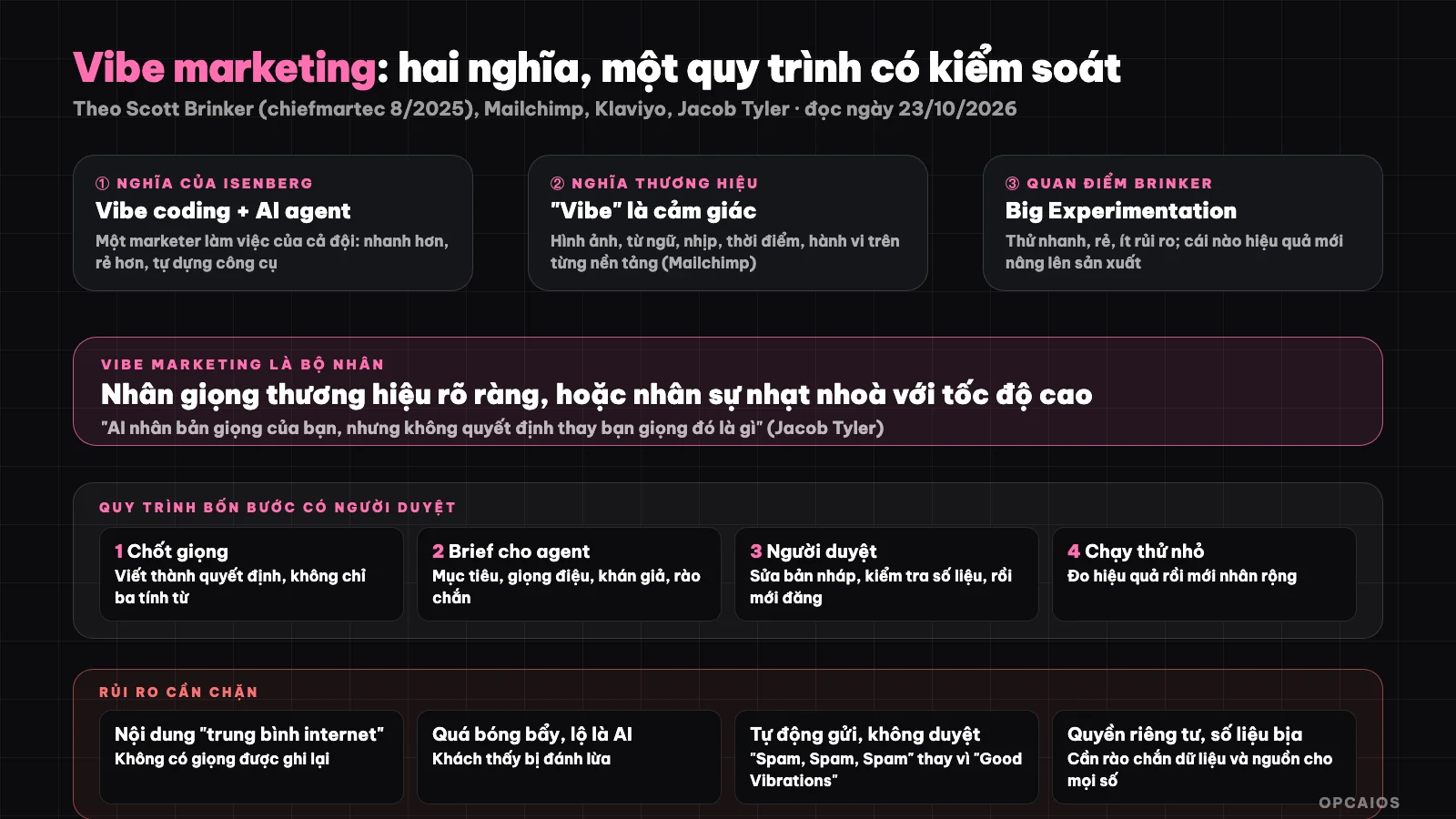
Vibe marketing replicates both brand voice and blandness, so you need to lock in voice and have a reviewer before scaling. Diagram: OPCAIOS.
What is vibe marketing?
Meaning 1: is vibe marketing vibe coding plus AI agent and automation process?
Vibe marketing is the way Greg Isenberg defines the combination of vibe coding with AI agent and automation process, according to Scott Brinker's summary on chiefmartec (August 2025, read 23/10/2026). This combination helps each marketer do things that previously required a whole team of experts, with three benefits:
- First, run faster.
- Next, get more ideas to market at low cost.
- Finally, easily build or customize tools to your own needs.
Brinker says straight out this is like the next generation of "growth hacking", and some people call that role "GTM engineer". We haven't read the source from Isenberg himself but relied on Brinker's summary. For example, instead of hiring 3 people to write, build and post content, a marketer delegates to an AI agent running on Claude (Anthropic) and just reviews the result.
Meaning 2: is "vibe" the feeling of the brand?
According to the "Vibe Marketing 101" guide page (Mailchimp, read 23/10/2026), vibe marketing focuses on how a brand feels: image colors, words, rhythm, references, how it acts on each platform and emotional tone. Mailchimp distinguishes three concepts:
- Brand voice is consistent personality.
- Tone is the part that changes by situation.
- Vibe includes both, plus design, cultural perception, timing and mood.
The two meanings meet at one point: AI speeds up production, but people must decide what the brand wants others to feel. Brinker himself also believes agents and automation "are not vibe", and according to Brinker, vibe lies in the marketer listening to the audience when receiving things made by the machine. For example, a small café using Claude (Anthropic) to write posts still has to choose whether the voice is intimate or refined.
How is vibe marketing different from traditional marketing and regular AI marketing?
The difference is the role of the person: from producer to director and reviewer. According to Jacob Tyler agency's post (30/6/2026), the bottleneck has shifted from production to judgment: the marketer no longer makes most of the product, but sets direction, sets voice then coordinates the machine executing.
| Criterion | Traditional marketing | Vibe marketing |
|---|---|---|
| Who produces | Expert team, each step | One person coordinating AI agent |
| Bottleneck | Production: write, build, resize | Decision: voice, direction, review |
| Test speed | Weeks | Hours to days |
| Main risk | Slow, expensive | Bland, wrong brand, wrong facts |
| Core work of people | Making products | Locking voice, brief, review, measure |
What steps does controlled vibe marketing include?
Controlled vibe marketing is a four-step process with review, synthesized from Klaviyo's guidance (3/24/2026, read 10/23/2026) and Scott Brinker's "large-scale experimentation" perspective. The four steps are:
- Document your brand voice in writing: not just three adjectives, but a set of decisions (how you speak when confident, what you never say, whether you open with a problem or a promise, which jokes to use and avoid).
- Brief an agent with a brief: according to Klaviyo, the brief includes objectives, tone, audience, and guardrails; then iterate across drafts.
- Human review before publishing: review, publish, then refine based on performance data.
- Run small tests, measure, then scale: Brinker calls this "Big Experimentation": most experiments should be fast, cheap, and low-risk; ideas that work get promoted to production, ideas that don't get discarded.
Here's a hypothetical example—a sample brief for asking Claude (Anthropic) to write a post; adjust it to your brand:
Objective: [post introducing feature X, expecting clicks on Y]
Audience: [small shop owners, not tech-savvy]
Tone: [friendly, straightforward, avoid clichés; don't make absolute promises]
Don't: [make up numbers, mention competitors, use "comprehensive solution"]
Must do: source every number; flag places needing human review.
Return: 3 short versions in different tones for me to pick, not yet published.
What infrastructure do you need for vibe marketing to work?
According to Klaviyo, the toolkit includes a centralized customer data warehouse, AI agents for content, targeting and optimization, plus MCP connections so AI can access CRM, brand assets, and other systems. Remember this is from a vendor with commercial interest. For small business, a minimal viable version includes:
- A brand voice document and a set of "right tone, wrong tone" examples.
- An AI model for drafting. See Which AI model should I choose? to weigh costs by task.
- A CRM to know who your customers are, like in What is HubSpot?.
- Automation tools to link the steps, like n8n, Make, or Zapier. If an agent needs data access, see What is MCP? for the principle of least privilege.
What is vibe marketing's biggest risk?
The biggest risk of vibe marketing is scaling bland content fast. The sources reviewed, read 10/23/2026, list five risks:
- "Internet-average" content: according to Jacob Tyler, creating content at scale without a documented voice means you get "the statistical average of the internet, wearing your logo," and that's a fundamental error, not a tool error.
- Content too polished or obviously AI: Mailchimp notes it can make customers feel tricked rather than drawn in.
- Chasing every trend: Mailchimp advises against following every fad.
- Automating sends to recipients: Brinker asks how recipients feel—"Good Vibrations" or "Spam, Spam, Spam"—and stresses the need for guardrails on data and privacy rights.
- Factual errors: AI can make up numbers or endorsements; every public number needs a source and a reviewer.
Also, most of these sources are from vendors or agencies like Mailchimp and Klaviyo, so read their data carefully; this post uses no advertising statistics. For example, a promotional email Claude (Anthropic) writes may sound right in tone but promise a discount wrong—that's a small error magnified thousands of times.
OPCAIOS's experience with AI doing marketing
OPCAIOS uses AI to draft lots of content, but has one fixed rule: AI drafts, human reviews, then publish. Specifically, the website's content and marketing system has review queues; SEO copy written automatically and AI-drafted posts both go on a review list for the site owner to review before publishing—never self-published. The series of "What is X" posts on this blog is done that way: AI researches, drafts, scores against the site's rubric, then the blog owner reviews before scheduling publication. The real lesson: the rule "no number without a source" and a human review step is what keeps quality up as speed increases.
Where should small businesses start with vibe marketing?
Start with one channel and one measurable goal, not with tools.
- Write your brand voice into a one-page document, with 5 example sentences that match the voice and 5 that don't.
- Pick one repeating task, like a social media post or care email, for AI to draft.
- Set rules: all content goes through a reviewer; all numbers must have a source.
- Run a one-week test, measure results, then decide whether to scale.
- Respect customer privacy and follow current advertising rules; if unsure, ask a legal expert.
To learn this process with guidance, see OPCAIOS's AI application training course.
Frequently asked questions
What is vibe marketing?
Vibe marketing is a way to do marketing by giving an AI agent the goal of creating content, building pages, running tests and optimizing, so one person can do the work of a whole team. In brand terms, "vibe" is also the overall feeling a brand creates.
Who came up with the term vibe marketing?
According to Scott Brinker (chiefmartec), Greg Isenberg is often credited as the first to use the phrase, as a mix of vibe coding with AI agents and automated workflows. We based this on Brinker's piece, and have not read the original from Isenberg himself.
How is vibe marketing different from vibe coding?
Vibe coding is asking AI to write code without reviewing the code; vibe marketing is asking AI to create and run marketing content. Both speed things up a lot, but both need someone to set direction and review results.
What risks does vibe marketing have?
Bland and repetitive content, wrong voice or wrong brand, auto-sending to people who get annoyed, privacy violations, and made-up numbers. Ways to lower the risk are to lock in your voice as text, write clear briefs, have a reviewer, and run small tests first.
Should small businesses use vibe marketing?
Small businesses should try vibe marketing with one channel and one measurable goal, but always keep a reviewer. AI helps cut production time, it can't replace decisions about brand and truth of information. First, write your brand voice into a one-page document. Next, pick one repeating task like a social media post or care email for AI to draft using Claude (Anthropic). Last, run a 1-week test and measure results before you scale. According to Scott Brinker, you need guardrails for customer data rights and privacy (chiefmartec, read 23/10/2026). Example scenario: a store with 2 people should start with a post-purchase care email, because the content is short and easy to check sentence by sentence.
Source: "1967 was the Summer of Love; we will remember 2025 as the Summer of Vibes" by Scott Brinker (chiefmartec, 8/2025); "Vibe Marketing 101" page by Mailchimp; "What is vibe marketing" by Klaviyo (24/3/2026); "Vibe Marketing Scales Your Brand Voice. Or Your Slop." by Jacob Tyler (30/6/2026); read 23/10/2026. eMarketer blocks automated access so cannot be used directly. Most sources are blogs from vendors or agencies with business interests. No original source from Greg Isenberg himself; process experience is from OPCAIOS.
Translated from Vietnamese with AI. Read the original.
Want to apply this in your business?
Book a free 30-minute call (Vietnam time, in English or Vietnamese).