


What is Micro-Agency AI, and can a small agency reach 100 million đồng monthly revenue with software costs under 3 million?
Micro-Agency AI is a very small agency (one to a few people) selling services to businesses, using AI and automation to speed up repetitive work. On the numbers, this article does not report actual revenue from a real agency; OPCAIOS does not publish its own revenue and has no verified figures from other agencies to cite. Instead, the article breaks down a hypothetical model with clear calculations so you can plug in your own numbers: how many clients you need, what price, how many hours, and what software costs actually include. The 100 million đồng monthly figure is an illustrative target, not something proven.
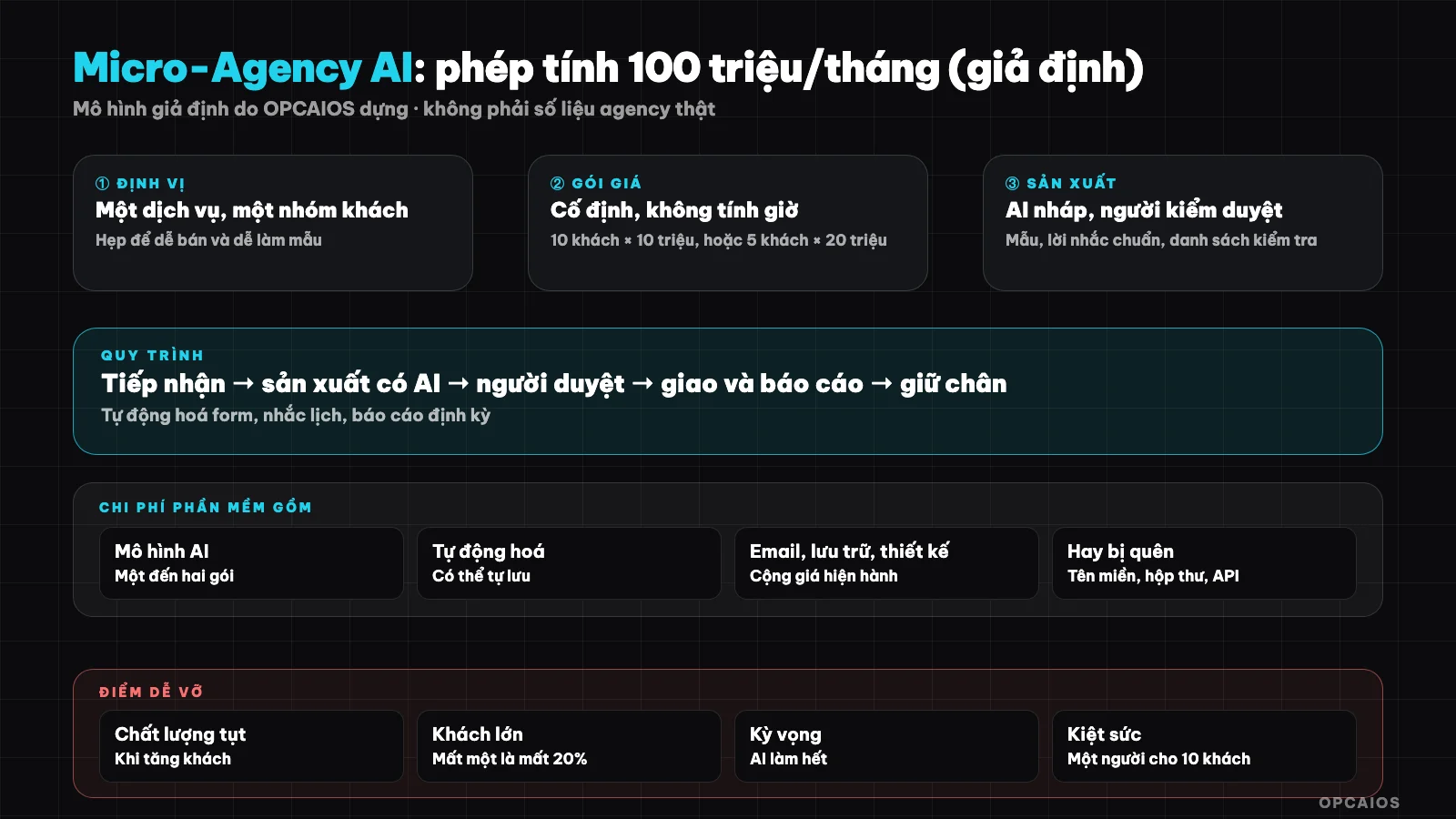
One service, fixed package pricing, AI-powered production, human review. Figures in this article are assumed. Diagram: OPCAIOS.
Revenue calculation (assumed)
Revenue calculation for a micro-agency divides your revenue target by package price to get the number of clients needed, then checks that against your own hours. With an assumed target of 100 million đồng a month, a 10 million đồng package needs 10 clients, a 5 million đồng package needs 20 clients, and a 20 million đồng package needs only 5 clients. The table below lists ways to divide this up:
| Ways to reach 100 million per month | Clients needed |
|---|---|
| 10 million đồng package per month | 10 clients |
| 5 million đồng package per month | 20 clients |
| 20 million đồng package per month | 5 clients |
| Mix: 3 clients at 20 million + 8 clients at 5 million | 11 clients |
The deciding question is whether you can sell to and serve that many clients with your time. Each client paying 10 million a month might take 8 to 15 of your hours if you don't automate; 10 clients is 80 to 150 hours, nearly using up one person's time budget. That is why you need a process.
Operating process
1. Positioning: one service for one client group
Positioning means choosing one service for one client group so that both selling and delivery can repeat. Example assumed: monthly reports and marketing content for a small dental clinic. Narrow positioning makes pitching easy, prototyping easy, and lets you reuse standard prompts for later clients. This is only assumed to illustrate; OPCAIOS has not verified this sector.
2. Packaging and pricing
Packaging and pricing means turning a service into a fixed package: what is included, how many deliverables, how long, and what is not included—no hourly billing. See What is Productized Service?. Price is based on value to the client and your actual labor cost per hour, not on AI cost. Example assumed: a dental clinic package at 10 million đồng a month; if it takes 8 real hours, that is about 1.25 million đồng per hour; if it takes 15 hours, about 667 thousand per hour. First, count the real hours; next, set the price; last, state clearly the limit on revisions.
3. Client intake
Intake survey, short contract, upfront payment. Automate with forms and workflows (auto sales funnel).
4. AI-powered production
AI writes drafts (content, reports, analysis), you do strategy and decisions. Use templates, standard prompts, checklists. See Building a one-person marketing agency with AI.
5. Human review
Human review means every deliverable goes through before handoff, and is what the client truly pays for. Check four things: accuracy (numbers, names, prices sourced), brand voice, image rights, privacy. Log AI mistakes to update your standard prompts.
6. Delivery and reporting
Regular reporting, quick replies, short meetings; automate schedule reminders and report sending.
7. Retention and growth
Satisfaction survey, ask for referrals, upsell packages.
Software costs "under 3 million": what does it include?
Software costs under 3 million dong per month are only feasible when your tool stack stays lean and your customer base is still small. A lean stack might include: one or two paid plans for AI models, one automation tool (which could be self-hosted), email, storage, and a design tool. We do not state specific prices because prices change and exchange rates fluctuate; add up the current list prices of the tools you choose yourself. A few notes:
- Costs often forgotten: domain names, professional email accounts, accounting software, API call costs when usage is high.
- Costs grow with customer count and usage volume; "under 3 million" might be true for 5 customers but not for 20.
- Software is only part of your costs; taxes, your time, and customer acquisition costs are usually larger.
- See AI tool costs replacing 3 staff members and auditing AI tool costs.
Sample profit and loss statement (assumed)
| Item | Per month (assumed) |
|---|---|
| Revenue | 100 million |
| Software | under 3 million (at your current prices) |
| Outsourcing, contractors | depends on your model |
| Advertising, customer acquisition | depends on your model |
| Taxes and fees | per current regulations |
| Profit | what's left, you calculate |
Don't confuse revenue with income; calculate actual profit and taxes (see Legal checklist for solopreneurs).
Where this model breaks easily
- Quality drops as customers grow: AI is fast but errors multiply with customer count.
- Depends on a few large customers: losing one customer means losing 20 percent of revenue.
- Customers expect "AI does everything": contracts need to clearly state who is responsible.
- Customer data security risk: see Data security when using AI.
- Burnout: one person serving 10 customers is high intensity.
OPCAIOS experience
OPCAIOS runs on AI agents and automation, and we've found that most time savings come from processes and standard templates rather than from the tools themselves. We do not publish our actual revenue or software costs and we don't use the 100 million per month model above as an achieved result. The spreadsheet in this post is a thinking tool, not a report.
Frequently asked questions
Is 100 million dong monthly revenue feasible?
100 million dong monthly revenue is feasible on paper, but actually selling to and serving that many customers is the real challenge, and OPCAIOS has no guarantees or verified figures. On paper, a 10 million dong package needs 10 customers, each might take 8 to 15 hours without automation, meaning 80 to 150 hours per month, nearly your entire working hours. So three questions need answering. First, how many customers can you actually sell to. Second, how many hours per customer can processes and standard templates save. Third, how much revenue is left after software costs, taxes, and customer acquisition time. For example, losing one customer out of five large ones means losing 20 percent of revenue.
Is software cost under 3 million real?
Software cost under 3 million dong per month can be true for a lean stack and a few customers, but there's no guarantee, because tool prices change and grow with usage. List each tool, note its current list price (convert if charged in USD), and add forgotten costs. OPCAIOS does not state specific prices in this post.
Can AI replace staff in an agency?
It can replace repetitive work; strategy, review, and customer relations still need people.
What service should I sell?
A narrow service for one customer group you understand.
Where do I start?
Start with one fixed-price package and your first 3 customers. See OPCAIOS's AI application training course.
Source: assumed model built by OPCAIOS; no actual revenue or cost figures from any agency; software prices are not stated because they change. Experience is OPCAIOS's.
Translated from Vietnamese with AI. Read the original.
Want to apply this in your business?
Book a free 30-minute call (Vietnam time, in English or Vietnamese).