


What is Social Listening?
Social listening is the systematic collection of what people say online about your brand, your competitors, and the problems customers are facing, then reading out trends and choosing what to do. Unlike random scrolling, social listening runs on a fixed keyword list, on schedule, and pours results into one place to filter and process. The title says "no need to sit and scroll," but I need to be straight: the tool only replaces the repetitive search part, you still have to read, filter and decide; many places customers talk (closed groups, messages, Zalo) no tool can read legitimately. This post does not promise social listening brings customers, and OPCAIOS has not published any results from the internal listening tool. The post shows how to tell monitoring from listening apart, pick keywords, data sources and platform API limits, filter noise, use AI for emotion analysis at what level, turn data into action, and notes on privacy and terms.
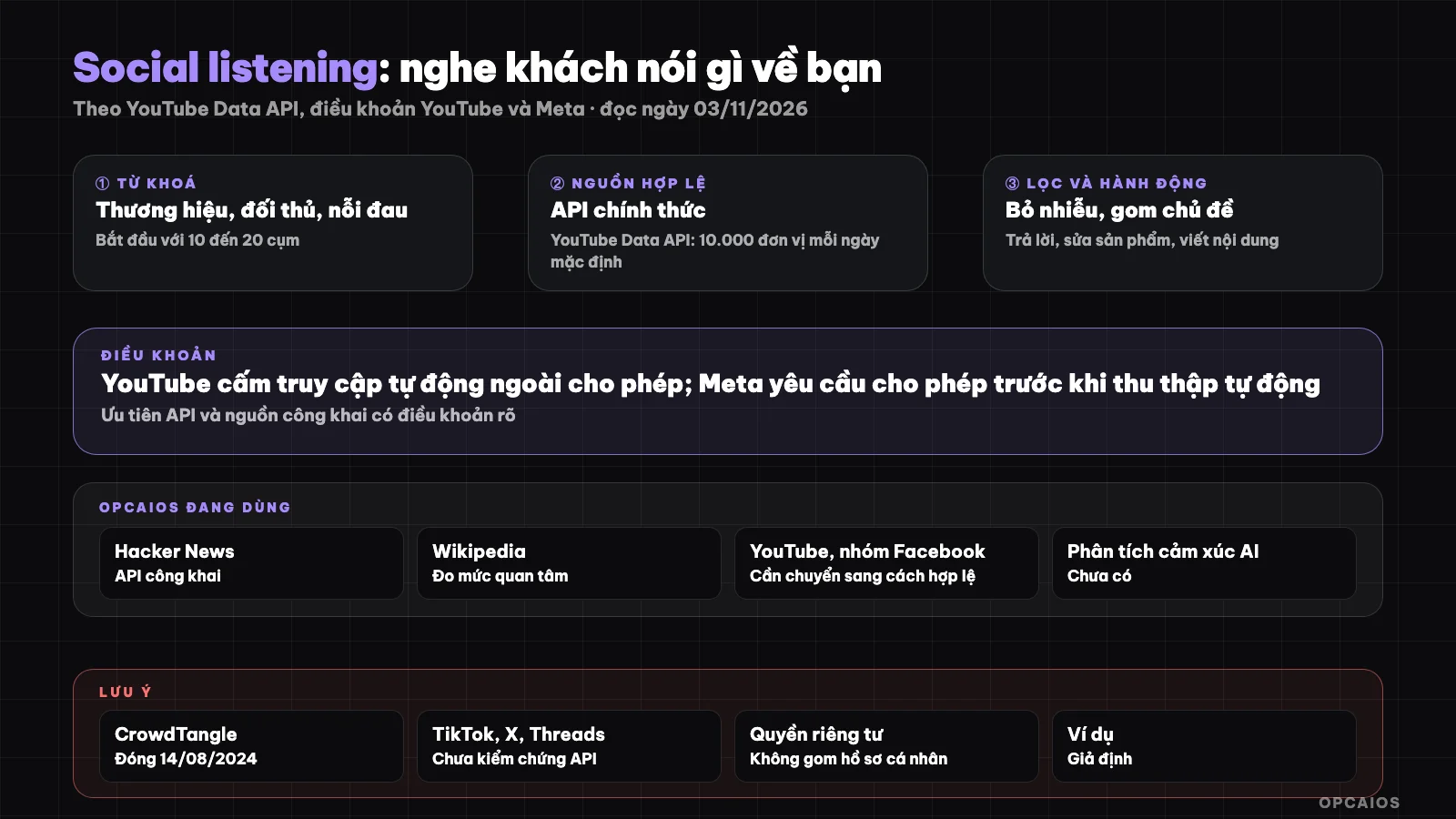
Keywords, valid sources, filter, reviewer, then action. Diagram: OPCAIOS.
How is Social Listening Different from Social Monitoring?
Social listening differs from social monitoring in purpose: monitoring replies to each specific mention, listening reads many mentions to see trends. Social monitoring is to follow and respond: someone tags the brand, complains under an ad, asks price in a comment, you reply the same day. Social listening is stepping back: gather mentions and related conversations over a few weeks, then ask "what is the customer complaining about repeatedly," "what is the competitor criticized for," "what need is growing." Monitoring gives a list of things to reply to; listening gives decisions about product, content, price. Small business should start with monitoring on their own pages, where data comes legitimately through page management tools, then expand to listening with a few keywords.
How to Pick Keywords for Social Listening?
Pick social listening keywords by three groups: brand, competitors and customer pain. A simple starter set has 10 to 15 phrases:
- Brand: brand name, product name, founder name, common misspellings, with and without diacritics.
- Competitors: names of 3 to 5 direct competitors, with words like "review," "scam," "good or not."
- Customer pain: phrases customers really type when facing a problem, for example "automate zalo," "learn AI for office," "run ads no orders."
The third group usually has the most value for small business, because someone who does not know you is still talking about the problem you solve. Take keywords from actual customer words in messages, calls, comments, do not think it up yourself in professional language. Avoid broad words like "AI" or "marketing," because it will pull back thousands of unrelated results.
Where to Get Social Listening Data and What Are the Limits?
Valid social listening data comes from official platform APIs, paid tools with agreements with the platform, or data you own (comments on your page, messages to your inbox). Four points I verified when writing this (read on 03/11/2026):
- YouTube: YouTube's terms of service ban automated access like bots or scraping tools, except public search engines that follow robots.txt or when YouTube gives written permission. The legal way is YouTube Data API v3: default quota 10,000 units per day; the search.list command costs 1 unit in a separate search quota pool.
- Facebook: Meta's automated data collection terms require explicit written permission from Meta before collecting; agreeing to terms is not that permission.
- Meta research tools: CrowdTangle shut down on 14/08/2024; the replacement Meta Content Library according to announcements only opens to academic researchers and nonprofit organizations.
- Hacker News: has public search API via Algolia, no key needed, suitable for English tech topics.
We have not verified TikTok, X, Threads API terms and pricing in this post so we don't mention them. Real consequence: most Vietnamese conversations sit in Facebook, Zalo, messaging groups, where there is no valid automated reading method for small businesses. See also What is API.
How to Filter Noise in Social Listening?
Filtering noise in social listening means removing results that match keywords but not meaning, before a reader has to look at them. Four simple but effective filters:
- Require keyword match in title or content, don't trust "related" results that the platform suggests itself.
- Prioritize freshness: posts in the last 2 days are worth reading more than posts from a year ago; old posts only for trend analysis.
- Exclude keywords: add negative terms for overlapping meanings, for example a brand name that matches a song title.
- Score and dedupe: add points by number of matching keywords, freshness, engagement level; each link is saved only once.
After filtering, you still need one person to skim the list each day or week and mark "opportunity", "handled", "skip".
What Does AI Sentiment Analysis Help and Where Are Its Limits?
AI sentiment analysis helps quickly sort large amounts of comments into positive, negative, neutral and summarize repeated topics, but isn't reliable enough to decide alone. Large language models read Vietnamese quite well on clear sentences, but often get wrong on four things:
- Sarcasm and reverse speak: "great, waited 3 weeks haven't seen the goods" is criticism, not praise.
- Slang, abbreviations, no diacritics from each community.
- Sentences with multiple subjects: praise the product but criticize delivery.
- Ratio on small sample: 20 comments then "60% negative" is only 12 people.
Practical way to use it: have AI summarize and group, reader checks the negative posts and high engagement posts. Don't send commenters' personal data to AI services when you don't need to. See What is LLM.
How to Turn Social Listening Data Into Action?
Turning social listening data into action means linking each signal type to a specific task and a specific person. Five common task types:
- Questions about problems you solve: answer publicly, helpful, don't insert sales links right away.
- Repeated pain points: become blog post ideas, videos, FAQs on your sales page.
- Criticism of competitors: file in competitor profile, check your product has the same weakness. See Monitor competitors with Firecrawl and n8n.
- Complaints about you: handle same day, fix root cause.
- Influencer talking about the topic: add to long-term relationship list, see What is Dream 100.
One hypothetical example, not real data: in one month, a bakery sees 9 comments asking "do you deliver same day"; the right action is add delivery info to the page and pinned post, not run more ads.
Privacy and Terms to Keep in Mind
Privacy and terms are the hard limits of social listening: public data doesn't mean you're free to collect, store, and use it however you want. Four principles to keep:
- Read each platform's terms before automating; prioritize official APIs.
- Store as little as possible: links, short excerpts, matching keywords; don't collect personal profiles of the person who posted.
- No intrusive outreach: don't send bulk messages to people who just complained online.
- Have a way to delete data when you no longer need it.
In Vietnam, the Law on Protection of Personal Data is a document worth reading when storing people's names, photos, and content; this section is for reference only, not legal advice. See more 5 data security rules for business when using AI.
OPCAIOS's Experience
OPCAIOS has a "Listen to Social" page in our internal marketing management area, written by a programmed agent. Each topic has up to 15 keywords and a few platforms; a scheduled task reads each topic at most once a day, matches keywords without diacritics, scores 0 to 100 based on keyword matches, freshness and engagement, stores each link once, then sends the best results summary to the owner. Each result can become a task or a post idea. Current sources in the code: YouTube search results pages, Hacker News via public Algolia API, TikTok and Facebook groups via third-party scraping service (requires separate account). When we checked the terms while writing this, we found that reading YouTube search pages and scraping Facebook groups don't match the automation terms of YouTube and Meta mentioned above; so we don't recommend you do it that way, and the direction we should shift toward is YouTube Data API. The tool doesn't yet have AI sentiment analysis. Another page measures interest levels by topic using monthly Wikipedia page views via Wikimedia API, used instead of Google Trends since Google Trends has no official API. We haven't published any numbers on results or opportunities found.
Frequently Asked Questions
Do small businesses need paid social listening tools?
Not necessarily right away. A reasonable first step is to monitor comments and messages on your own pages, plus manually search 10 to 15 keywords each week across a few major platforms. When manual searching takes too many hours, or you need to track multiple competitors at once, paid tools with data agreements from the platforms become worth considering. Before buying, ask clearly how the tool collects data from Facebook groups, TikTok, and Zalo.
Can social listening read private Facebook groups and Zalo?
No, not in a legitimate way. Private groups, messages, and Zalo are private spaces; Meta requires written permission before collecting data automatically. The legitimate way is to join groups as a real member, read and contribute by hand, following the group's rules. With your own data, like messages to your page or your Zalo OA account, you can read it through the platform's official management tools to compile repeated questions.
How many keywords should I track?
Around 10 to 15 phrases is enough to start: a few for your brand, a few for competitors, the rest for customer pain points. More than that and results grow faster than one person can read. Each month, drop keywords that only pull junk results or add exclusion terms, and split up keywords that show lots of opportunities.
Is AI sentiment analysis accurate?
Accurate enough to group and summarize, not accurate enough to decide alone. Language models often misread sarcasm, slang, mixed praise and criticism, and percentages from a few dozen comments are easy to misinterpret. Let AI suggest labels and summarize repeated topics, then have a person reread the negative ones and the ones with lots of engagement. Report the sample size clearly, like "12 out of 20 comments," instead of just a percentage.
How do I start social listening in one week?
Day one, list keywords in three groups from old customer messages and comments. Two days later, test each keyword on the main platforms, drop ones that pull junk. Next, make a spreadsheet noting the link, platform, matching keyword, and action needed. End of week, reread and pick three things: one reply, one content idea, one fix on your sales page. If you want to learn how to automate the search part using APIs and AI the legitimate way, see OPCAIOS's AI application training course.
Source: YouTube Terms of Service; Google for Developers, YouTube Data API v3 quota page and search.list page; Meta automated data collection terms (all read 03/11/2026); CrowdTangle shutdown on 14/08/2024 per NPR and Search Engine Land stories via search results (full text not read); TikTok, X, Threads API terms and pricing not checked; the bakery example is hypothetical; OPCAIOS has not published listening results. The experience is OPCAIOS's.
Translated from Vietnamese with AI. Read the original.
Want to apply this in your business?
Book a free 30-minute call (Vietnam time, in English or Vietnamese).