


What is System Design Primer?
System Design Primer is an open-source repository on GitHub compiled by Donne Martin, gathering concepts of large-scale system design (scalability, caching, load balancing, databases, queues) into an ordered curriculum, complete with sample solutions for interviews and Anki flashcard decks. According to GitHub (API, read 04/11/2026), the donnemartin/system-design-primer repository was created on 26/2/2017, has around 376,700 stars, over 59,000 forks, the most recent code push on 15/9/2026, and is released under the Creative Commons Attribution 4.0 (CC BY 4.0) license. The material is completely free, requiring no GPU or API keys. This post discusses what it teaches, how to learn from it, who it suits, and why even solo business owners should read it.
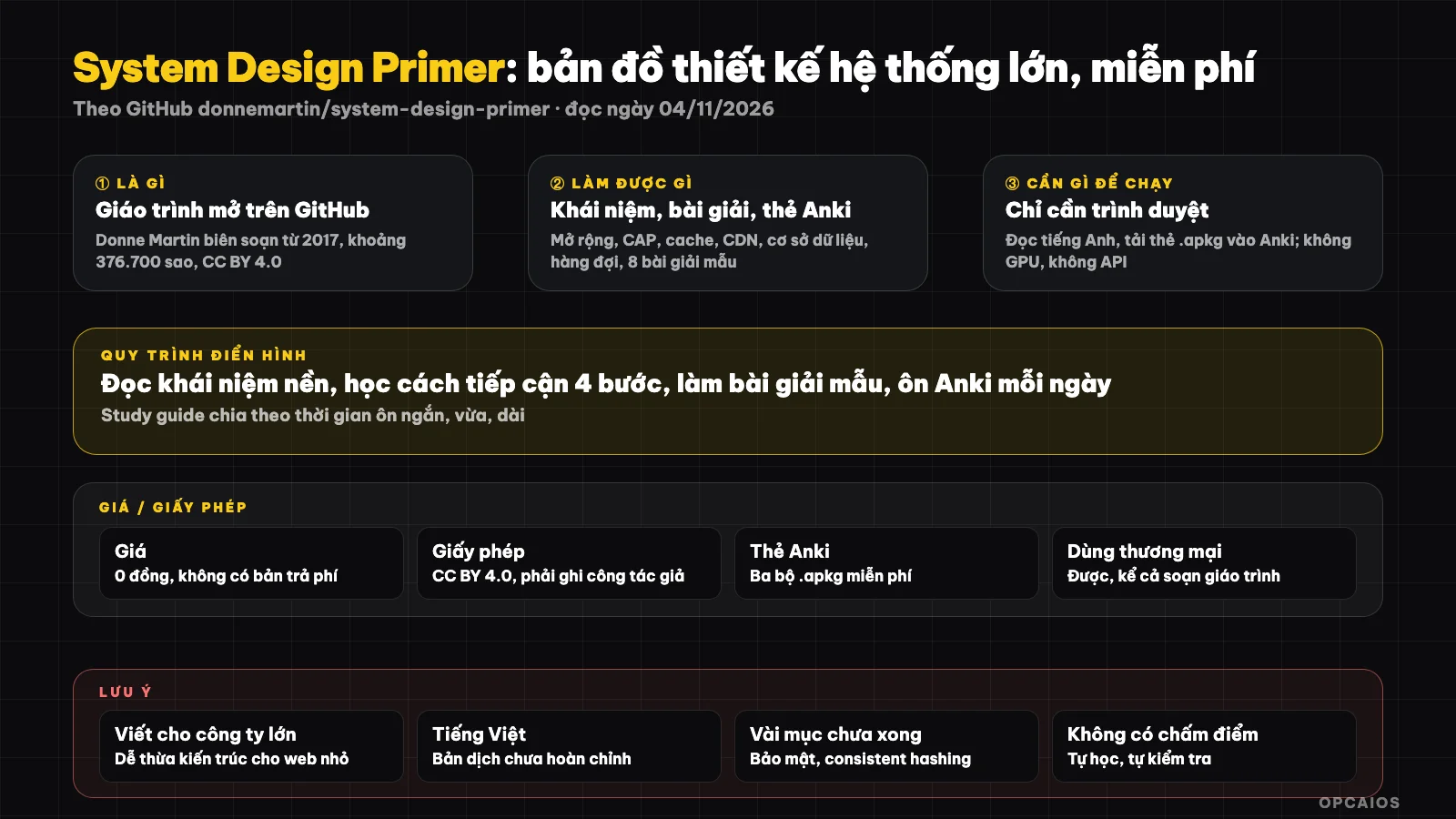
System Design Primer has three parts: concepts, interview solutions, and flashcards. Diagram: OPCAIOS.
What is System Design Primer and who created it?
System Design Primer is learning material, not software: you read a long README on GitHub, follow the table of contents, then do exercises and study with Anki flashcards. The author Donne Martin wrote it with two goals, according to the README (read 04/11/2026): learning how to design systems that handle heavy loads, and preparing for system design interview rounds at tech companies.
The reason the project was created, as stated by the author: material on this topic is "scattered throughout the web", so he compiled it into an ordered collection. The README notes the license comes from the author personally, not from the company he works for (Facebook). The project has been translated by the community into nearly 20 languages, including Japanese, Chinese, Korean, German, French, and Russian; Vietnamese appears in the language bar but the link points to an issue on GitHub rather than a complete translation, so Vietnamese readers still need to read the original English version. The repository continued receiving code pushes in September 2026 and has over 600 open issues, meaning the community is still active. If you need background on GitHub, read What is GitHub?.
What does System Design Primer teach?
System Design Primer teaches the building blocks of a large web system, each block accompanied by pros, cons, and links for deeper reading, with a recurring principle that every choice is a tradeoff. The table of contents according to the README (GitHub, read 04/11/2026):
| Topic Group | Main Content |
|---|---|
| Foundations | Scalability, performance versus scalability, latency versus throughput, availability versus consistency, CAP theorem |
| Consistency and Availability | Weak consistency, eventual, strong; active-passive and active-active failover; data replication; measuring availability by "nines" |
| Network and Distribution | DNS, push and pull CDN, layer 4 and layer 7 load balancers, reverse proxy |
| Application Layer | Microservices, service discovery |
| Database | Scaling RDBMS (replication, federation, sharding, denormalization, SQL tuning); NoSQL key-value, document, wide column, graph; choosing SQL or NoSQL |
| Caching | Caching at client, CDN, web server, database, application; cache-aside, write-through, write-behind, refresh-ahead strategies |
| Asynchrony | Message queues, task queues, back pressure |
| Communication | TCP, UDP, RPC, REST |
| Security | Just the basics: encryption, input sanitization, parameterized queries, least privilege; README notes this section needs updating |
| Appendix | Powers of 2 table, "latency numbers every programmer should know", real-world architectures and tech blogs from companies |
Three topics are still marked "in development": distributed computing with MapReduce, consistent hashing, and scatter-gather. Many concepts in the table already have their own posts on this blog, such as What is CDN?.
Is System Design Primer Free?
System Design Primer is completely free with no paid version: all content is in a public GitHub repository under the CC BY 4.0 license, copyright 2017 Donne Martin (README, read 04/11/2026). There are no hidden costs like GPU fees or API keys, since this is reading material.
| Item | Details (read 04/11/2026) |
|---|---|
| Price | 0 đồng, no paid plans, README mentions no courses or donations |
| License | CC BY 4.0: can copy, edit, use commercially, as long as you credit the author |
| Anki Cards | Three free .apkg files (System Design, System Design Exercises, Object-Oriented Design); Anki app on desktop is free, official iOS version has fees under Anki's pricing policy, we haven't read that pricing page |
| System Requirements | Just a browser; sample solutions include Python code but you don't have to run it |
| Limitations | Content in English; some sections incomplete; the author himself says the security section is rough |
CC BY 4.0 means you can translate, excerpt, or turn it into internal teaching materials or slides to sell with a course, as long as you clearly cite the source and author. This is not legal advice.
How Do I Learn System Design Primer?
Learning System Design Primer requires no installation, but you should follow the learning path the author suggests rather than reading start to finish. The README (read 04/11/2026) has a "Study guide" section split by time: short, medium, and long review periods; more time means more practice questions. The steps are:
- Start by reading the foundational concepts in order: scaling, CAP, caching, databases. Each section is short with links for deeper reading when needed.
- Next, learn the four-step approach to a design question: clarify use cases, constraints, and assumptions; sketch the high-level design; design each core component; scale the design and handle bottlenecks. The README also covers quick estimation ("back-of-the-envelope").
- Work through sample solutions: Pastebin or Bit.ly, Twitter timeline and search, web crawler, Mint.com, social network data structures, key-value store for a search engine, Amazon sales ranking, scaling to millions of users on AWS. The object-oriented design section (hash map, LRU cache, parking lot, chat server) is still being developed.
- Finally, review with Anki: download the three .apkg files from the README links and import them into the Anki app to review using spaced repetition.
The README has no installation commands; everything is links and files to download. To contribute or translate, read CONTRIBUTING.md in the repository. My own tip: paste a README section into Claude Code or Antigravity and ask it to explain with examples tied to your product; see What is LLM? if you're new to it.
Limitations and Things to Watch Out For
The biggest limitation of System Design Primer is it was written for interviews at large companies, so problems assume "millions of users," while most solo products never need sharding or active-active fail-over. Four things to keep in mind:
- Scale mismatch: blindly applying patterns from the material can lead to over-engineered architecture (microservices, many cache layers) for an app with a few thousand users. Read to understand tradeoffs, not to copy.
- Slow updates in some sections: the author himself says the security section needs updating; modern topics like serverless, edge computing, or AI agent architecture aren't in the table of contents.
- English only: Vietnamese translation is incomplete across the README language versions.
- No auto-grading: you grade yourself; no course, certificate, or official Q&A community.
On security and legal matters: since this is reading material, there's no personal data risk; just credit the author when reusing content under CC BY 4.0.
System Design Primer vs Other Options
System Design Primer is open documentation, so a fair comparison is with other system design learning resources. The table below is a general overview, not a measurement:
| Option | Difference | Suits |
|---|---|---|
| "Designing Data-Intensive Applications" book (Martin Kleppmann) | Much deeper on distributed data, requires purchase | People who want to understand fundamentals, have time |
| Paid interview prep courses (Grokking, ByteByteGo...) | Video, structured path, monthly or yearly fee; we haven't checked their pricing | People prepping under time pressure, need lectures |
| Kaggle Generative AI course | About AI, not infrastructure; see Kaggle Generative AI Course | People learning applied AI |
| Tech blogs from companies | Practical, scattered, no order | People with existing foundation |
| Asking an LLM directly | Fast, but prone to hallucination and no learning path | Looking up a point, combined with Primer |
System Design Primer sits in the middle: free, structured, broad enough to be a map, but not as deep as a book and not as convenient as video courses.
When to Read System Design Primer?
System Design Primer suits three groups: people preparing for software engineering interviews, people building their own products who want to understand why systems are slow or crash, and people directing AI agents who need enough vocabulary to review the architecture the agent proposes.
| Situation | Recommendation |
|---|---|
| System design interview round in 1 to 3 months | Follow the Study guide, do all sample solutions, review Anki daily |
| Your website slows down when a few hundred people visit at once | Read the cache, CDN, load balancing sections first |
| You ask an AI agent to build your backend and want to understand what it's proposing | Read the database and queue sections so you know where to ask better questions |
| You only need a landing page or small site | Not yet; read when your product actually has load |
| You want to write an internal curriculum | Allowed under CC BY 4.0, remember to credit the author |
Example (hypothetical): a digital shop owner uses Next.js to build a document sales site, and every time they run ads the site slows down. Reading the cache and CDN sections in Primer, they understand why they should put a CDN in front of static images and cache product query results, then ask an AI agent to do those two things specifically instead of "optimize everything."
OPCAIOS's Experience
We added System Design Primer to the Repo list in the Utilities section on opcaios.org after reading the README and checking the repository is still active; we haven't completed the learning path, so this section outlines the criteria we used to decide, not an evaluation after use. Four criteria:
- Is the repository still active: yes, latest code push September 15, 2026, over 600 open issues, community translations ongoing.
- License: CC BY 4.0, allows us to quote it in our internal training materials if we credit the author.
- Hidden costs: none; only time spent reading English.
- Does it replace a tool we use: this is not a tool but a concept map. The opcaios.org website runs on one dedicated server through an AI agent, nowhere near the scale needing sharding; the value for us is having enough vocabulary to review the architecture Claude Code or Antigravity propose, instead of just nodding along.
Legal risk is nearly zero with a read-only document.
Read more: What is Docker?, What is VPS?.
Frequently Asked Questions
Does System Design Primer have a Vietnamese version?
The language bar in the README lists Vietnamese, but the link points to a GitHub issue rather than a complete translation (as of 04/11/2026). So Vietnamese readers still need to read the original English version, or paste each section into an LLM to translate and explain. If you translate it, you can contribute back to the repository following the guidelines in CONTRIBUTING.md.
Can someone without coding knowledge read System Design Primer?
You can read the concepts section, since the material explains things with diagrams and text, along with pros and cons of each choice. The sample solutions section has Python code and object-oriented design that require a programming background. Small business owners handing tasks to AI agents can stop at the concepts section to know how to ask the agent the right questions: why do we need cache, why do we need queues.
How do I use the Anki flashcard decks in System Design Primer?
The README links to three decks in .apkg format: System Design, System Design Exercises, and Object-Oriented Design; the sister repository Interactive Coding Challenges has an additional Coding deck. You download the files, open the Anki app on your computer, and import them, then review each day according to the spaced repetition schedule that Anki sets automatically. The README doesn't include any commands or configuration.
Is System Design Primer enough to pass an interview?
The material gives you a concept map and a four-step approach, plus eight sample solutions. But system design interviews grade you on how you ask follow-up questions, make estimates, and discuss tradeoffs, so you need to practice speaking out loud with another person or with an LLM roleplaying as an interviewer. We haven't measured anyone's pass rate, so I can't say whether it's "enough" or "not enough."
Does a solo business owner need to learn system design?
You need it at the concept level, not at the interview-solving level. When you hand off to an AI agent to build a website, CRM, or automated workflow, the agent will suggest databases, cache, queues; if you don't have the vocabulary, you can only nod along. System Design Primer gives you that vocabulary for free, with an ordered table of contents and tradeoff tables. Read the foundations, databases, and cache sections, then skip the interview prep if you're not job hunting. What you want to avoid is applying the "millions of users" pattern to a product with a few hundred customers. If you want to learn how to hand off technical work to AI in a controlled way, check out OPCAIOS's AI application training course.
Source: GitHub donnemartin/system-design-primer (README contains License and Contact sections, API, read 04/11/2026), no separate official website; not yet read/verified: contents of the Anki decks, status of Vietnamese translation, prices of paid courses mentioned for comparison; star counts may change. Experience is from OPCAIOS.
Translated from Vietnamese with AI. Read the original.
Want to apply this in your business?
Book a free 30-minute call (Vietnam time, in English or Vietnamese).