


What is ZeroTTS?
ZeroTTS is an open-source text-to-speech (TTS) model built specifically for Vietnamese, released by the zeroweight-ai team, running faster than real-time on a laptop CPU without needing a GPU. According to GitHub (API, read on 04/11/2026), the zeroweight-ai/ZeroTTS repository was created on 15/08/2026, has around 320 stars, uses MIT license for both code and weights, with the most recent code push on 17/09/2026. The PyPI package zerotts is at version 0.1.5 (released 15/09/2026). This post explains what ZeroTTS does, how to install it, where the hidden costs are, and one important point that's easy to misunderstand: the current public version cannot yet clone voices from your own audio.
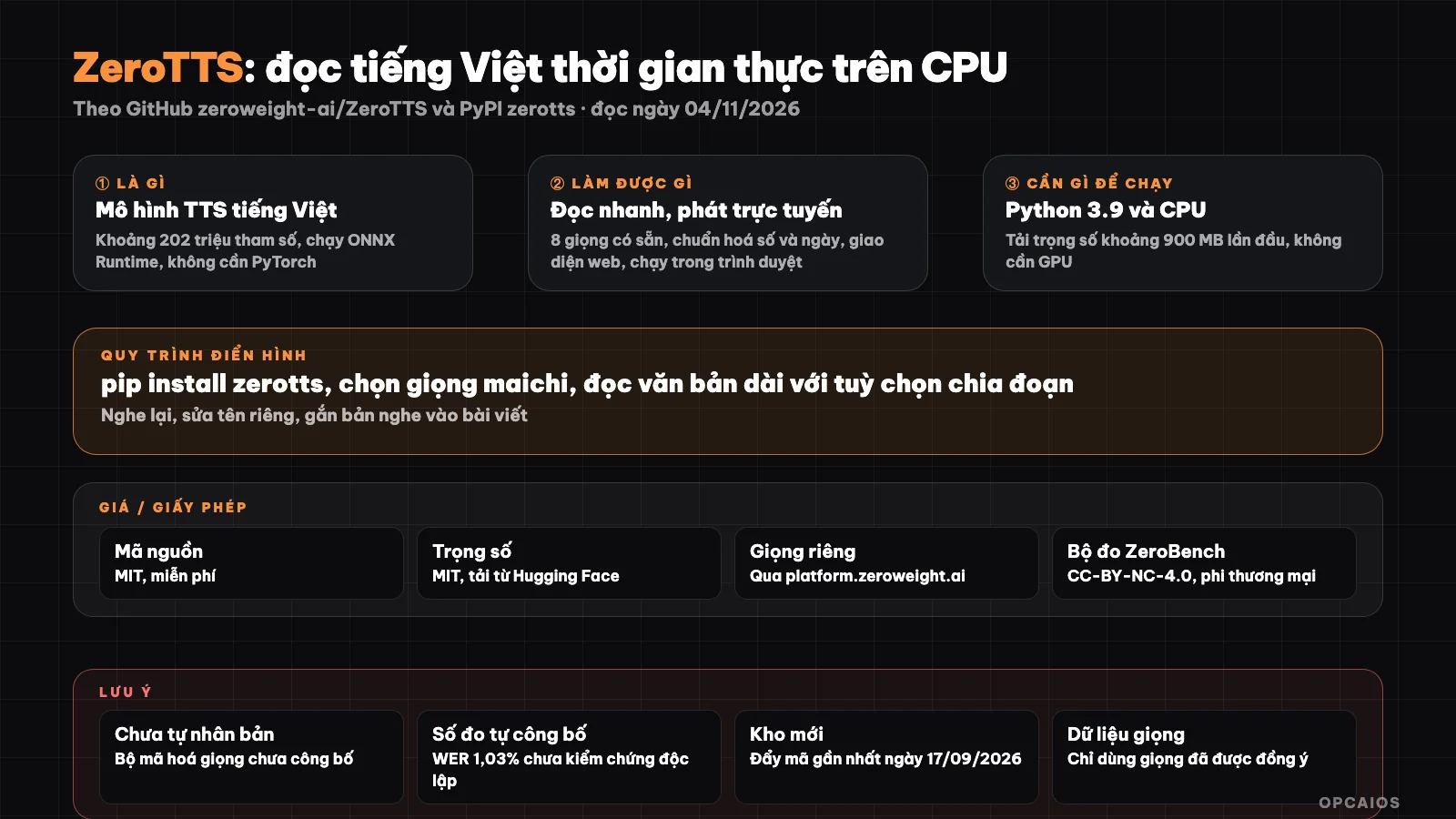
ZeroTTS reads Vietnamese text on CPU, with voices taken from built-in voice packs. Diagram: OPCAIOS.
What is ZeroTTS and who created it?
ZeroTTS is a Vietnamese TTS model with around 202 million parameters, packaged as a Python library running on ONNX Runtime, so it doesn't need PyTorch or a graphics card. The creators are the zeroweight-ai organization on GitHub, with their own blog at zeroweight.ai and a voice platform at platform.zeroweight.ai.
According to the README on GitHub (read on 04/11/2026), ZeroTTS aims to read Vietnamese accurately straight from raw text: tone marks, mixed English phrases, dates like 31/12/2026. Output audio is at 48 kHz. The audio decoding part uses MOSS-Audio-Tokenizer-Nano from the OpenMOSS team (Apache-2.0 license), while the Vietnamese text normalization part is rewritten based on rules from the soe-vinorm project (MIT). On Hugging Face, the zeroweight-ai/ZeroTTS weights page shows around 7,100 recent downloads (read on 04/11/2026). This is a new project, only about two and a half months old, so the community is still small and documentation is mainly the README plus the docs/ directory.
If you're not familiar with AI model concepts, first check out What is LLM? to understand how models are packaged and downloaded.
What are the main features of ZeroTTS?
ZeroTTS focuses on four things: reading Vietnamese accurately, running fast on CPU, streaming audio output in chunks, and running in the browser. The table below summarizes the GitHub README (read on 04/11/2026); the speed numbers are as published by the project and haven't been independently verified.
| Feature | Short description |
|---|---|
| Runs on CPU | Real-time factor around 0.5x, meaning it generates audio twice as fast as playback duration |
| Streaming output | First audio chunk arrives after around 70 milliseconds |
| Eight built-in voices | Labeled by gender, age, and voice type; default voice is maichi |
| Vietnamese normalization | Dedicated functions convert dates, times, fractions, money amounts to words before reading |
| Long text | Function divides text into chunks of around 15 seconds since the model learns by sentence, not full paragraphs |
| Web interface | Gradio demo runs locally on default port 7860 |
| Runs in browser | js/ directory uses onnxruntime-web, no server needed |
| int8 compressed version | Quantization tool reduces processing time by about half on DDR4 machines |
On quality, the README posts a comparison table on the ZeroBench-TTS test set created by the team itself. ZeroTTS's word error rate (WER) is 1.03%, compared to 4.13% for OmniVoice and around 16 to 18% for two XTTS versions fine-tuned for Vietnamese. These are numbers published by the project on a dataset chosen by the project and haven't been independently verified; OPCAIOS hasn't measured them. That table also shows OmniVoice's voice similarity is slightly better (0.950 versus 0.936).
How much does ZeroTTS cost, what are its licenses and limits?
ZeroTTS is free: both code and weights are under the MIT license, which allows commercial use as long as you keep the copyright notice. The real cost lies in the machine running it, the model weights are about 900 MB to download, and creating custom voices must go through the developer's platform.
| Item | Status (as of 04/11/2026) |
|---|---|
| Source code | MIT, free |
| Model weights | MIT, downloaded from Hugging Face on first use |
| MOSS decoder included | Apache-2.0 |
| ZeroBench-TTS test suite | CC-BY-NC-4.0, applies only to measurement data, not to the model |
| Custom voice cloning | Not available in public version; must use platform.zeroweight.ai |
| zeroweight.ai platform pricing | Haven't checked pricing page, not mentioned |
Hidden costs include: a computer with a strong enough CPU (README measured with 8 threads), 900 MB bandwidth for downloading, and if you host it on a server then server rental costs. All costs above do not include taxes and may change. The most notable limit is that the README clearly states the voice encoder has not been published. You can only load preset voice packs or voice packs downloaded from the platform, not create voices from audio files on your machine.
How do I install ZeroTTS and get started?
Installing ZeroTTS only requires Python 3.9 or higher and one pip command; the weights automatically download from Hugging Face on first run and are cached. The steps below follow the README on GitHub (as of 04/11/2026), OPCAIOS has not run it ourselves.
- First, create a separate Python environment and install the package:
pip install zerotts
- Next, list available voices and try reading a sentence from the command line:
zerotts voices
zerotts say "Xin chào các bạn." --voice maichi -o hello.wav
- For long text, add the chunking option:
zerotts say "$(cat article.txt)" --voice maichi --chunk -o article.wav
- Finally, if you want a button-clicking interface, install the web component and open it in a browser:
pip install "zerotts[webui]"
python webui/app.py
Programmers can call it from Python using the ZeroTTS.from_pretrained class and then the synthesize function. Note: this function does not automatically normalize dates and numbers; you call normalize_vi_text separately first, while the command line and web interface have this turned on by default.
Example (hypothetical): someone selling online courses has 20 tutorial posts and wants each one to have an audio version. They run the zerotts say command with the --chunk option for each text file, listen back to fix mispronounced proper names, then attach the audio files to the page. Everything runs on their laptop, no need to rent a GPU.
What security, copyright and legal risks does ZeroTTS have?
ZeroTTS's main risks don't come from the source code but from how you use the voices and measurement data. Real voices are personal data, and the test suite has a non-commercial license. The section below is just for reference, not legal advice, and we have not cross-checked the original legal texts.
First, when creating a custom voice through platform.zeroweight.ai, you upload a recording to a third party's server. Only use your own voice or a voice from someone who has agreed in writing, and read the platform's data terms first. Second, voice is information tied to a specific person; in Vietnam, personal data protection regulations and personality rights may apply, so consult a lawyer if using it for commercial purposes. Finally, the ZeroBench-TTS suite is under CC-BY-NC-4.0 because it contains audio from repositories like VIVOS and viVoice; you should not use it to train commercial products. Synthesized audio posted on social media should be labeled as AI voice, since many platforms require AI-generated content to be tagged.
How does ZeroTTS compare to other options?
ZeroTTS is strong in Vietnamese and CPU usage, while other options excel at multiple languages or free voice cloning. The table below is a general description, not a measurement by OPCAIOS.
| Tool | Strengths | Things to consider |
|---|---|---|
| ZeroTTS | Specialized for Vietnamese, runs on CPU, MIT license | Cannot clone voices freely on your machine yet |
| OmniVoice | Over 600 languages, voice cloning from 3 to 10 second samples | Better with GPU, larger model |
| XTTS Vietnamese version | Long-standing community | Needs GPU for speed, Coqui's own license |
| Voicebox | GUI application runs locally | Depends on underlying model |
| Cloud TTS services | No installation needed | Pay per character, data leaves your machine |
When should you use ZeroTTS?
ZeroTTS works well when you need to generate large amounts of Vietnamese audio on a regular machine, don't want to rent a GPU, and don't need your own voice. If you need to clone a real voice or support multiple languages, consider other tools.
| Situation | Suggestion |
|---|---|
| Audio versions for articles, internal documents | Use ZeroTTS with built-in voices |
| Voice assistant needing quick responses | Try streaming mode, measure actual latency on your machine |
| Need the channel owner's exact voice | Consider OmniVoice or zeroweight.ai's platform |
| Multilingual video | Use a multilingual model |
| Serverless web app | Try onnxruntime-web version, accept one-time 900 MB download |
OPCAIOS's experience
We recently added ZeroTTS to the Repository list in the Utilities section on opcaios.org after reading the README and checking that the repository is still maintained; we haven't tested it yet, so this section outlines the criteria we use to consider it, not an evaluation after using it. Four criteria:
- Is the repository still being updated: the most recent code push was 09/17/2026, meaning about seven weeks have passed without changes; we need to keep monitoring.
- License: MIT for both code and weights is a major advantage compared to many other voice models.
- Hidden costs: no GPU needed, but creating custom voices depends on an external platform whose pricing page we haven't read yet.
- Can it replace the tools we're using: we currently clone Vietnamese voices using OmniVoice; ZeroTTS is only worth trying for quick reading with built-in voices.
Read more: What is OmniVoice?, What is Voicebox?, What is VideoLingo?, Voice AI agent confirming orders, 7 best AI voice cloning tools 2026 for Vietnamese.
Frequently Asked Questions
Can ZeroTTS clone my voice?
The public ZeroTTS release on GitHub cannot clone voices from audio files on its own. The README states that the voice encoder has not been released, so the library can only load pre-built voice packages. To get a custom voice, you upload a recording to platform.zeroweight.ai, receive a zip file back, then load it using the add_voices function. This means your audio goes through the developer's servers. Please read the platform's data terms first and only use your own voice or one from someone who has agreed.
Does ZeroTTS need a GPU?
ZeroTTS does not need a GPU. The library runs on ONNX Runtime on CPU and does not install PyTorch unless you add the quality measurement module separately. According to the README on GitHub (read on 04/11/2026), the real-time factor is around 0.5x when running on 8 CPU threads, and the first audio output comes after about 70 milliseconds. These are numbers published by the project and have not been verified. Slower machines will be slower; the int8 compressed version helps speed things up on machines with DDR4 RAM.
Can ZeroTTS be used for commercial purposes?
ZeroTTS code and weights are under the MIT license, so in principle commercial use is allowed if you keep the copyright notice and license. The MOSS decoder included is under Apache-2.0, which also permits commercial use. The ZeroBench-TTS measurement dataset is under CC-BY-NC-4.0 and is for non-commercial use only. If you use a real person's voice, you need their consent. This is reference information, not legal advice.
Does ZeroTTS read Vietnamese numbers and dates correctly?
ZeroTTS has a normalize_vi_text function that converts dates, times, fractions, currency amounts, and abbreviations into Vietnamese text before reading. The command line and web interface have this step enabled by default, but the synthesize function in Python does not, so you can control it yourself. For text with a lot of English, consider turning off normalization using the --no_text_norm option. We have not independently verified the accuracy of this part.
Can someone who doesn't know how to code use ZeroTTS?
Someone without coding knowledge can still use ZeroTTS if willing to install Python and type a few commands: pip install "zerotts[webui]" then run the web interface to type text and click to listen. Common difficulties are setting up the Python environment and downloading the 900 MB weights on first run. If you want to use AI to automate this, an agent like Claude Code can run commands to help you. To learn systematically how to apply AI to your work, check out OPCAIOS's AI application training course.
Source: GitHub zeroweight-ai/ZeroTTS (README, API, read on 04/11/2026), PyPI zerotts and Hugging Face zeroweight-ai/ZeroTTS (read on 04/11/2026); not read/not verified: zeroweight.ai blog, pricing and terms for platform.zeroweight.ai, quality and speed measurements published by the project; star count and pricing may change. Experience is from OPCAIOS.
Translated from Vietnamese with AI. Read the original.
Want to apply this in your business?
Book a free 30-minute call (Vietnam time, in English or Vietnamese).