


What is a landing page?
A landing page is a single web page built for exactly one goal, usually to get visitors to leave their information or schedule an appointment, rather than directing them to browse your entire website. According to Google Ads guidelines (read on 25/10/2026), a good landing page matches the ad, puts key information up front, avoids clutter, and loads fast on mobile.
One honest thing to say upfront: no structure guarantees a conversion rate, and this post does not cite any conversion numbers because we have not measured them. This post explains what a landing page is, how it differs from a homepage, the structure of each block for a page selling AI services, speed, personal data, how to measure, and OPCAIOS's experience.
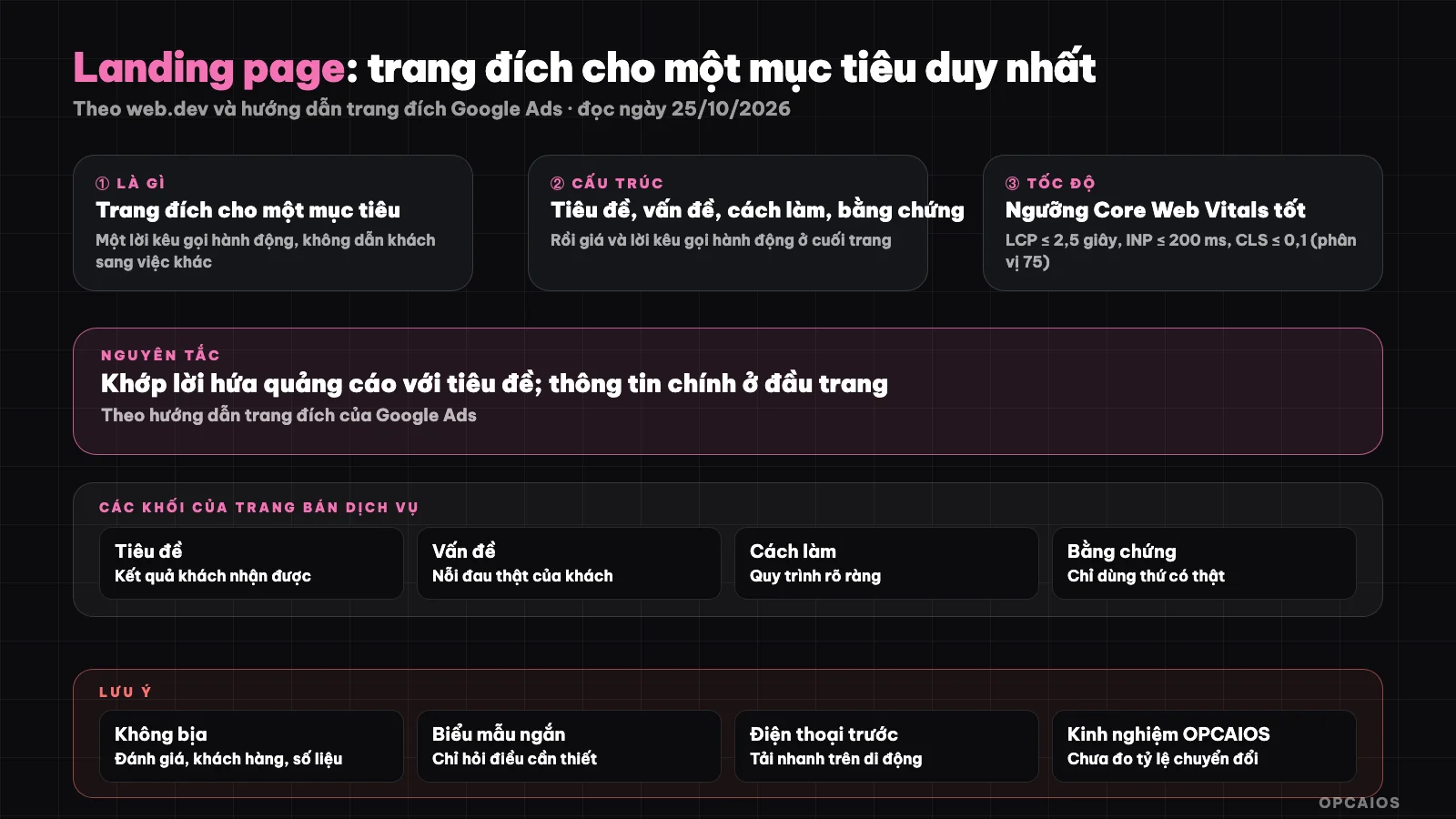
Structure of a landing page selling AI services: one goal, one call to action. Diagram: OPCAIOS.
How is a landing page different from a homepage?
A landing page serves only one action, for example leaving an email or booking a consultation, so it usually drops the long menu and extra links. A homepage must serve many audiences at once: new customers, existing customers, job seekers, press. So a homepage introduces, while a landing page persuades and collects information.
| Criterion | Homepage | Landing page |
|---|---|---|
| Goal | Introduce everything | One single action |
| Common traffic source | Brand name search, direct entry | Ads, posts, email, search results on one topic |
| Navigation | Complete menu | Reduced or none |
| Content | Broad | Narrow, sticks to one promise |
The table above is a general description, not a measurement.
What blocks does an AI service sales landing page need?
An AI service sales landing page should have six blocks in order: a headline stating the result, the customer's problem, how you do it, real proof, scope and price, then a form. Each block answers a different concern. If a block does not have real content yet, drop it; do not fill it in just to be complete.
- Headline and subheading. Tell the customer what they get, who it is for, how long it takes if you can keep your word. Avoid "breakthrough AI solution".
- Problem. Describe the situation the customer is facing in their language: replying to messages slowly, writing weekly reports by hand, posting content unevenly.
- How we do it. 3 to 4 short steps: take the request, build a trial, hand over, support. AI service customers often worry "what if the AI gets it wrong", so make clear the human review step.
- Proof. Use only what is real: sample products, visible processes, reviews from people who have used it and agreed to publish. If you have no customers yet, say straight "now taking first customers", do not make up testimonials.
- Scope and price. Clearly state what the package includes and does not include. If you do not yet want to publish a price, say the range and how the price is calculated. See also what is a productized service to package a service with fixed scope.
- Form and call to action. One main button, repeated in the middle and end of the page.
What should a form ask and how many fields?
A form should ask only what you really need right now: name, email or phone number, and at most one question about needs. Each field added is one reason for a customer to leave, and is extra personal data you must protect. I do not state an optimal number because we have no reliable source for it.
Some practical principles:
- Multiple-choice questions can be scored and results returned right away, gathering information while delivering value to the customer. How to connect a form to a personalized report is described in the post automate form funnel, AI, personalized reports.
How fast does a landing page need to load?
Google publishes the "good" threshold for Core Web Vitals at the 75th percentile of page views: LCP no more than 2,500 ms, INP no more than 200 ms, and CLS no more than 0.1 (web.dev, read on 25/10/2026). Google Ads guidelines also stress speed on mobile. This is a technical target, not a revenue guarantee.
Ways to keep a page light: fewer heavy images, set image size beforehand, limit third-party code and test on a real phone. Measurement tools fluctuate between runs, so take the median of many runs.
Do I Need to Pay Attention to Legal Issues When Collecting Customer Information?
Yes. In Vietnam, the Personal Data Protection Law No. 91/2025/QH15 takes effect from 01/01/2026, and according to a summary by EY Vietnam (read on 25/10/2026), Decree 356/2025/NĐ-CP takes effect on the same date, replacing Decree 13/2023. Consent must be clear, verifiable, and not pre-checked in an "agree" state. This is not legal advice.
What to take away for your form:
- Don't pre-check the box for agreeing to receive marketing emails. Let customers check it themselves or click it.
- Clearly state what you'll use the information for (consultation inquiries, sending documents, sending newsletters) right next to the submit button.
- Keep a record of when and what the customer agreed to, because the burden of proof lies with the party collecting the data according to the summaries we've read.
- Include an unsubscribe link in every marketing email and make your privacy policy easy to find.
We've only read summaries from advisory firms and legal information sites, not the original text of the laws themselves, so please check the official documents or ask a lawyer before applying this. For data protection in general when using AI, see 5 data security rules when using AI.
How Do I Know If My Landing Page Is Working?
You need to measure two things: how many people visit the page and how many complete the form. The completion rate depends heavily on the source, your industry, and your offer, so don't compare yourself to generic averages. Set your own baseline, make small changes one at a time, then compare over time.
A simple approach for someone working alone:
- Add tracking parameters (UTM) to each link you post, so you know where customers come from.
- Set up GA4 and mark form submission as a conversion event.
- Check Google Search Console to see which searches your page appears for.
- Change only one element at a time (headline, button, number of fields), and record the date of each change.
When customers leave their information, add them to a CRM so you don't lose anyone, and prepare a lead magnet for those who aren't ready to buy yet.
Common Mistakes When Building a Landing Page
The most common mistake is cramming multiple goals into one page, overpromising, and not measuring results. The list below comes from experience and is meant for self-checking before you launch, not from data-driven research.
- Multiple goals on one page, forms asking too many questions, missing a phone field.
- Fake testimonials and made-up numbers: both dishonest and easy to get caught.
- Writing with AI and posting as is. Go back and read it, cut empty sentences, and verify every claim. For using AI to analyze customer psychology, see this post.
OPCAIOS's Experience
We built a dedicated landing page for a content service, with a short diagnostic questionnaire: customers answer and get sorted into the right group, then leave their contact info. The page can be edited from the admin panel without touching code. We also have separate free resource pages where we trade documents for emails, limit repeat signups per address, and have an unsubscribe link.
What we haven't done or measured yet: we don't have a reliable conversion rate to publish, we haven't run A/B tests on this service page with enough traffic to draw conclusions, and we haven't enabled two-step email confirmation for the form (we chose to limit signups instead). We don't have verified customer testimonials so we don't put them on the page.
Frequently Asked Questions
How is a landing page different from a website?
A website has many pages serving many purposes. A landing page is a single page for one goal, like booking an appointment or signing up to receive materials. A landing page can live within a website or stand alone.
Should a landing page be long or short?
We don't have reliable data to point to an optimal length. High-priced services usually need more information than free materials.
Do I need custom code or can I use a pre-built builder?
Both work. Pre-built tools are faster at first, custom code is more flexible and gives you better control over speed and data. Choose based on your skills and how much you want to own your customer data.
Do I need permission to collect emails?
According to summaries of personal data protection laws effective from 01/01/2026, consent must be clear and not pre-selected as agreed. Compare against the original text or ask a lawyer since this is not legal advice.
How do I learn to use AI to build and run a landing page?
Start with one page for one goal, measure results yourself, then improve gradually. If you want guided learning, check out OPCAIOS's AI application training course.
Source: Google Ads landing page guide (support.google.com), Core Web Vitals threshold from web.dev, summary of Law 91/2025/QH15 and Decree 356/2025/NĐ-CP by EY Vietnam, PwC Vietnam and LSVN, read on 25/10/2026; have not read each provision in the original legal documents; no conversion rate data because we couldn't find reliable sources and we haven't measured it ourselves. Experience is from OPCAIOS.
Translated from Vietnamese with AI. Read the original.
Want to apply this in your business?
Book a free 30-minute call (Vietnam time, in English or Vietnamese).