


Micro-Community là cộng đồng nhỏ, có chủ đề hẹp và lời hứa rõ, nơi thành viên trả phí định kỳ để tiếp cận người cùng mối quan tâm, nội dung chọn lọc và sự hỗ trợ trực tiếp từ tôi. Mô hình khác với một nhóm đông không kiểm soát. Tiêu đề nhắc tới "100 thành viên" và "dòng tiền đều đặn", nhưng cần nói trước: không có gì bảo đảm tôi đạt 100 thành viên, và thu nhập có thể dao động vì người rời đi, nền tảng thay đổi hoặc tôi kiệt sức.
Các con số trong bài là phép tính minh hoạ giả định, không phải kết quả của tôi. OPCAIOS chưa chạy cộng đồng trả phí, nên bài là tổng hợp cách làm thực dụng, không phải tường thuật trải nghiệm. Tính đến ngày đọc 25/10/2026, bài không có số liệu cộng đồng thật. Bài đi qua 5 bước: chọn ngách, chọn định dạng, chọn nền tảng như Discord hoặc Telegram, gia hạn và giữ chân, quy tắc cộng đồng; sau đó là khối lượng công việc, vai trò của AI và rủi ro.
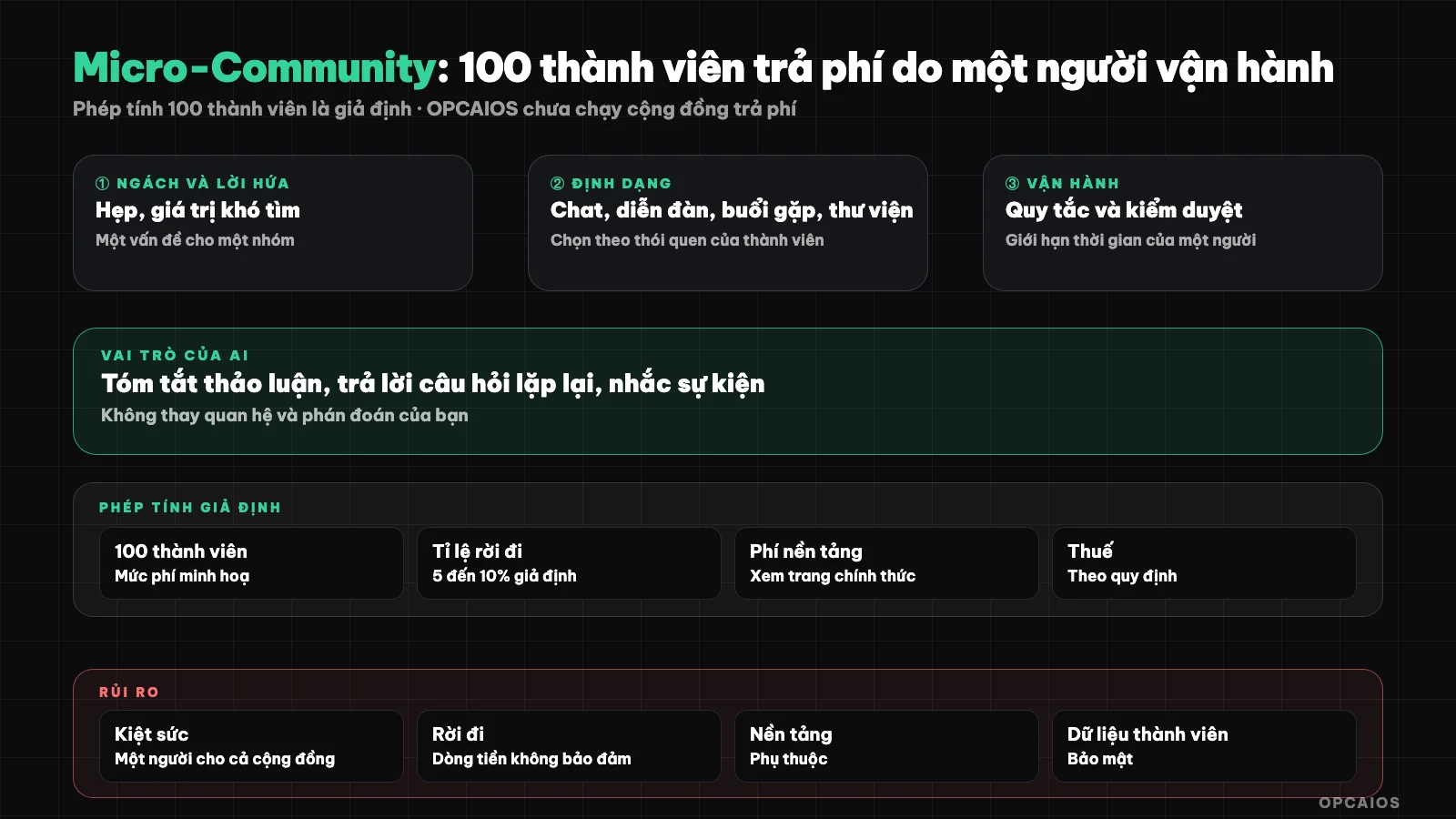
Từ lời hứa đến vận hành hằng tuần và giữ chân thành viên. Sơ đồ: OPCAIOS.
Phép tính minh hoạ: 100 thành viên nghĩa là gì?
Doanh thu gộp hằng tháng của cộng đồng trả phí bằng số thành viên nhân với mức phí, chưa trừ phí nền tảng, phí cổng thanh toán, thuế và công cụ. Giả sử mức phí là P mỗi tháng, thì 100 người trả phí cho 100 × P. Với mức giả định 100 nghìn đồng, doanh thu gộp là 10 triệu đồng; với 300 nghìn đồng là 30 triệu đồng; với 500 nghìn đồng là 50 triệu đồng. Nếu chỉ có 60 người, các con số lần lượt là 6 triệu đồng, 18 triệu đồng và 30 triệu đồng.
Đây chỉ là phép nhân minh hoạ, không phải mức phí khuyến nghị. Điều quan trọng hơn là tỉ lệ rời đi (churn). Chẳng hạn, nếu mỗi tháng có 5 trong 100 người rời đi, tôi phải tìm thêm khoảng 5 người mới chỉ để giữ nguyên quy mô; nếu 10 người rời đi thì gánh nặng gấp đôi. Tỉ lệ thực tế chưa biết cho tới khi chạy thật, nên hãy tính ba kịch bản thấp, vừa, cao trong Excel và coi "đều đặn" là mục tiêu, không phải cam kết.
Bước 1: Chọn ngách và lời hứa như thế nào?
Ngách tốt cho cộng đồng trả phí là chủ đề hẹp mà có người sẵn lòng trả tiền cho kết quả hoặc sự kết nối. Ví dụ, nhóm chủ shop nhỏ học dùng AI cho bán hàng, nhóm dịch giả freelance, hoặc nhóm người làm một nghề cụ thể ở Hà Nội hay Đà Nẵng. Lời hứa nên viết bằng một câu có thể kiểm chứng, nêu thành viên được gì mỗi tuần hoặc mỗi tháng, chẳng hạn "mỗi tuần 1 buổi hỏi đáp 60 phút và 1 mẫu tài liệu".
Ngoài ra, tránh lời hứa về thu nhập vì không ai kiểm soát được. Hãy chọn chủ đề tôi đủ kiến thức và đủ hứng thú để duy trì ít nhất một năm. Cuối cùng, thử lời hứa với 10 người quen trong ngách trước khi mở thanh toán, rồi ghi phản hồi vào Google Sheets. Đây là gợi ý thực hành của OPCAIOS, chưa có số liệu kiểm chứng về số người thử tối thiểu.
Bước 2: Chọn định dạng cộng đồng nào?
Định dạng cộng đồng là cách thành viên gặp nhau và trao đổi, gồm 4 loại chính. Nhóm chat như Telegram hay Zalo sôi động và dễ bắt đầu, nhưng thông tin trôi nhanh và khó tìm lại. Diễn đàn theo chủ đề dễ lưu và tìm, cho phép trả lời có chiều sâu, nhưng cần nhắc để mọi người quay lại. Buổi gặp trực tuyến hoặc trực tiếp gắn kết mạnh, nhưng tốn thời gian của tôi và khó đặt lịch. Thư viện tài liệu và mẫu có giá trị lâu dài, nhưng phải cập nhật, nếu không sẽ thành kho chết.
Nhiều cộng đồng nhỏ kết hợp hai đến ba loại. Ví dụ, nhóm chat hằng ngày, một buổi gặp mỗi tháng và một thư viện cô đọng trong Notion. Bắt đầu với càng ít càng tốt, rồi thêm dần khi đã giữ được nhịp. Với 100 thành viên, một người dẫn dắt khó duy trì cả bốn loại cùng lúc.
Step 3: How do you choose a platform and set up payments?
Community platforms come in three groups of solutions. The first group is chat apps like Discord or Telegram. The second group is community platforms with built-in payments and courses like Circle or Skool. The third group is piecing together a website, a payment gateway, and a member directory yourself. OPCAIOS doesn't mention fees or limits of each platform because I haven't re-read the official pricing pages at the time of writing, and prices usually change. For example, you can make a comparison table of 3 platforms across 4 criteria in Google Sheets.
Before choosing, check the official page yourself against 4 criteria: support for payment methods in Vietnam, refund policy, ability to export member lists, and content terms. Besides that, ask 3 questions. Does it support recurring payments, and if not, how do you remind people to renew manually? Who controls access when a member stops paying? Can you take your member list with you if you switch platforms?
Step 4: How do you renew memberships and keep members?
Keeping members is the whole job of making people who pay continue to renew, and there are 4 specific things to do. The first is to clearly communicate the cycle and how to cancel, without making it hard for people who want to leave. The next is to remind them about renewal before the deadline, instead of letting them lose access suddenly. The third is to ask why when someone leaves through a short survey on Google Forms, because this is the most valuable data. The last is to welcome new members with an introduction post and a small task to do in the first week.
Example scenario: a 300,000 đồng package each month, you remind renewal 7 days before through email or Zalo, with a clear cancellation link. If 5 out of 100 people leave each month, read the reasons from all 5 before changing your promise or price. OPCAIOS doesn't have real retention numbers so this post doesn't mention a standard rate.
Step 5: Community rules and moderation
Write rules ahead of time: be respectful, no excessive advertising, don't share other people's private content outside, no hate speech. Specify consequences clearly (reminder, temporary ban, ask them to leave) and apply them consistently. For sensitive content (health, finances, legal, personal information), put a disclaimer that it's "for reference only" and don't take the place of certified experts. As the community grows, ask a few trusted members to help with moderation.
How much work is it for one person?
The workload for one person running 100 members is real, made up of 6 groups of tasks each week by estimated assumption. Group 1 is posting main content and asking open-ended questions, where regularity matters more than length. Group 2 is replying and connecting members, something you have to check every day. Group 3 is moderation and handling disputes, which can spike suddenly. Group 4 is meetings and preparing materials on a fixed schedule. Group 5 is payments, renewal, and technical support, often forgotten. Group 6 is finding new members, can't stop if people keep leaving.
The limit is very clear: if you get sick, travel, or are busy with other things, the community cools down fast. For example, taking 7 days off straight can make threads go quiet and make members question whether the fee is worth it. So set a member cap, make your schedule public, and write a guide so members can help each other.
What is AI's role in paid communities and what are its limits?
AI helps with repetitive tasks, including summarizing the week's discussions, answering repeated questions from materials you've prepared, reminding people of events, suggesting topics based on common questions, and drafting newsletters. For example, Claude or n8n can group 50 questions in a week into 5 topics and draft a newsletter for you to review in 30 minutes. See more on how to organize this at 24/7 AI agent system for business owners and AI RAG chatbot with Dify and Supabase.
The limits include 3 points. First, AI doesn't create human connection. Second, AI can give wrong answers with confidence. Third, feeding member messages into an AI tool is a privacy issue, needing disclosure, anonymization, and reading the terms; see 5 data security rules when using AI. Answering paying members should have a real person review it, especially important questions.
Main Risks
| Risk | How to Reduce |
|---|---|
| Burnout | Limit scale, set fixed schedule, automate repetitive parts |
| Members leaving frequently | Survey reasons, improve first week, adjust promises |
| Platform dependency—policy or price changes | Keep exportable member list, have backup communication channels |
| Sensitive content, disputes | Clear rules, reference warnings, consistent moderation |
| Member data leak | Collect minimal data, use access controls, don't share carelessly |
| Revenue lower than expected | Model three scenarios, have other revenue streams in parallel |
Taxes and business registration for recurring revenue: see legal checklist (reference only, not legal advice).
Paid Newsletter and Community Connection
A small community and a paid newsletter follow the same logic: a small group, clear promise, recurring payment, and the retention puzzle. The difference is a newsletter is one-way, while community requires you present almost daily. Read paid newsletter 1,000 readers using AI to compare, or combine both: newsletter as the draw, community as a deeper bond layer. For the bigger picture, also see illusion of solo business passive wealth.
OPCAIOS Experience
We haven't run a paid community and have no member counts, revenue figures, or churn rates to share. What we actually have is a blog, a document shop (with free templates), training courses, an email sequence, and internal automation tools; these give us a feel for the effort it takes to sustain regular content, but don't replace the experience of running a community.
Frequently Asked Questions
Is 100 paid members an easy target?
No. That's just a number for illustration. Whether you reach it depends on your niche, your promise, your ability to attract and retain members, and it could take many months or never happen.
Is cash flow from community steady?
Recurring by format, but it fluctuates because people leave, cards expire, platforms change policy. Model it by scenario.
Can one person run it?
One person can run it at small scale if you cap numbers, automate repetitive work, and publish a clear rest schedule. The biggest risk is burnout, because a paid community asks you to be there almost every day. For example, a 100-member community needs you to post content, reply, moderate, renew subscriptions, and recruit new members across 6 work buckets each week. Use Claude or n8n for repetitive tasks, set a member ceiling, and take at least one day a week off from replies. OPCAIOS hasn't run a paid community so I have no actual hours to share; all estimates here are assumptions.
Which platform should I pick?
We haven't verified current fees and features across platforms, so I won't rank them. Compare on official pages by payment, data export, and terms.
Where do I learn to build an AI support system?
Start by automating one small repetitive task, like summarizing weekly discussions with Claude, then expand. If you need hands-on guidance from OPCAIOS, see AI application training course.
Source: common practice roundup; didn't read platform pricing pages so no fees listed (checked 25/10/2026); all numbers are assumptions, not real people; laws and taxes unverified. Experience is OPCAIOS's.
Translated from Vietnamese with AI. Read the original.
Want to apply this in your business?
Book a free 30-minute call (Vietnam time, in English or Vietnamese).