


Obsidian Second Brain là gì?
Obsidian Second Brain là một bộ kỹ năng (skill) mã nguồn mở của Eugeniu Ghelbur, cho Claude Code, Codex CLI, Gemini CLI, OpenCode, Antigravity và vài agent khác một bộ nhớ lâu dài dưới dạng tệp Markdown thuần trong vault Obsidian, kèm 49 lệnh để lưu, tổng hợp, tìm kiếm và "nghĩ cùng" ghi chú. Theo GitHub (API, đọc ngày 04/11/2026), kho eugeniughelbur/obsidian-second-brain tạo ngày 24/03/2026, có khoảng 5.100 sao, giấy phép MIT, lần đẩy mã gần nhất ngày 01/11/2026, chưa bị lưu trữ. Bài này trả lời: kho làm được gì, cài thế nào, cần API key nào, tìm kiếm ngữ nghĩa chạy ở đâu, rủi ro khi để agent tự ghi vào vault, và khác gì Obsidian Skills của kepano.
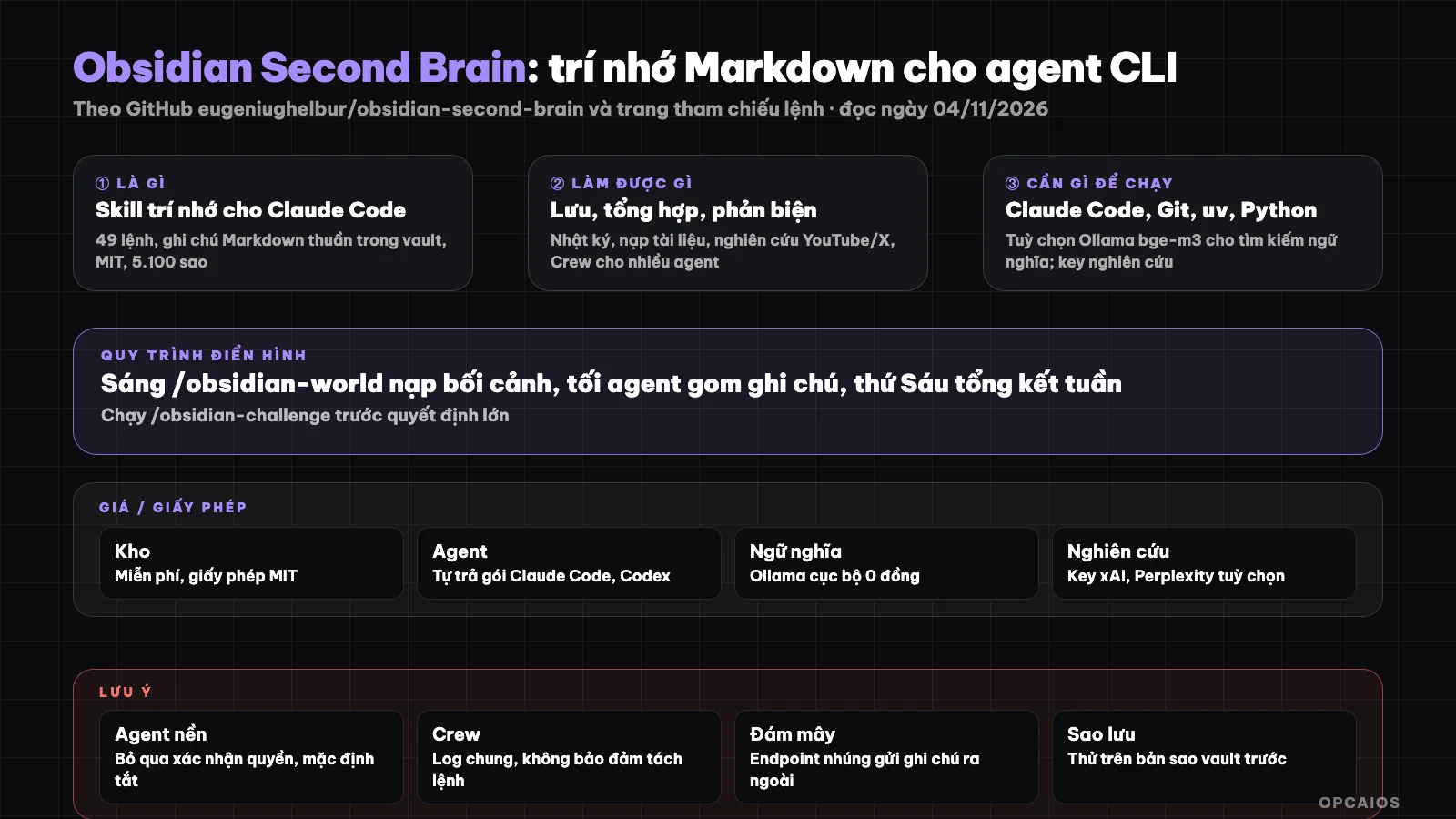
Agent đọc và ghi thẳng vào vault Markdown; tìm kiếm ngữ nghĩa và bộ nghiên cứu là phần tuỳ chọn. Sơ đồ: OPCAIOS.
Obsidian Second Brain là gì và ai tạo ra?
Obsidian Second Brain là cách biến vault Obsidian thành trí nhớ của agent lập trình, thay vì để mỗi phiên bắt đầu từ con số không. Tác giả là Eugeniu Ghelbur, người viết bản tin The AI Operator trên Substack về hệ thống agent chạy thật (theaioperator.io, đọc ngày 04/11/2026); dự án nhận tài trợ qua GitHub Sponsors.
Điểm thiết kế quan trọng, theo README (đọc ngày 04/11/2026), là ghi chú vẫn là Markdown thường: nếu bạn ngừng dùng kỹ năng này hay đổi công cụ, vault vẫn mở được bằng Obsidian hoặc bất kỳ trình soạn thảo nào. Kỹ năng đọc và ghi tệp trực tiếp, không cần plugin Obsidian, thậm chí không cần cài Obsidian. Kho mặc định dựng cho Claude Code, rồi có lệnh dựng bản cho Codex CLI, Gemini CLI, OpenCode, Antigravity, các nền tảng theo chuẩn Agent Skills, Hermes, Pi và Grok Bot. Chưa rõ khái niệm nền thì đọc Second Brain là gì? và Skill là gì, cách dùng skill.
Obsidian Second Brain làm được gì?
Obsidian Second Brain gom 49 lệnh thành bốn nhóm: quản lý vault, công cụ tư duy, bộ nghiên cứu và lệnh meta, cộng thêm Crew là logbook dùng chung cho nhiều agent. Bảng theo README và trang tham chiếu lệnh (đọc ngày 04/11/2026).
| Nhóm | Làm được gì |
|---|---|
| Quản lý vault (17 lệnh) | Lưu nhanh (/obsidian-capture), nhật ký ngày (/obsidian-daily), nạp tài liệu, tổng hợp, việc cần làm, người liên hệ, kiểm tra sức khoẻ vault, gộp ghi chú, tài liệu hoá codebase (/obsidian-architect) |
| Công cụ tư duy (14 lệnh) | Phản biện (/obsidian-challenge), ra quyết định (/obsidian-decide), động não, "hội đồng" nhiều góc nhìn, nối ý, chắt lọc |
| Bộ nghiên cứu (8 lệnh) | /research, /research-deep, /youtube, /podcast, /x-read, /x-pulse, /notebooklm; đưa nguồn ngoài vào vault kèm trích dẫn |
| Meta (10 lệnh) | /obsidian-init, /obsidian-health, /obsidian-export, /obsidian-world nạp bối cảnh về bạn và trạng thái hiện tại |
| Crew | Logbook chung để nhiều agent (kể cả Cursor) ghi và đọc việc đã làm của nhau; /crew setup |
| Tự động | Agent theo lịch: sáng 8 giờ, gom ghi chú 22 giờ, tổng kết tuần thứ Sáu 18 giờ, kiểm tra vault Chủ nhật 21 giờ; bot Telegram thu giọng nói, ảnh, PDF, liên kết |
Kho còn có bốn bộ cấu hình sẵn (executive, builder, creator, researcher), bố cục kiểu wiki, và quy tắc "độ tươi" OKM: mỗi sự thật lưu vào vault phải bất biến, có ngày, hoặc là con trỏ tới nguồn, do scripts/freshness_lint.py kiểm tra. Số lệnh giữa README (48) và trang tham chiếu (49) chênh một đơn vị tuỳ thời điểm đọc.
Is Obsidian Second Brain Free? Licensing and Hidden Costs
Obsidian Second Brain is completely free software under the MIT license; hidden costs lie in agent tokens and optional research API calls. Table from README (read 04/11/2026); excludes taxes, subject to change.
| Item | Reality |
|---|---|
| Repository price | 0 đồng, MIT (GitHub API) |
| Agent running commands | You pay for Claude Code, Codex, or Gemini CLI yourself; heavy commands consume many tokens |
| Keyword search | Free, no additional setup needed |
| Semantic search | Optional, disabled by default; recommend local Ollama with bge-m3 embedding model; or OpenAI-compatible endpoint (incurs cost, sends notes outside) |
| Research toolkit | Optional keys: xAI, Perplexity, Gemini, YouTube Data API, OpenAI; /research has free sources without keys; costs logged to ~/.research-toolkit/usage.log |
| Auxiliary software | Git, uv, Python 3.10 or later; optional openai-whisper, ffmpeg, yt-dlp, LibreOffice 26.2 or later |
| GPU | Not required; Ollama runs on CPU but slower |
We haven't checked the pricing pages of xAI, Perplexity, or Gemini, so we're not listing API costs.
How Do I Install Obsidian Second Brain?
The recommended installation method from README is the Claude Code plugin marketplace; the older way is running a script. The commands below are taken verbatim from README (read 04/11/2026); we haven't tested them yet.
- First, add the marketplace and install the plugin in Claude Code:
/plugin marketplace add eugeniughelbur/obsidian-second-brain
/plugin install obsidian-second-brain@obsidian-second-brain
- Next, add
"OBSIDIAN_VAULT_PATH": "/path/to/vault"to theenvsection in~/.claude/settings.json, then restart Claude Code. - Finally, open Claude Code in your vault and run
/obsidian-second-brain:obsidian-init.
Classic script installation (requires jq):
git clone https://github.com/eugeniughelbur/obsidian-second-brain ~/.claude/skills/obsidian-second-brain
bash ~/.claude/skills/obsidian-second-brain/install.sh
bash ~/.claude/skills/obsidian-second-brain/scripts/setup.sh "/path/to/your/vault"
If you don't have a vault yet, create one with uv run python scripts/bootstrap_vault.py --path ~/Documents/MyVault --name "Your Name" --preset builder. Build for other platforms: bash scripts/build.sh --platform codex-cli (or gemini-cli, opencode, agent-skills, hermes, pi). Put research keys in ~/.config/obsidian-second-brain/.env with chmod 600. README notes that installation via hermes plugins install with a non-working repository URL exists, and Windows needs some special path handling. Those unfamiliar with Codex or Antigravity should start with Claude Code, since that's the default.
Limits, Risks, and Security When an Agent Writes to Your Vault
The main risk of Obsidian Second Brain is that the agent has write permission to your personal knowledge base, so errors or malicious content could leak into your vault. README (read 04/11/2026) spells out several points:
- The agent runs in the background after context compression using the
--dangerously-skip-permissionsflag, though it's restricted to Read, Write, Edit, Glob, Grep, doesn't load MCP, and only adds or edits notes; it's disabled by default. Only enable it after backing up your vault. - Crew treats another agent's logs as data, not commands, but README admits "cannot guarantee" complete isolation; the lesson only takes effect once a real person runs
keep. This is a form of prompt injection through shared memory. - Semantic search via cloud endpoints sends notes outside; use
OBSIDIAN_EMBED_EXCLUDEto exclude private folders. The index doesn't update itself; you must rerun it. - Open models obey commands worse; README recommends Claude or
hermes-4-405bfor heavy tasks. - There's no isolation within a single vault; can't load presentation files or spreadsheets; Spotify podcasts aren't supported because of DRM.
On law and personal data: vaults often contain notes about real people, contracts, finances. If you let an agent send content to an API, you're responsible for that data; we're not lawyers and haven't checked specific regulations. The /youtube, /podcast commands download third-party content, so respect platform terms and copyright.
Obsidian Second Brain vs Obsidian Skills and Other Options
Obsidian Second Brain focuses on memory and processes, while kepano's Obsidian Skills teaches agents to write in proper Obsidian format. The table is a general description, not a measurement.
| Tool | Focus | What's Different |
|---|---|---|
| Obsidian Skills (kepano) | Obsidian-style Markdown, Bases, Canvas, CLI | Teaches how to write, no memory commands, automatic scheduling or Crew |
| CLAUDE.md and Claude Code's built-in memory | Project conventions | No semantic search, no periodic synthesis |
| RAG self-built with vector database | Search by meaning across large repositories | Flexible but you have to write it yourself |
| Notion or team wiki | Person-to-person collaboration | Not designed for agents to read and write directly |
If you just need agents to write in proper Obsidian syntax, Obsidian Skills is lighter. If you want agents to remember across multiple sessions and self-summarize, Obsidian Second Brain is more complete, but also more complex.
When Should You Use Obsidian Second Brain?
Use it when you already have an Obsidian vault, use Claude Code daily, and are ready to back up before letting agents write.
| Situation | Suggestion |
|---|---|
| Every Claude Code session has to explain the context again | Install the plugin, run /obsidian-world at the start of the session |
| Only want agents to write in proper format | Obsidian Skills is enough |
| Multiple agents working on one project | Turn on Crew to share work logs |
| Vault contains sensitive customer data | Local Ollama, exclude private directories, don't turn on background agents |
| Not comfortable with command line yet | Wait; you need to know how to edit settings.json and run scripts |
Example (hypothetical): a consultant logs every client call into the vault; each evening the agent compiles notes into a customer page, each morning /obsidian-world loads today's work, and before giving a quote they run /obsidian-challenge so the agent can challenge their own assumptions.
OPCAIOS Experience
We added Obsidian Second Brain to the Repo list in the Tools section on opcaios.org after reading the README and checking that the repository is still maintained; we haven't tested it yet, so this section describes the criteria we use to evaluate, not an assessment after use. Our Obsidian vault is our main knowledge repository, but we haven't installed this one. Four criteria:
- Is the repository still being updated: yes, the latest code push was November 1, 2026 according to GitHub API.
- License: MIT, no commercial use restrictions.
- Hidden costs: agent tokens for heavy commands; local Ollama doesn't cost API but needs enough RAM.
- Risks: background agents skip permission checks and Crew is shared memory between agents, so we'll test on a vault copy, not on the vault we use.
Read more: What is Obsidian?, What is Claude Code?, What is Ollama?, What is context engineering?.
Frequently Asked Questions
Does Obsidian Second Brain require installing Obsidian?
No, it's not mandatory. According to the README (read on 04/11/2026), the skills read and write Markdown files directly in the vault folder, don't need Obsidian plugins, and run without Obsidian. Obsidian is still useful for you to view, edit, and browse the link graph. If you don't have a vault yet, the bootstrap_vault.py command creates a new vault with preset configurations like builder or creator.
Does Obsidian Second Brain send my notes to the internet?
By default, no: core commands run through agents on your machine, keyword search runs locally, and semantic search is recommended to use Ollama with bge-m3 on-premises. However, agents (Claude Code, Codex) still send the content they read to the model provider according to their policies. Choose a cloud embedding endpoint or a research suite with a key, then content leaves your machine; the README recommends using OBSIDIAN_EMBED_EXCLUDE for private folders.
How does Obsidian Second Brain differ from Obsidian Skills by kepano?
Obsidian Skills teaches agents to write proper Markdown in Obsidian style, Bases, JSON Canvas and use Obsidian CLI; it doesn't manage memory. Obsidian Second Brain is a memory system and workflow: 49 commands to capture, synthesize, critique, research, schedule agents, and Crew for multiple agents. The two repositories complement each other: kepano's skills handle formatting, this one handles memory.
Can I install Obsidian Second Brain for Codex or Antigravity?
Yes. The README lists builds for Codex CLI, Gemini CLI, OpenCode, Antigravity, Agent Skills platform, Hermes, Pi, Grok Bot via bash scripts/build.sh --platform <name>. Some builds lack scheduled commands because they need MCP Google Calendar. The README recommends Claude or hermes-4-405b for heavy commands because open models follow instructions less well; we haven't verified this on Antigravity.
Can people who don't know how to code use it?
Hard at the setup step, easy at the usage step. Setup requires editing settings.json, running scripts, possibly installing uv, Ollama; after that all tasks are typing commands like /obsidian-capture or speaking in English, German, Spanish, Portuguese, Simplified Chinese according to the reference page. Vietnamese is not mentioned, though agents usually understand it anyway. If you want someone to guide you building a knowledge base for agents from scratch, see OPCAIOS's AI application training course.
Source: GitHub eugeniughelbur/obsidian-second-brain (README, API, read on 04/11/2026), command reference page eugeniughelbur.github.io/obsidian-second-brain and theaioperator.io (read on 04/11/2026); not read/not verified: source code of scripts, pricing pages of xAI, Perplexity, Gemini, command quality with Vietnamese; star count may change. This post is not legal advice. The experience is OPCAIOS's.
Translated from Vietnamese with AI. Read the original.
Want to apply this in your business?
Book a free 30-minute call (Vietnam time, in English or Vietnamese).