



20-Hour Workweek for OPC Owners
A 20-hour workweek for an OPC owner means a one-person-company owner uses AI and automation to compress work into about 4 days—roughly 20 hours of focused work—while keeping the activities that directly generate revenue. The title says "without losing sales," but nobody can guarantee that, not even OPCAIOS: your revenue depends on your product, your customers, seasonality, and whether you cut correctly or not. This post has no statistics about OPC owners working 20 hours, because OPCAIOS doesn't have any; the only source cited is the four-day week trial in the UK run by 4 Day Week Global (read on 25/10/2026).
Instead, the post lays out a trial process with stopping conditions, in seven parts: (1) a two-week time audit; (2) sorting tasks; (3) keeping revenue-generating work, automating or outsourcing the rest; (4) a sample four-day week; (5) deep work blocks and customer feedback rules; (6) buffer time; (7) tracking metrics and when to go back to five days.
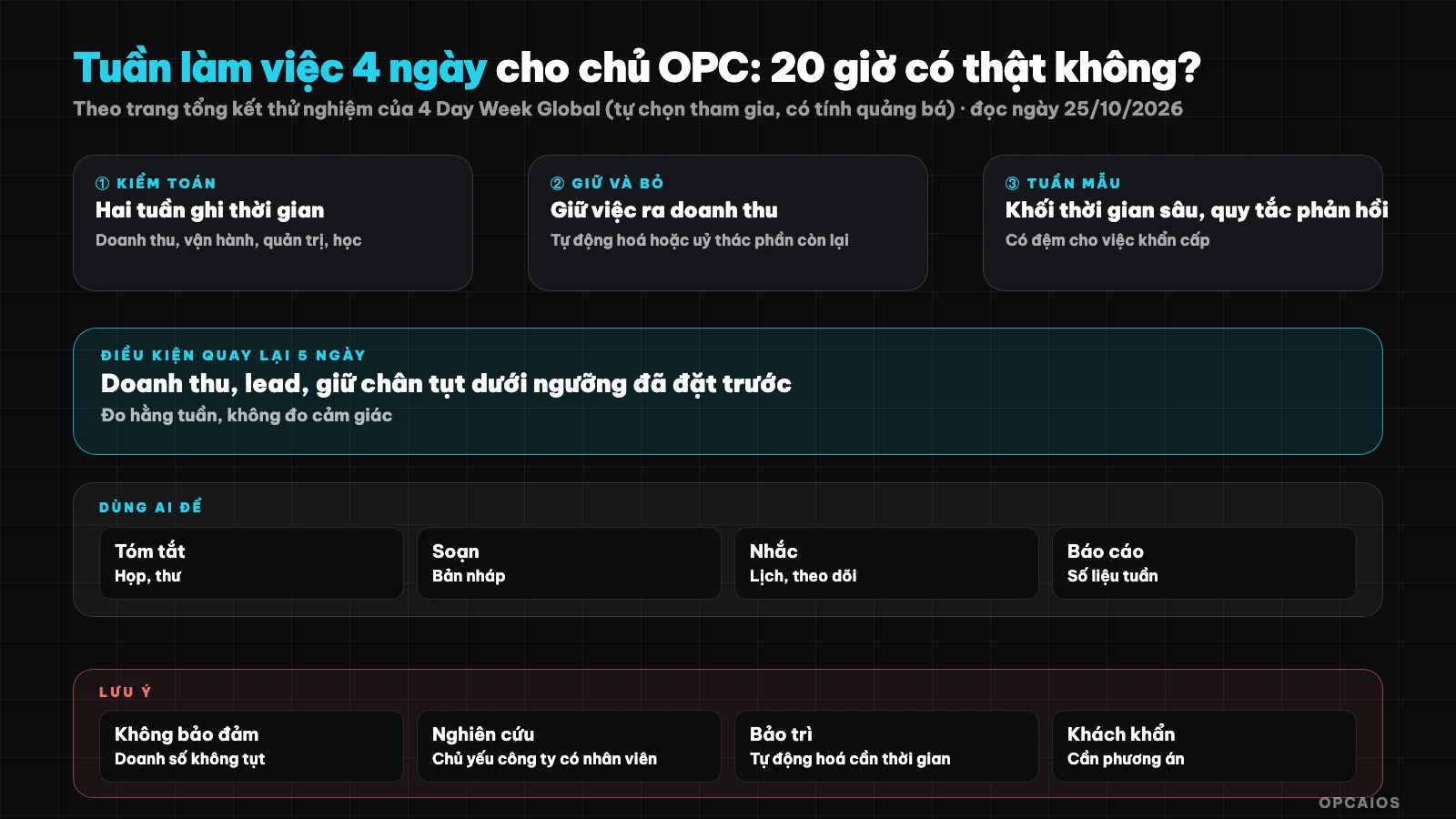
Measure first, cut second, track always, and have a way back. Diagram: OPCAIOS.
What the four-day week research says, and doesn't say
The four-day week trial in the UK in 2022, run by the 4 Day Week Campaign, 4 Day Week Global, and Autonomy, lasted six months after two months of setup, with independent research from Boston College, Cambridge University, and Autonomy. The summary page on 4 Day Week Global (read on 25/10/2026) gives these numbers: average revenue rose 35% according to participating firms, turnover fell 57%, employee burnout fell 71%, and 92% of firms planned to keep going.
Read these numbers with three caveats:
- The subjects were companies with employees, usually cutting hours but keeping pay, not solo workers. An OPC owner has no coworker to cover work when they're off.
- Businesses chose to join and reported their own results; the page I read doesn't describe sample size or measurement method, and because it comes from the organization that ran the trial (and also sells related services), it has a promotional tone. The full report hasn't been read yet.
- "Average revenue rose" doesn't mean your revenue will rise. It doesn't prove causation.
The real takeaway: research shows a trial is reasonable at some firms, it gives you no guarantee. So the post proposes a controlled trial instead of betting on a number.
Step 1: How do you run a two-week time audit?
A time audit means writing down what you do in 10 straight workdays so you have real data before you cut. Log it in half-hour blocks using Google Sheets or Notion; by 2026 there are many free time-tracking apps. Don't change what you do in these two weeks, just log it. At the end, add up the hours by group—for example, hours meeting clients, hours building product, hours invoicing, hours learning.
The number that usually surprises is not total hours but the share of hours that goes into work nobody pays you for. For instance, if you log 80 hours in 10 days and 24 hours sits in scattered messages and invoicing, that's the first candidate for automation with n8n. Next, flag the hour blocks tied straight to revenue to protect them. Last, save the audit sheet as a baseline to compare against for 8 to 12 weeks of trial, because later metrics need to be set against this period, not against how it felt.
Step 2: How do I classify work into four groups?
Classifying work means dividing all recorded hours into four groups to decide whether to keep, automate, consolidate, or limit them. The revenue group includes meeting clients, quoting, delivering main products, and creating sales content; the approach is to keep and protect the best time. The operations group includes sending invoices, scheduling reminders, answering repeated questions, and posting; the approach is to automate or delegate. The administration group includes bookkeeping, reporting, internal emails, and paperwork; the approach is to consolidate into one block and use Claude to draft. The learning group includes trying new tools and reading materials; the approach is to limit to one fixed block each week.
Ask each task this way: if I drop this task for a month, will revenue or clients be affected? If not, drop it. If yes but someone else or a machine can do it, delegate or automate. If only you can do it and it generates revenue, keep it. For example, scheduling reminders via Zalo can go to n8n, but quoting for new clients should stay. Say an audit finds 80 hours of which 30 are operations, then operations is where to cut first.
Step 3: How do I automate and delegate the rest using AI?
Automating the rest means handing repetitive operations tasks to AI or tools, while you only review the output. There are 4 groups of tasks AI can handle well, all capabilities, not guarantees. Summarization group: Claude summarizes meetings, long emails, and client documents, then you just read the summary and check key points. Drafting group: reply emails, template quotes, posts—you edit and approve. Reminders group: turn client forms into tasks using n8n and automated forms. Reporting group: collect revenue, leads, returning clients into a weekly report.
AI limits: the model can draft wrong, misunderstand client context, or silently break a process. Everything sent to clients, touching money or sensitive data needs human review, and client data must be protected (5 security rules). See also AI system running alone and AI helping one person run a business.
Step 4: What does a sample 20-hour week look like?
The sample week is a layout illustration assuming hypothetical conditions, not a verified version; adjust based on your audit. Example assumption: Monday has one deep block on main product or client delivery and a short admin block, around 6 hours. Tuesday is for client meetings, quoting, and lead follow-up, around 5 hours. Wednesday has a second deep block on content or sales and 1 hour learning, around 5 hours. Thursday is a buffer for spillover, unexpected client needs, reviewing AI output, and the weekly report, around 4 hours.
Friday through Sunday off, only checking urgent alerts by response rules. The roughly 20 hours is just the target of the sample model. Your real week might need 25 or 30 hours at first; that number is information, not failure. After 4 weeks, compare the sample week with the Google Sheets table from the audit phase to see which blocks need moving. Don't change both schedule and tools at once.
What is a deep time block and when should I set it?
A deep block is 2 to 3 straight hours for value creation, notifications off, and a clear goal from the start. Set your deep block when you're most alert, put meetings and chores into the rest. Work needing less focus like invoices and organizing goes into the end-of-day or buffer block. For example, if you work best from 8 to 11 a.m., reserve that frame for your main product, turn off Zalo and email, then reply at 2 p.m. Finally, write it to Google Calendar so clients see your schedule and don't book meetings over your deep block.
What are the rules for customer response when working 4 days?
Customer response rules are a set of commitments you write down so customers know when they'll get a reply, even when you're not working. Reducing work days doesn't mean disappearing, so tell your customers in advance and write out 4 points. Point 1 is your normal response time, for example "within one business day," whatever you set. Point 2 is how to report urgent matters through a separate channel like Zalo or phone number, with a clear definition of what counts as urgent. Point 3 is a helpful auto-reply that states your work schedule and which tasks get handled when. Point 4 is repeated questions answered through a FAQ page or chatbot with RAG, with a handoff path to you when the bot isn't sure.
Example scenario: customer messages on Friday, receives an auto-reply promising a response by Monday; if urgent, customer calls the dedicated number. The goal is customers know about 3 days off beforehand, and don't have to wait 72 hours in limbo. Write these commitments in a Google Doc and send it to your current customers at the start of the month.
What is a buffer zone and why do you need it?
A buffer zone is a fixed time block to hold unexpected work and fixes from automation. Planning 100% of your time is the surest way to have your week break by Monday. Keep a fixed buffer block, like Thursday 4pm in your sample week. If the buffer is always empty, you can cut further; if it's always drained, your plan is too tight. Example scenario: after 4 weeks, the buffer block is fully used 3 out of 4 times, so you should move some admin work to the next week or delegate it to an assistant. Record your buffer usage in a Google Sheet on the same day to compare weeks.
What are the tracking metrics and conditions for returning to 5 days?
Tracking metrics are a set of measurements you choose before you try, made up of 5 metrics: revenue, leads, customer retention, response time, and health. Set a timeframe of 8 to 12 weeks and compare it to an audit period. Revenue is measured by total income each month versus before; the warning sign is a sustained drop beyond your chosen threshold. Leads are measured by new contacts or quote requests per week. Retention is measured by the rate of repeat customers or renewals. Response time is measured by the median time to reply to customers. Health is self-assessed through fatigue level and hours of sleep.
Conditions for returning to 5 days should be written in advance, for example "if revenue for two consecutive months is below threshold X, or if customer churn rises, then return to 5 days to find the cause." Returning isn't failure, it's a test result. When tracking sales, remember to separate causes from your weekly structure versus causes from seasonality or market conditions.
Risks
- Customer emergencies: one incident on your day off could collapse the whole plan. You need an urgent channel and a backup person if you have one.
- False recovery: squeezing 40 hours into 4 long days but still working weekends is just moving the problem. Count your real hours.
- Automation maintenance time: workflows break, APIs change, licenses expire; budget time for this, don't treat automation as free. See cost of AI tools.
- Cutting revenue-generating work by mistake: audit the first group carefully before cutting.
- Fooling yourself: use numbers, not feelings.
OPCAIOS experience
We have not tried and have no data on 20-hour weeks or 4-day weeks for OPC owners, so this post is a test framework, not a proven result. What we do have are automation support tools: n8n self-hosted on VPS, in-house CRM, email sequences, and AI agents. The 30-day roadmap to build foundations is at 30-day roadmap to build OPC with AI.
Frequently Asked Questions
Is working 4 days guaranteed not to hurt my revenue?
No. The research in the UK is from companies with employees and self-reported data; OPC owners need to test themselves and track their own metrics.
Where should I start?
Start with a 10-day time audit and sort your work into four groups: revenue, operations, administration, learning. First, log your hours in 30-minute blocks in Google Sheets. Next, mark revenue work to keep, operations work to automate with n8n or Claude, administration work to batch. Finally, pick 5 metrics and set a target for 8 to 12 weeks. Without measurement, don't cut anything, because cutting revenue work by mistake is the biggest risk. For example, if 30 hours out of your 80-hour audit are repetitive operations work, that's where to try automation first.
What can AI help with?
Summarizing, drafting, reminding, and reporting. Any output going to clients or involving money needs human review.
When should I go back to 5 days?
When your metrics fall below the threshold you set beforehand, like revenue or client retention declining over time, or your health gets worse.
What else do I need to learn to automate?
Start with small repetitive processes; details are in OPCAIOS's AI application training course.
Source: 4 Day Week Global's summary page of the 4-day week trial in the UK (read 25/10/2026); not verified: full reporting, sample size and method of the trial, any impact on OPC owners' revenue; sample week is an assumption; experience is from OPCAIOS.
Translated from Vietnamese with AI. Read the original.
Want to apply this in your business?
Book a free 30-minute call (Vietnam time, in English or Vietnamese).