


What is OpenSEO?
OpenSEO (repository every-app/open-seo) is an open-source SEO tool that positions itself as an alternative to Semrush and Ahrefs. It includes keyword research, rank tracking, competitor analysis, backlink analysis, site audits, and monitoring of brand presence in AI-generated answers. According to the GitHub API (read on 04/11/2026), the repository was created on 27/2/2026, has around 26,200 stars, is licensed under MIT, written in TypeScript, with the latest release v0.1.23 launched on 4/11/2026. The web version at openseo.so offers a Base plan at $10 per month, according to the pricing page (read on 04/11/2026). This article explains what OpenSEO can do, how pricing works based on DataForSEO data, two ways to self-host, risks to know about, and when to use it.
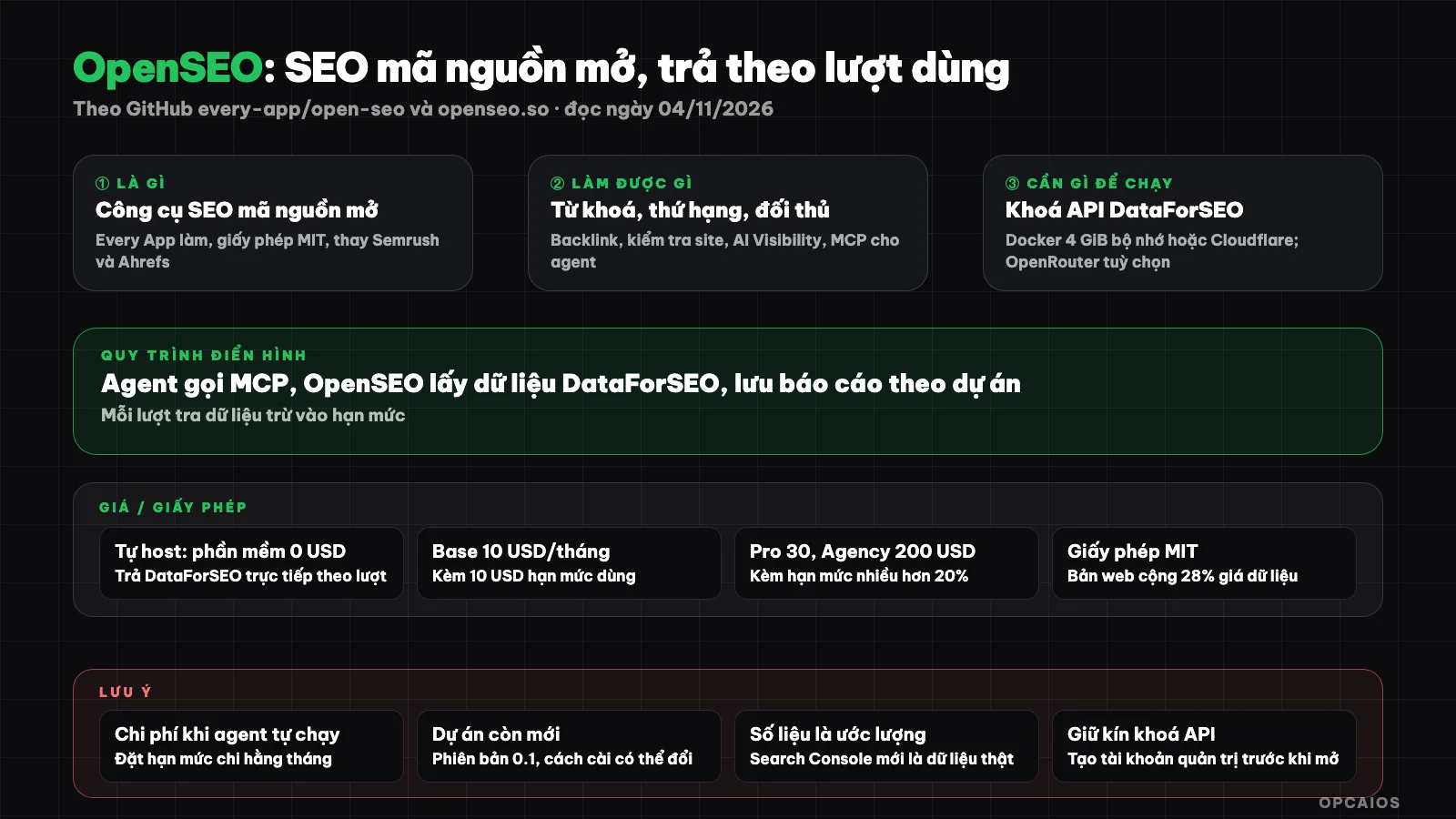
OpenSEO sits between users or agents and paid SEO data sources. Diagram: OPCAIOS.
What is OpenSEO and who made it?
OpenSEO is a lightweight SEO toolkit developed by Every App, Inc. and released as open source on GitHub. The main idea is to avoid expensive subscriptions from large SEO suites: you bring your own DataForSEO API key and only pay for the data you actually use.
Every App, Inc. is the company behind OpenSEO, according to the footer of openseo.so (read on 04/11/2026); the site states the company is backed by Y Combinator and has over 3,000 users, a figure disclosed by the project and not yet verified. The README on GitHub (read on 04/11/2026) describes OpenSEO as an SEO tool "for you and your AI agent". This means OpenSEO is not just a web interface: the project provides an MCP server and Agent Skills so Claude Code (Anthropic), Codex (OpenAI), ChatGPT, or Cursor can read your SEO data directly. If you're not familiar with MCP, see What is MCP?. The project invites users to fork the code to customize it into their own tool. OpenSEO is still young: the version number is still at 0.1, so the interface and installation process may change quickly.
What are OpenSEO's main features?
OpenSEO focuses on six core SEO workflows, according to the README, plus an MCP layer for AI agents. The table below restates the README and openseo.so page (read on 04/11/2026).
| Feature | Short description |
|---|---|
| Keyword research | Keyword suggestions, search volume, difficulty, intent, view search results |
| Rank tracking | Track keyword position over time |
| Competitor analysis | Estimate organic traffic and ranking keywords for a domain |
| Backlinks | View inbound links and referring domains |
| Site audit | Scan pages, flag technical SEO errors |
| AI Visibility | Track brand mentions and citations in AI-generated answers |
| MCP and Agent Skills | Agents call SEO data, with sample skills like site audit and keyword research |
| Google Search Console | Connect real Search Console data from your site |
How much does OpenSEO cost, how much is free?
OpenSEO is free software when self-hosted, but SEO data always costs money because it comes from DataForSEO. The web version at openseo.so sells monthly plans with usage caps, plus adds 28% to data pricing, according to the README and pricing page (read on 04/11/2026).
| Plan (openseo.so) | Price per month | Included usage cap |
|---|---|---|
| Trial | 0 USD | $0.50 credit to try |
| Base | 10 USD | $10 usage per month |
| Pro | 30 USD | $36 usage per month, priority email support |
| Agency | 200 USD | $240 usage per month, private Slack channel |
| Self-hosted | 0 USD software | Pay DataForSEO directly, add OpenRouter if using AI |
Prices exclude tax and may change. The pricing page estimates one keyword lookup at around $0.05 and one rank check at just a few cents; annual plans get two free months. These are figures disclosed by the project; we have not verified them against real invoices. When self-hosting, you also pay for a server or Cloudflare account, and prepay DataForSEO according to their terms, which we have not reviewed on the DataForSEO pricing page.
How to Install OpenSEO and Get Started?
OpenSEO has three ways to get started: try it on openseo.so, self-host with Docker, or self-host on a Cloudflare account. Both self-hosting methods require a DataForSEO API key; Docker needs at least 4 GiB of memory, according to the self-hosting documentation in the repository (read 04/11/2026).
Steps to self-host with Docker according to the docs/SELF_HOSTING_DOCKER.md file in the repository:
- First, clone the repository and create a configuration file:
git clone https://github.com/every-app/open-seo.git
cd open-seo
export COMPOSE_FILE=deploy/standalone/compose.yaml
cp deploy/standalone/.env.example deploy/standalone/.env
- Next, open the
.envfile, setSTORAGE_SECRET_KEYto a random string of your own, andDATAFORSEO_API_KEYto your key. Do not share this file. - Start the service and view the initialization logs:
docker compose pull
docker compose up -d
docker compose logs -f init
- Finally, open the admin page on your machine and create an admin account right away. The documentation notes that registration will close once this account exists, so create it before putting the site on the internet. Team members join via invitation link.
To use AI conversation and summaries, add OPENROUTER_API_KEY; to connect Search Console, create your own Google OAuth application. If you're not familiar with containers, read What is Docker? and What is VPS? first.
Real-world example (hypothetical): a blog writer connects the OpenSEO MCP to Claude Code, asks it to find and group keywords for the topic "posting schedule", then has the agent pick three low-difficulty keywords to write about first. Each search deducts from your plan's usage limit.
What are the risks and limitations of OpenSEO?
OpenSEO has four main risks: hard-to-predict data costs when agents make many calls, the project is still young, data is estimates from a third party, and API keys need to be kept secret. There are no terms-of-service risks like video downloads, but you should still read DataForSEO's terms.
The first risk is costs when you let an AI agent run on its own. An agent like Claude Code can make dozens of keyword research calls in a single session, and each call deducts money according to DataForSEO pricing. The OpenSEO pricing page (read 04/11/2026) lets you set a monthly auto-recharge limit; when self-hosting, you should set a limit right in your DataForSEO account. The next risk is maturity: the repository is eight months old, version 0.1, and installation steps may change. Third, search volume, difficulty, and competitor traffic are DataForSEO estimates, not Google numbers; only Google Search Console has real data about your site. Last is security: the documentation is for no-login mode, which is only safe behind a private network or authentication proxy. Don't open the admin port to the internet until you have an admin account, and don't put API keys in your Git repository.
How is OpenSEO different from Semrush, Ahrefs, and other tools?
OpenSEO differs from Semrush and Ahrefs in that it charges per use and is open source, in exchange for having fewer reports. The table below is a general description, not a measurement; we did not read Semrush or Ahrefs pricing pages in this post.
| Tool | Billing | Strengths | Weaknesses |
|---|---|---|---|
| OpenSEO | Per use, plans from $10 USD | Open source, MCP for agents, can self-host | New, few advanced features |
| Semrush, Ahrefs | Monthly subscription | Large dataset and reports, well-established | Expensive for solo workers |
| Google Search Console | Free | Real data from your site | Cannot see competitors |
| DataForSEO directly | Per API call | Flexible, cheap if you write your own tool | No ready-made interface |
| GEO SEO Claude | Per AI model you use | GEO analysis skills for Claude | No own keyword database |
When should you use OpenSEO?
OpenSEO suits solo SEO workers or small teams who want keyword and competitor data without paying a large subscription, especially when already working with AI agents. If you only need to track your own site, free Search Console is enough.
| Situation | Recommendation |
|---|---|
| Only need to know how your site ranks | Use Google Search Console first |
| Need keyword research a few times a month | Base plan on openseo.so |
| Working for many clients | Pro or Agency plan, or self-host |
| Want data on your own server | Self-host Docker or Cloudflare |
| Want an agent to write SEO reports | Use MCP and Agent Skills, set a spending limit |
OPCAIOS's Experience
We built an SEO toolset in the opcaios.org admin panel following the open-seo model: keyword research, rank tracking, competitor tracking, and weekly site audits. We did not install open-seo as-is. When considering whether to use open-seo as-is, we looked at:
- Whether the repository is still being updated: open-seo is releasing new versions very regularly.
- License: MIT allows learning and modifying code.
- Hidden costs: DataForSEO data and AI models are priced per call.
- Can we replace the tool we're using: only if we need more reports than our custom-built version.
We have not yet measured costs or data accuracy by the numbers. See also What are SEO and GEO? and the Repo list in the Tools section.
Further reading: What is MCP?, What is Google Search Console?, What is Claude Code?, Measuring whether AI cites your website, 6 best free SEO tools in 2026 for SEO and GEO.
Frequently Asked Questions
Is OpenSEO truly free?
OpenSEO software is free under the MIT license when you self-host, via GitHub API (read November 4, 2026). But SEO data is not free: you need a DataForSEO API key and pay them per call. The version on openseo.so offers a trial with 0.50 USD credit, then requires a monthly plan from 10 USD, per the pricing page read the same day. Price excludes tax and may change. If you use the AI conversation feature when self-hosting, you pay extra to OpenRouter or for your own model server.
Where does OpenSEO get its data from, and is it accurate?
OpenSEO gets keyword, rank, backlink, and domain data from DataForSEO, an SEO data API provider, per the README. Search volume, difficulty, and competitor traffic are estimates, not numbers Google publishes. Real data about your site's impressions and clicks comes from Google Search Console when you connect it. We have not verified accuracy ourselves, so treat the numbers as trends.
How do I use OpenSEO with Claude Code?
OpenSEO has an MCP server for Claude Code, Codex, ChatGPT, or Cursor to call SEO data, plus Agent Skills—template workflows. Per the README (read November 4, 2026), setup instructions are on the openseo.so docs page for each application. Once connected, you give commands in plain language, for example find and group keywords for a topic. Set a spending limit, since the agent can make many calls and each costs credit.
What kind of server do I need to self-host OpenSEO?
Per the self-hosting docs in the repository (read November 4, 2026), the Docker way needs Docker Engine or Docker Desktop with Compose and at least 4 GiB of memory for Docker. The Cloudflare way needs no separate server; you deploy with one command to your Cloudflare account and it runs on the free plan. Both ways need a DataForSEO key. Create an admin account before putting your site online.
Can someone who doesn't know code use OpenSEO?
Yes, if you use the version on openseo.so: you sign up, use the web interface, and don't need to install anything. Self-hosting requires basic knowledge of Docker, config files, and keeping API keys safe. Newcomers should try with free credit first. To learn how to combine SEO tools with AI agents in your daily work, see OPCAIOS's AI application training course.
Sources: GitHub every-app/open-seo (README, docs/SELF_HOSTING_DOCKER.md, API, Releases page, read November 4, 2026), openseo.so and openseo.so/pricing (read November 4, 2026); not read/not verified: DataForSEO pricing page, Cloudflare self-hosting docs, data accuracy, 3,000+ users figure claimed by the project; star count and prices may change. Experience is OPCAIOS's.
Translated from Vietnamese with AI. Read the original.
Want to apply this in your business?
Book a free 30-minute call (Vietnam time, in English or Vietnamese).