


What is VibeVoice?
VibeVoice is a family of open-source voice models from Microsoft, consisting of speech recognition (ASR) for recordings up to 60 minutes long with speaker identification and timestamps, along with text-to-speech models (TTS) for multiple speakers and a real-time 0.5B parameter version. According to GitHub (API, accessed 04/11/2026), the microsoft/VibeVoice repository was created on 25/08/2025, has around 55,100 stars, is licensed under MIT, with the most recent code push on 08/10/2026, and has not been archived. The README clearly states the model is "for research and development only". This post answers: what models does VibeVoice include, what does it need to run, how free is it, why was the TTS part removed, and when should a content creator consider it.
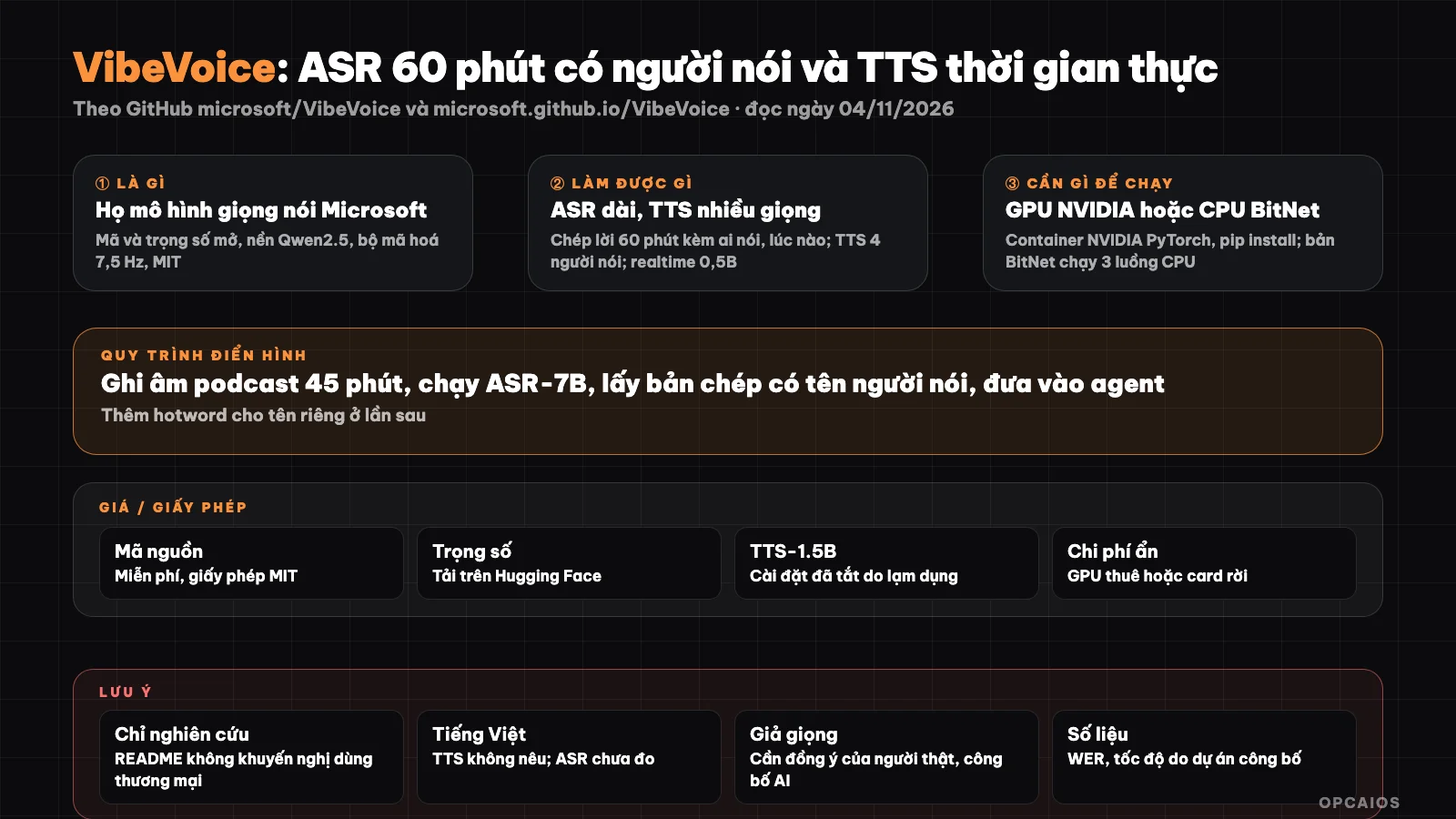
VibeVoice consists of a recognition branch (ASR) and speech synthesis branch (TTS) sharing a common speech encoder. Diagram: OPCAIOS.
What is VibeVoice and who created it?
VibeVoice is a Microsoft research project, with code and weights published on GitHub and Hugging Face, described briefly on GitHub as "Open-Source Frontier Voice AI". The project started with a multi-speaker TTS model, then expanded to long speech recognition and a CPU-running version.
According to the README (accessed 04/11/2026), the architecture consists of three parts. First are two continuous speech encoders (acoustic and semantic) running at a very low frame rate of 7.5 Hz, which helps process long sequences more efficiently. Next is a large language model (the public version uses Qwen2.5 1.5B) to understand text context and conversation flow; see What is LLM?. Finally there is a diffusion head that generates speech details. The original TTS paper was accepted at ICLR 2026 as an Oral presentation, according to the README. Key milestones: TTS open-sourced 25/08/2025, 0.5B real-time version 03/12/2025, VibeVoice-ASR 21/01/2026, ASR streaming 03/09/2026.
What can VibeVoice do?
VibeVoice does two main things: convert speech to text (ASR) and convert text to speech (TTS). The ASR branch is currently being updated the most. The table below follows the README and docs in the repository (accessed 04/11/2026); all figures are from the project's announcements and have not been independently verified.
| Model | Capabilities |
|---|---|
| VibeVoice-ASR-7B | Recognize recordings up to 60 minutes in a 64K token context in one pass; return who spoke, when, and what they said; support custom keywords (hotword); over 50 languages, auto language detection |
| VibeVoice-ASR-Streaming | Transcribe as audio arrives, output text in segments; 10 languages |
| VibeVoice-ASR-BitNet | Compressed version runs on CPU via VibeASR.cpp, reduced from 4.62 GB to 1.58 GB, real-time with 3 CPU threads or more |
| VibeVoice-TTS-1.5B | TTS for up to 90 minutes, maximum 4 speakers, English and Mandarin; installation notes state "disabled due to widespread misuse" |
| VibeVoice-Realtime-0.5B | TTS for one speaker, first token latency around 300 ms, primarily English, 9 experimental languages (German, French, Italian, Japanese, Korean, Dutch, Polish, Portuguese, Spanish) |
The repository also contains code for fine-tuning ASR with LoRA (directory finetuning-asr), vLLM plugins, integration with Hugging Face Transformers and Azure AI Foundry Labs. For Vietnamese speakers: Vietnamese is not mentioned in the TTS language list, while ASR only states "over 50 languages" without listing them; we have not measured accuracy with Vietnamese.
Is VibeVoice free? License and hidden costs
VibeVoice is free for code and weights under the MIT license, but real costs lie in hardware and usage boundaries. MIT allows commercial use, but the README says the project does not recommend commercial or production use without further testing. Table below follows README, docs and project page (accessed 04/11/2026); does not include taxes, subject to change.
| Item | Reality |
|---|---|
| Software price | 0 đồng, MIT per GitHub API |
| Weights | Download free on Hugging Face; VibeVoice-Large version marked "Disabled" |
| GPU | ASR-7B and TTS use NVIDIA CUDA environment; docs do not state minimum VRAM; Realtime-0.5B tested by project on NVIDIA T4 and Mac M4 Pro |
| CPU | Only ASR-BitNet version via VibeASR.cpp |
| API key | Not required; runs locally |
| Managed service | ASR available on Azure AI Foundry Labs; we have not read the Azure pricing page so cannot quote price |
For a solo business, the biggest hidden cost is GPU: rent GPU server by the hour or buy a discrete card. Try the BitNet version on CPU first before deciding.
How to Install VibeVoice?
I install VibeVoice following the ASR docs in three steps: run an NVIDIA PyTorch container, install the repository with pip, then run the demo. The commands below are taken verbatim from docs/vibevoice-asr.md (read on 04/11/2026); I haven't tested them yet.
- First, start an NVIDIA PyTorch container (docs have verified versions 24.07 through 25.12):
sudo docker run --privileged --net=host --ipc=host --ulimit memlock=-1:-1 --ulimit stack=-1:-1 --gpus all --rm -it nvcr.io/nvidia/pytorch:25.12-py3
- Next, clone the code and install the package; if flash attention is missing, install it separately:
git clone https://github.com/microsoft/VibeVoice.git
cd VibeVoice
pip install -e .
pip install flash-attn --no-build-isolation
- Finally, run the Gradio demo (needs ffmpeg) or recognize a file:
apt update && apt install ffmpeg -y
python demo/vibevoice_asr_gradio_demo.py --model_path microsoft/VibeVoice-ASR --share
python demo/vibevoice_asr_inference_from_file.py --model_path microsoft/VibeVoice-ASR --audio_files [audio-path]
The Realtime-0.5B version uses pip install -e .[streamingtts] and python demo/vibevoice_realtime_demo.py --model_path microsoft/VibeVoice-Realtime-0.5B. If you're new to containers, read What is Docker?. People who don't know code can try the ASR playground at aka.ms/vibevoice-asr or the Colab the README points to.
Limitations, Risks, and Legal Considerations When Using VibeVoice
The biggest risk with VibeVoice is voice spoofing: Microsoft removed the TTS code from the repository on 05/09/2025 after discovering misuse. The project page states they shut down the repository until they are certain misuse is no longer feasible, and as of 04/11/2026 the TTS installation section still shows it as disabled.
Technical limits according to the docs (read on 04/11/2026):
- TTS-1.5B only works well with English and Chinese; other languages may produce unexpected audio; background music sometimes appears on its own; it doesn't handle overlapping speech.
- Realtime-0.5B handles only one speaker; inputs of three words or fewer are unstable; custom voices require contacting the development team.
- ASR is limited to 60 minutes per run; accuracy varies by language (the project reports WER from 7.99 for English to 21.54 for Portuguese, unverified).
- All models inherit biases from the underlying Qwen2.5 model.
On the legal side, I'm not a lawyer and haven't reviewed the actual legal text. Three points: cloning a real person's voice requires their consent; content created with AI should be disclosed as AI, as the README recommends; meeting recordings and interviews contain personal data, running locally is an advantage but you still need permission from the people being recorded.
VibeVoice vs. Whisper, OmniVoice, and Other Options
VibeVoice differs from popular tools in combining speaker identification, timestamps, and transcription in one pass for long recordings. The table is a general description from public documents, not measurements.
| Tool | Main strength | How it differs from VibeVoice |
|---|---|---|
| Whisper (OpenAI) | Multilingual ASR, has Vietnamese | No built-in speaker identification |
| OmniVoice | TTS for over 600 languages, voice cloning | TTS only; has Vietnamese |
| ZeroTTS | Vietnamese TTS, runs on CPU | Vietnamese-focused, lighter |
| VidBee | App to download videos and transcribe locally | For people who don't code |
If you need Vietnamese transcription without coding, Whisper through an app like VidBee is easier. VibeVoice works well for people who need transcripts with speaker labels for podcasts, long meetings, or who want to fine-tune ASR with their own data.
When Should I Use VibeVoice?
Use VibeVoice when you have a GPU or can tolerate CPU, need speaker identification in long recordings, and accept "research" status.
| Situation | Recommendation |
|---|---|
| Transcribe podcasts, meetings 30 to 60 minutes long, need to know who spoke | Try ASR-7B on rented GPU |
| No GPU on your machine | ASR-BitNet via VibeASR.cpp |
| Need to read Vietnamese text aloud | Not ready yet; see OmniVoice or ZeroTTS |
| Use in commercial product | README does not recommend |
| Research speech architecture | Very good: has technical reports, fine-tuning code |
Example (hypothetical): a podcaster interviewing in English 45 minutes a week rents GPU by the hour, runs ASR-7B to get a transcript with speaker names, then feeds it to Claude Code to write an article; if the names are wrong, they add hotwords for next time.
OPCAIOS Experience
We recently added VibeVoice to the Repo list in the Utilities section of opcaios.org after reading the README and checking that the repository is still being maintained; we have not run a test yet, so this section outlines the criteria we use to consider it, not an evaluation after use. Four criteria:
- Is the repository still being updated: yes, the most recent code push was on 08/10/2026 according to the GitHub API.
- License: MIT, but with a disclaimer "research only" and the TTS portion is disabled, so we do not consider it a production tool.
- Hidden costs: requires an NVIDIA GPU for most models; the BitNet version is a cheap entry point.
- Can it replace the tool we are using: in our video speaking person production process, we use OmniVoice to clone Vietnamese voices; VibeVoice does not list Vietnamese for TTS so it cannot replace it yet.
Read more: What is Whisper?, What is OmniVoice?, What is Ollama?, Turn YouTube videos into 10 blog posts, 7 best AI voice cloning tools in 2026 for Vietnamese.
Frequently Asked Questions
Does VibeVoice support Vietnamese?
According to the docs in the repository (read on 04/11/2026), TTS-1.5B only lists English and Chinese, Realtime-0.5B lists English and 9 experimental languages, with no Vietnamese. The ASR branch lists over 50 languages but does not enumerate them, so we cannot confirm. To be sure, try the project's ASR playground with a short Vietnamese clip. For Vietnamese TTS, OmniVoice or ZeroTTS are clearer options.
Is VibeVoice free?
The code and weights are free under the MIT license (GitHub API, read on 04/11/2026). The real cost is an NVIDIA GPU to run ASR-7B and TTS, or money to rent a GPU server. The ASR-BitNet version runs on CPU so you can try it on a regular machine. The README does not recommend commercial use until further testing, so free does not mean ready for production.
Why was VibeVoice's TTS code removed?
The README notes that on 05/09/2025 Microsoft removed the VibeVoice-TTS code from the repository after detecting misuse. TTS docs through 04/11/2026 still list the installation section as disabled. The 1.5B weights are still listed on Hugging Face, while the Large version is marked "Disabled". This is a reminder that voice cloning tools carry the risk of impersonation, fraud, and misinformation.
What GPU do I need to run VibeVoice?
The ASR and Realtime docs require an NVIDIA CUDA environment through the NVIDIA PyTorch container and do not list minimum VRAM. The project states that Realtime-0.5B runs in real time on NVIDIA T4 and Mac M4 Pro (not verified). ASR-7B is a 7B parameter model so it needs more VRAM; we have not measured it. Without a GPU, use ASR-BitNet, which runs in real time with 3 or more CPU threads according to the README.
Can someone without coding knowledge use VibeVoice?
Yes, at the trial level: ASR playground at aka.ms/vibevoice-asr and the Colab notebooks that the README points to allow you to upload files and see results without installing anything. Installing on your own machine requires Docker, a GPU, and the command line, so beginners will struggle. If your goal is to transcribe and summarize videos for work, an app with an interface like VidBee is easier. If you want to learn how to integrate voice models into a single-person workflow, check out OPCAIOS's AI application training course.
Source: GitHub microsoft/VibeVoice (README, docs vibevoice-asr.md, vibevoice-tts.md, vibevoice-realtime-0.5b.md, API, read on 04/11/2026), project page microsoft.github.io/VibeVoice (read on 04/11/2026); not read/not verified: technical reports on arXiv, Azure AI Foundry pricing page, WER and speed numbers released by the project, accuracy with Vietnamese; star count and pricing may change. This post is not legal advice. The experience is OPCAIOS's.
Translated from Vietnamese with AI. Read the original.
Want to apply this in your business?
Book a free 30-minute call (Vietnam time, in English or Vietnamese).