



Which web scraping tool should you choose for AI? Short answer: to turn a website into clean text for a model without building your own scraper, choose Firecrawl; if you want an agent to click, fill out forms, and go through multiple steps on a page, choose Browser Use; if you want complete control and free local execution, choose Playwright. According to GitHub (as of 04/11/2026), the firecrawl/firecrawl repository has around 198,000 stars, AGPL-3.0 license; the microsoft/playwright repository has around 99,000 stars, Apache-2.0 license. This is a comparison of five tools, including Camoufox CLI and Agent Reach. "Best" is not an absolute ranking: we consider price, difficulty, self-hosting, update level, and legal risk, plus separate sections on robots.txt, terms of service, and personal data.

Choose the tool based on what you need: extract text, control a browser, or read platforms requiring login. Flowchart: OPCAIOS.
Quick comparison table of 5 web scraping tools
The table below summarizes five tools by use case, starting price, self-hosting capability, Vietnamese language support, and difficulty. Firecrawl and Browser Use have both open source and paid cloud versions. Playwright, Camoufox CLI, and Agent Reach are free, running on your machine. Prices checked on 04/11/2026, before tax, subject to change.
Logos of tools in this post, taken from each project's official page.
| Tool | Best for | Starting price (04/11/2026) | Self-host | Vietnamese | Difficulty |
|---|---|---|---|---|---|
| Firecrawl | Turn web pages into clean Markdown for AI | Free 1,000 credits/month; Hobby 19 USD/month | Yes (AGPL-3.0) | Can read Vietnamese pages; English interface | Easy |
| Browser Use | Agent to automate multi-step browser actions | Free library; cloud pay-as-you-go, 5 USD minimum | Yes (MIT library) | Depends on chosen model | Medium |
| Playwright | Full control, free local execution | Free | Yes (Apache-2.0) | Language-agnostic | Medium to hard |
| Camoufox CLI | Shell command for Firefox browser control for agent | Free | Yes (MIT) | Language-agnostic | Medium |
| Agent Reach | Read social platforms and video (mainly Chinese) | Free | Yes (MIT) | Documentation mostly in Chinese | Medium |
What criteria do we use?
The five criteria below determine the order of recommendations in this post. Most data comes from reading official documentation and GitHub as of 04/11/2026. Only Playwright is a tool OPCAIOS has actually tested in its own projects; the other four we have not yet run.
- Output for AI: Markdown, JSON, or just raw HTML.
- Price and hidden costs: charged per page, per browser hour, or per model token.
- Self-hosting: can you run it on your machine or VPS, what license.
- Difficulty: how much programming knowledge you need.
- Legal and ethical risk: does the tool respect robots.txt, does it have features easy to abuse for circumventing blocks. All five GitHub repositories are still active as of the reading date, no archived repositories.
Detailed evaluation of each tool
Each tool below solves a different part of the problem "let AI read the web". Firecrawl handles text extraction, Browser Use handles reasoning and actions, Playwright is the foundation for browser control, Camoufox CLI and Agent Reach are specialized layers.
1. Firecrawl: best for newcomers who need clean text
Firecrawl is a service and open source software that converts web pages into Markdown or structured data for input into language models. According to GitHub (read 04/11/2026), the firecrawl/firecrawl repository was created in April 2024, has around 198,000 stars, primary license AGPL-3.0; SDKs and some interface components use MIT. Firecrawl has MCP and CLI for agents like Claude Code (Anthropic). According to the official pricing page (read 04/11/2026), the Free plan includes 1,000 credits per month, no card required, 2 concurrent requests; Hobby at $19/month for 5,000 credits; Standard at $99/month for 100,000 credits. Each page crawled costs 1 credit, adding JSON format costs an additional 4 credits per page. Pricing excludes tax and may change. Notable point: the README states that Firecrawl respects robots.txt by default, and users are responsible for complying with the website's policies.
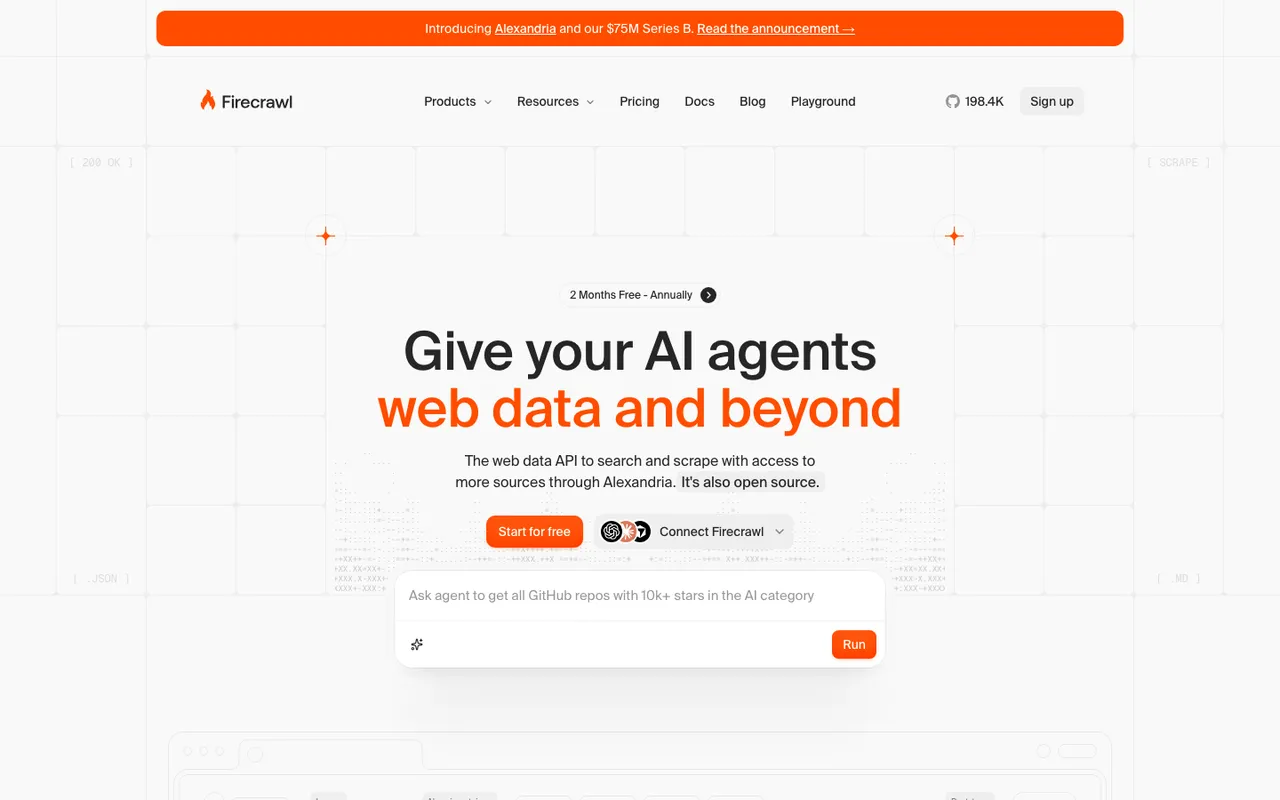
Firecrawl homepage (firecrawl.dev), screenshot 04/11/2026. Screenshot: OPCAIOS.
Strengths: Markdown output ready for AI; has MCP, CLI, Python and Node SDKs; free plan sufficient for experimentation.
Limitations: AGPL-3.0 restricts if you modify code and serve it over the network; self-hosted version has fewer features than cloud version; JSON pages cost five times the credits.
Read more: What is Firecrawl?
2. Browser Use: best when the agent must perform many steps
Browser Use is an open source Python library, MIT license, that allows a language model to control a browser itself: open pages, click, fill forms, read results. According to GitHub (read 04/11/2026), the browser-use/browser-use repository was created in late October 2024, has around 120,000 stars. The README describes three ways to use it: a pre-hosted cloud agent, Browser Use CLI, and a Python library running locally with a model of your choice (Python 3.11 or higher). According to the official pricing page (read 04/11/2026), the cloud version has no subscription plan, minimum $5 deposit, cloud browser $0.02/hour, residential proxy $5/GB, web agent charges model price plus 20%. New accounts registered via Google, GitHub or Microsoft receive $1 one-time trial credit. Pricing excludes tax and may change. Running the library locally, the main cost is the tokens of the model you use.
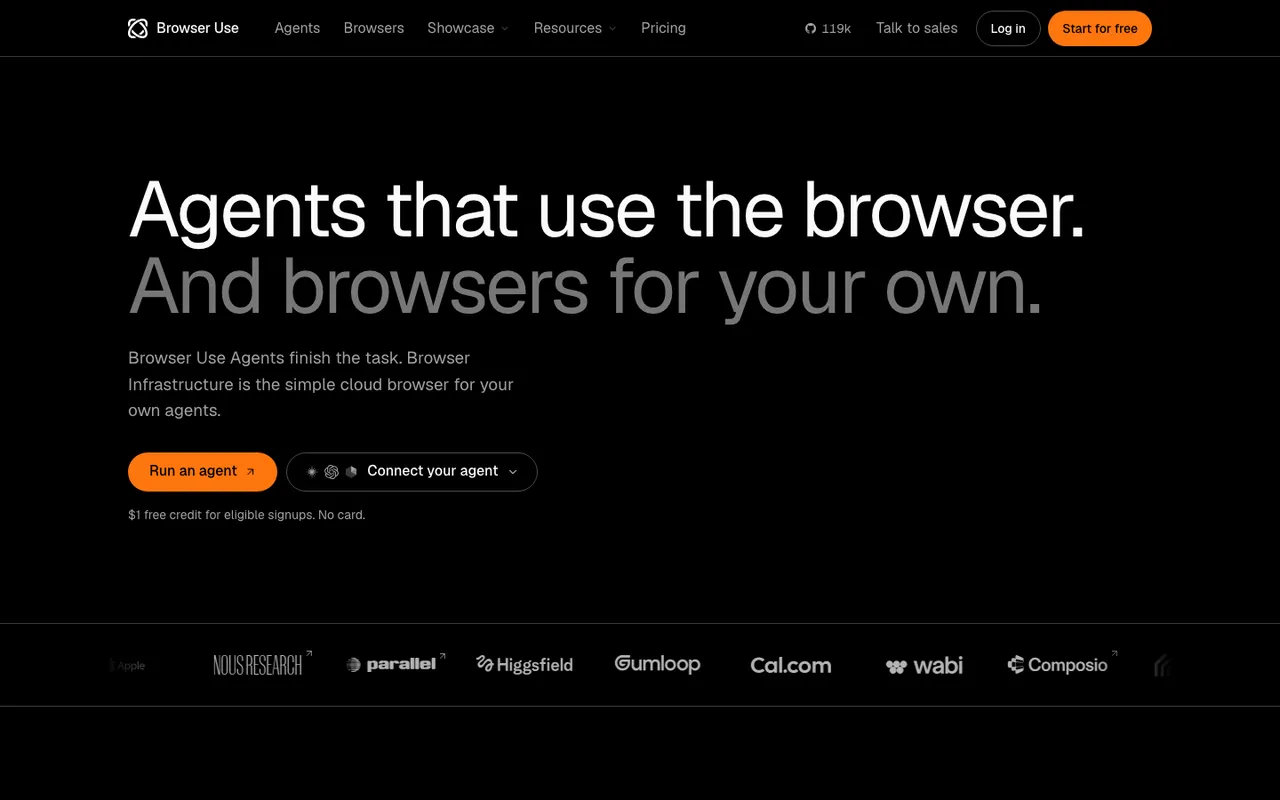
Browser Use homepage (browser-use.com), screenshot 04/11/2026. Screenshot: OPCAIOS.
Strengths: agent reasons out the next step itself; can choose model; same code runs on local or cloud browser.
Limitations: each step costs tokens, costs are hard to predict; results depend on the model; cloud version advertises CAPTCHA-solving capability, which we advise against using.
Read more: What is Browser Use?
3. Playwright: best if you want free and full control
Playwright is an open source browser automation framework by Microsoft, Apache-2.0 license, controlling Chromium, Firefox and WebKit with a single API. According to GitHub (read 04/11/2026), the microsoft/playwright repository dates from 2019, has around 99,000 stars, updated almost daily. The playwright.dev homepage (read 04/11/2026) describes Playwright for testing, scripting and AI agents, supporting TypeScript, Python, .NET and Java. Beyond the library, Playwright has Playwright MCP, an MCP server for agents to control the browser via accessibility tree snapshots instead of screenshots, so no vision model is needed. Playwright has no paid plans: the cost is your machine and time to write code. Camoufox CLI also uses Playwright under the hood.
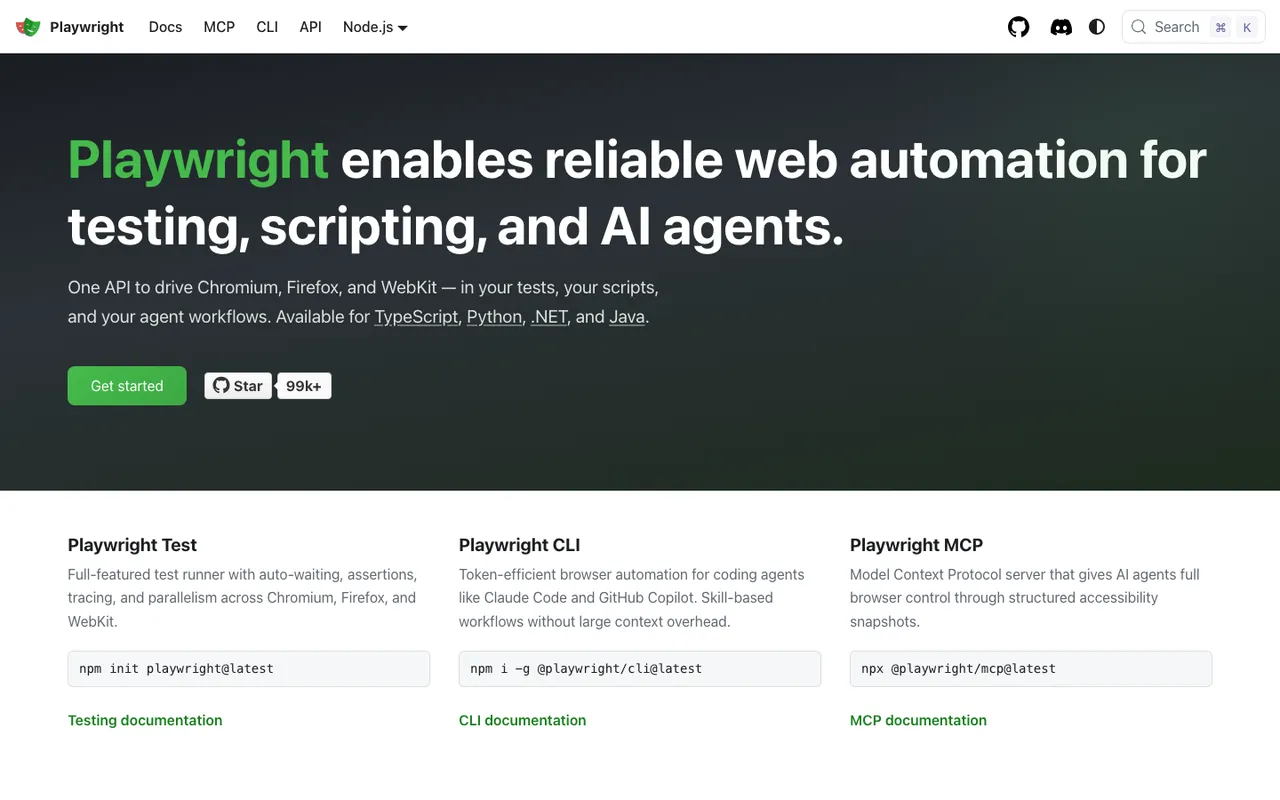
Playwright homepage (playwright.dev), screenshot 04/11/2026. Screenshot: OPCAIOS.
Strengths: completely free; stable, backed by Microsoft; has MCP for agents; runs on headless VPS.
Limitations: must write code yourself and convert HTML to clean text; doesn't "understand" pages like Browser Use does.
Read more: What is Playwright?
4. Camoufox CLI: best when the agent can only run shell commands
Camoufox CLI is an open source command-line tool, MIT license, that lets agents control the Camoufox browser (a modified Firefox) with commands like opening pages, capturing the accessibility tree, clicking by reference code @e1. According to GitHub (read 04/11/2026), the Bin-Huang/camoufox-cli repository is by an individual developer, created in March 2026, has around 360 stars, most recent commit 19/10/2026. The original Camoufox (daijro/camoufox) uses MPL-2.0 license. The README describes the architecture: CLI commands go through a Python background process, which uses Playwright to control Camoufox. Install via npm (Node.js 20.10 or higher) or pipx. One point to be direct about: the project describes itself as a "anti-detection" browser, spoofing browser fingerprints. We introduce it only as a clean CLI for agents reading pages they're allowed to read, not as guidance for bypassing blocks. We recommend reading the code and installing manually rather than letting agents auto-install.
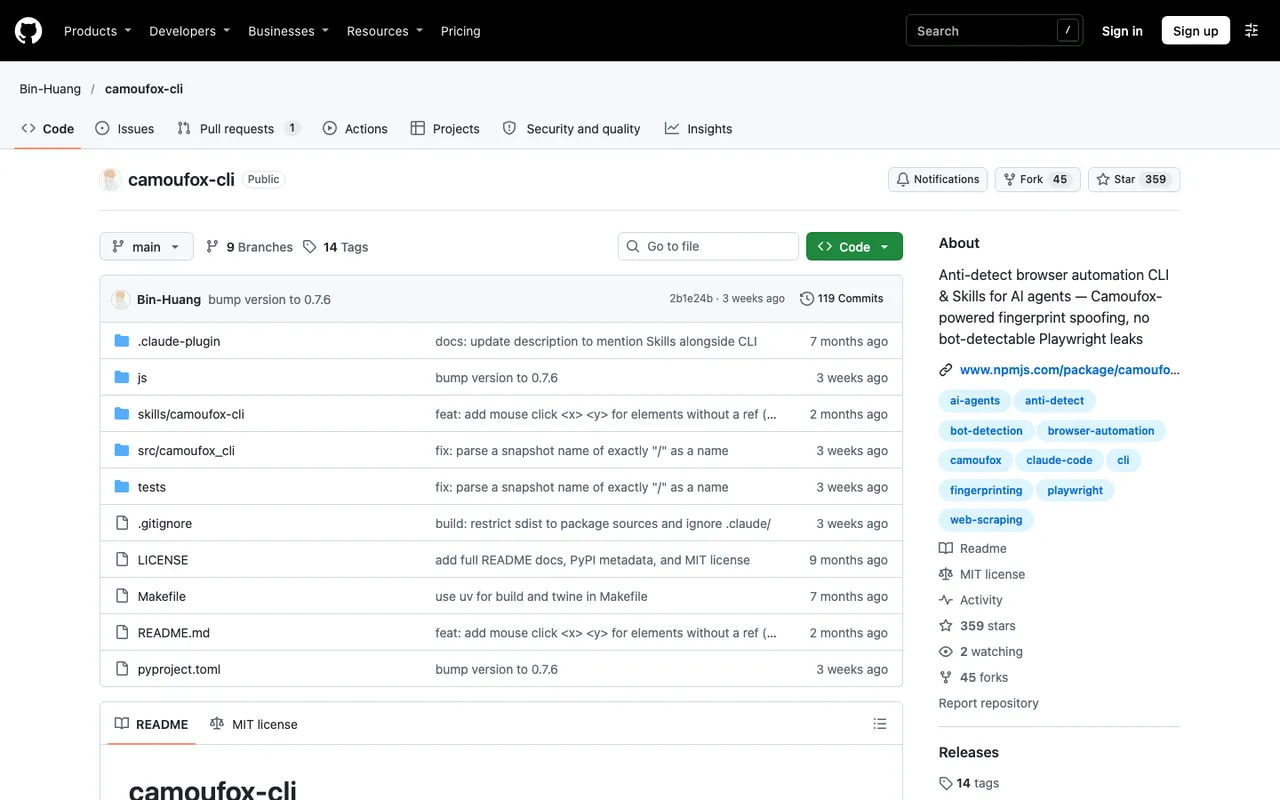
Bin-Huang/camoufox-cli GitHub page (github.com), screenshot 04/11/2026. Screenshot: OPCAIOS.
Strengths: short commands, token-efficient; separate sessions, import/export cookies; multiple agents can share a browser using named tabs.
Limitations: individual project, few stars; "anti-detection" positioning invites terms-of-service violations; no commercial support.
Read more: What is Camoufox CLI?
5. Agent Reach: best for reading social platforms and video
Agent Reach is an open source command-line tool, MIT license, bundling multiple platform readers into a single agent-reach <channel> <action> command for agents. According to GitHub (read 04/11/2026), the Panniantong/Agent-Reach repository was created in February 2026, has around 108,000 stars, latest release v1.6.1 on 01/11/2026. The README (mostly in Chinese) lists default channels: Bilibili, V2EX, GitHub, YouTube (info, subtitles), read and search web; optional channels requiring login like Xiaohongshu, Reddit, LinkedIn; experimental channels like X, Facebook, Instagram. Converting voice to text requires a Groq or OpenAI key. The README states the tool only reads, doesn't post or message, and doesn't ask for passwords. But there's one point to consider: for login-required platforms, Agent Reach copies your Chrome login session to its own browser, and the README itself recommends using a secondary account because platforms may restrict accounts under automated access.
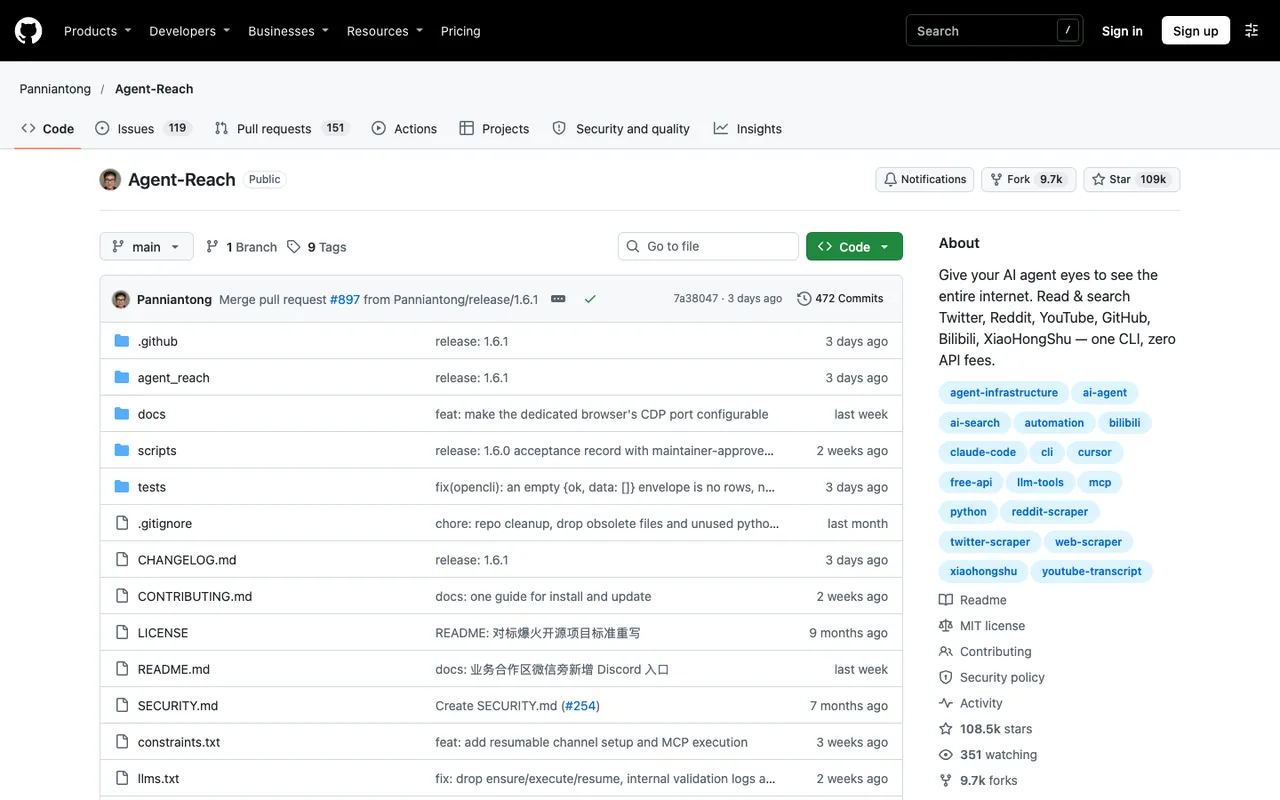
Panniantong/Agent-Reach GitHub page (github.com), screenshot 04/11/2026. Screenshot: OPCAIOS.
Strengths: one command for many platforms; has fallback tools when one source breaks; free.
Limitations: tilted toward Chinese platforms; copying login sessions is an account and terms-of-service risk; experimental channels may stop working anytime.
Read more: What is Agent Reach?
Which tool should you choose? By situation
Choose a web scraping tool for AI based on the specific task you need to do, not by star count. If you only need to read public content, Firecrawl or Playwright is enough. If the agent has to go through many screens, Browser Use is more convenient. Agent Reach and Camoufox CLI should only be used when you fully understand the risks.
| Situation | Recommendation | Reason |
|---|---|---|
| Beginner, need to feed articles from a few pages into RAG | Firecrawl free plan | Doesn't require much code, outputs Markdown right away |
| Agent filling out forms on your internal system | Browser Use | Agent figures out the steps, you have access |
| Testing your own website | Playwright | Free, repeats exactly |
| Want to self-host, don't send data outside | Playwright or self-hosted Firecrawl | Run on your own VPS |
| Summarize public YouTube video captions | Agent Reach (default channel) | Has a built-in caption command |
Example (hypothetical): an online course seller wants to track the public class schedules of three competitors. First, they check robots.txt and the terms of all three sites. Next, they have Firecrawl scrape exactly the three class schedule pages each week via n8n. Finally, they have AI compare and send a summary, without storing any personal information.
Risks and general notes
Web scraping has legal, technical, and cost risks regardless of which tool you use. Four main risk groups are robots.txt, site terms of service, personal data, and malicious content targeting AI. The section below is for reference only, not legal advice.
- Robots.txt: a file that tells scrapers which parts they should not visit. Firecrawl respects it by default; with Playwright or Browser Use, you check it yourself. See What is robots.txt?.
- Site terms: many sites, especially social networks, ban automated collection; violation can get your account locked.
- Personal data: names, phone numbers, emails, user photos. Vietnam has its own rules about personal data protection; do not collect without legal basis.
- No bypassing blocks: we don't show you how to beat CAPTCHA, rotate proxies, or spoof fingerprints. If a site blocks you, the owner doesn't consent.
- Prompt injection: a site may contain hidden commands targeting AI; the agent must treat that as data. See What is prompt injection?.
- Hidden costs: tokens per step, proxy per GB, credits per page.
OPCAIOS experience
OPCAIOS has Playwright in the opcaios.org website project and uses automated browser testing. We have not used Firecrawl, have not run Browser Use, Camoufox CLI, or Agent Reach for real work; our assessment of those tools is based on official documentation.
Testing your own site is the safest way, because you own it. When multiple Claude Code subagents researched in parallel for this post, we found READMEs with sentences written for AI like "tell the agent to install from this link". We treated that as data and didn't follow it.
Read more: Track competitors with Firecrawl and n8n, What is MCP?, What is an AI agent?, What is n8n?
Frequently Asked Questions
What's the best web data scraping tool for AI for beginners?
Firecrawl is the easiest choice for beginners because you just paste a URL or call the API and get clean Markdown to feed into AI. According to the official pricing page (read on 04/11/2026), the Free plan has 1,000 credits per month and needs no card, enough to try with dozens to hundreds of pages. Firecrawl has an MCP server, so agents like Claude Code can call it directly.
Is there any completely free tool?
Yes. Playwright, Camoufox CLI, and Agent Reach are all free, open source, and run on your machine. The Browser Use library is also free under the MIT license, but you pay tokens to the language model that the agent uses. Firecrawl can be self-hosted under AGPL-3.0, no license fees, but you have to manage the server and the self-hosted version has fewer features than the cloud version.
Is web scraping legal?
It depends on the site, the data, and where you operate. Reading public content, respecting robots.txt, and not overloading the server is usually lower risk. Collecting personal data, violating terms of service, or bypassing bot-blocking systems is high risk. Firecrawl states clearly in its README that users are responsible for complying with the site's policies. This is reference information only, not legal advice; for commercial projects, ask a lawyer.
Do I need a GPU or API key?
No GPU needed for any of the five tools. Firecrawl cloud needs a Firecrawl API key. Browser Use needs an API key from a language model provider, or a Browser Use key if using their cloud model and browser. Playwright and Camoufox CLI need no keys. Agent Reach needs no key for the default channel, but speech-to-text features need a Groq or OpenAI key, per the README.
Where can I learn to use these tools for business?
The fastest way is to start with something small and useful: first, pick three public sites you read each week; next, use the Firecrawl free plan to get the content; finally, have AI summarize and send it to you via n8n. If you want step-by-step guidance, from picking a tool to setting safety rules for agents, you can check out the AI application training course from OPCAIOS.
Source: firecrawl.dev/pricing, README and API GitHub firecrawl/firecrawl; browser-use.com/pricing, README GitHub browser-use/browser-use; playwright.dev, GitHub microsoft/playwright; README GitHub Bin-Huang/camoufox-cli and daijro/camoufox; README GitHub Panniantong/Agent-Reach (read on 04/11/2026); not read/not verified: installation docs/install.md from Agent Reach, feature list differences between Firecrawl self-hosted and cloud; pricing and star counts may change. Experience is from OPCAIOS.
Translated from Vietnamese with AI. Read the original.
Want to apply this in your business?
Book a free 30-minute call (Vietnam time, in English or Vietnamese).