


Which AI Voice Cloning Tool Should I Choose for Vietnamese?
Short answer: if you have a GPU and want to self-host, choose OmniVoice, because its official language list includes Vietnamese. If you're new and want a pre-installed app running on your machine, choose VoiceStudio (which uses OmniVoice by default). If you want a paid service without worrying about hardware, choose ElevenLabs as a benchmark. According to GitHub (read 04/11/2026), the k2-fsa/OmniVoice repository has 16,270 stars, Apache-2.0 license. There is no absolutely "best" tool. This post compares 7 tools by price, Vietnamese support, self-hosting, difficulty and update level, plus a mandatory section on ethics: only clone a voice with consent. We have not measured voice quality numerically.
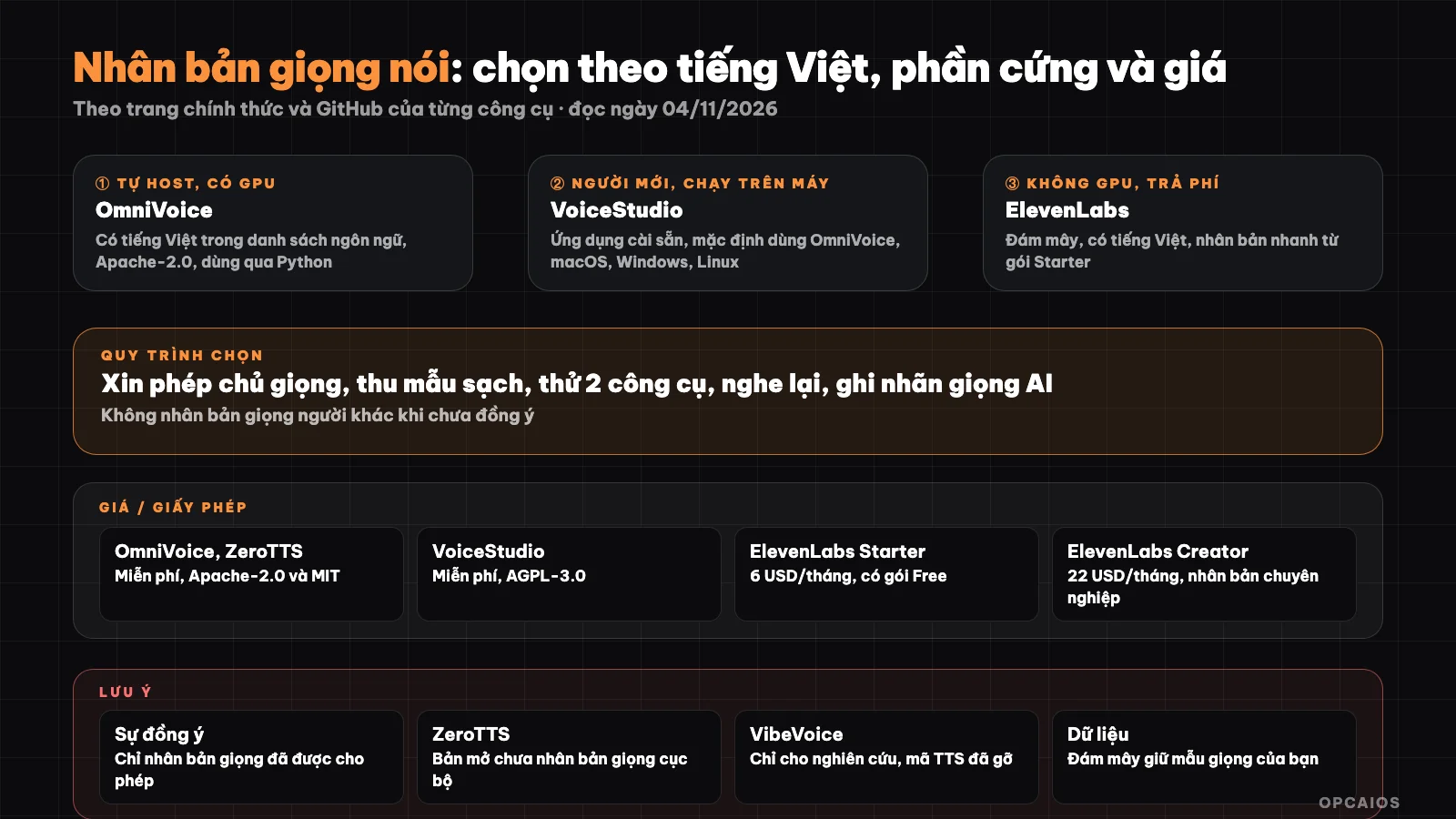
Map for choosing voice cloning tools by need, price and self-hosting level. Diagram: OPCAIOS.
Quick comparison table of 7 AI voice cloning tools
The seven tools include six open source projects and one paid service. Only OmniVoice, VoiceStudio and ElevenLabs have Vietnamese in the documentation and can clone voices right away. ZeroTTS specializes in Vietnamese but the open version does not yet clone locally; VibeVoice is for research, not production.

Logos of the tools in this post, taken from the official pages of each project.
| Tool | Best for | Starting price (read 04/11/2026) | Self-host | Vietnamese | Difficulty |
|---|---|---|---|---|---|
| OmniVoice | Self-host Vietnamese, has GPU | Free (Apache-2.0) | Yes | Yes in language list | Hard |
| VoiceStudio | Beginners, local app | Free (AGPL-3.0) | Yes | Yes (via OmniVoice) | Easy |
| ElevenLabs | Stable paid service | Free; Starter 6 USD/month | No | Yes | Easy |
| ZeroTTS | Vietnamese text-to-speech on CPU | Free (MIT) | Yes | Vietnamese specialist | Medium |
| Voicebox | Voice studio for AI agents | Free (MIT) | Yes | Not in README | Easy |
| Voice-Pro | Video voiceover on Windows | Free (GPL-3.0) | Yes | Not for cloning | Medium |
| VibeVoice | Research | Free (MIT) | Yes | Not for TTS | Hard |
What criteria did we use?
We chose based on five criteria, mainly from official documentation read 04/11/2026. Real experience we only have with OmniVoice, used in OPCAIOS's speaker video workflow. The other six tools we have not installed yet, so we do not give numerical scores.
- Vietnamese: we only mark "yes" when the official documentation lists it for voice generation.
- Real cloning: create a new voice from a recorded sample, or only use pre-made voices.
- Price and license: price does not include tax, may change.
- Hardware: needs GPU or runs on CPU.
- Updates and responsibility: date of latest code push, warnings against misuse.
Detailed evaluation of each tool
Each section lists who made it, license, data with source and read date, then strengths and limitations. GitHub stars only show the level of interest.
1. OmniVoice: best for Vietnamese if self-hosted
OmniVoice is a zero-shot voice cloning text-to-speech (TTS) model released by the k2-fsa team, licensed under Apache-2.0. According to the GitHub API (read on 04/11/2026), the k2-fsa/OmniVoice repository has 16,270 stars, created on 31/03/2026, with the latest code push on 02/11/2026. The README states OmniVoice supports over 600 languages; the official language list file includes Vietnamese (code vi). The model also has "voice design" by gender, age, pitch, and regional accent. The project claims speed roughly 40 times faster than real-time, unverified. Install via pip install omnivoice; the README provides guidance for NVIDIA GPU, Apple Silicon and Intel Arc. The Disclaimer section prohibits using the model to clone voices without authorization, impersonate or defraud.
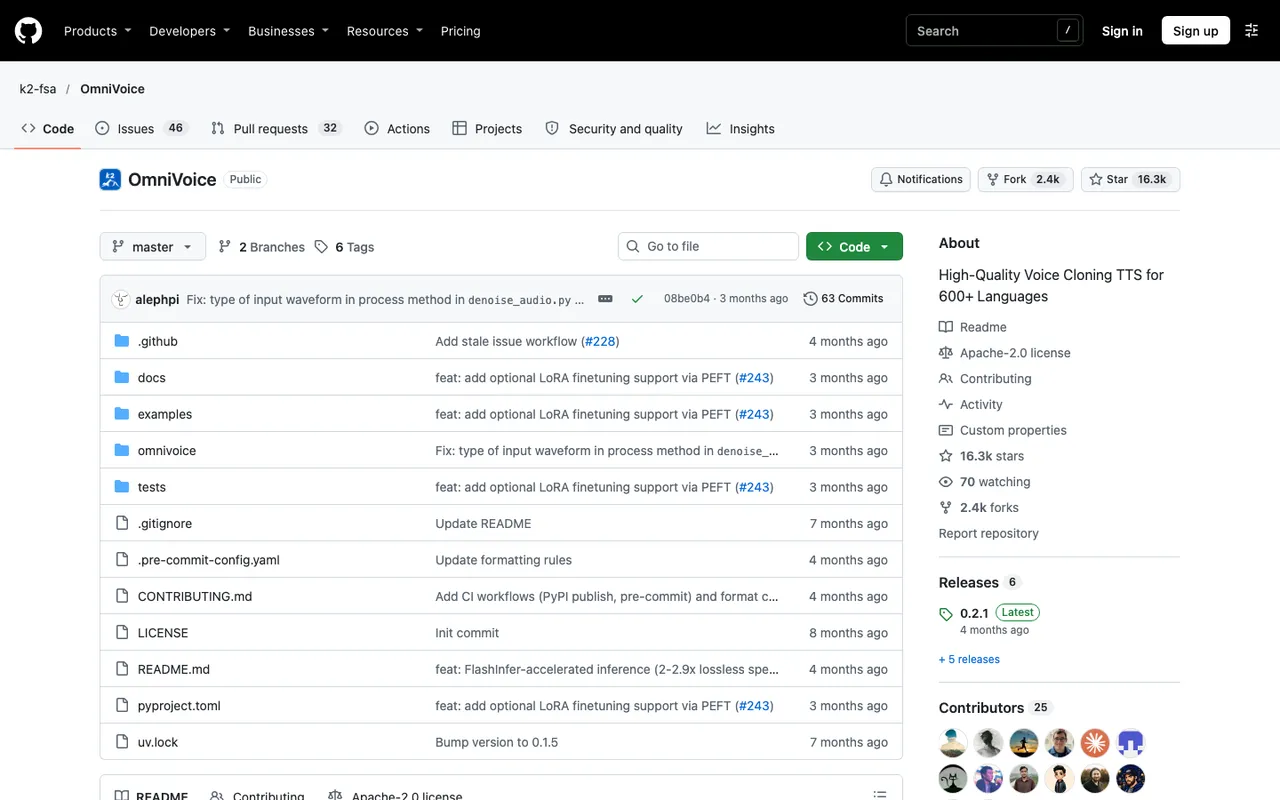
k2-fsa/OmniVoice GitHub page, screenshot on 04/11/2026. Screenshot: OPCAIOS.
Strengths: has Vietnamese, Apache-2.0, regularly updated.
Limitations: no ready-made interface for non-programmers. Runs best on GPU. Quality depends heavily on the sample recording.
Read more: What is OmniVoice?
2. VoiceStudio: best for beginners who want to run on their machine
VoiceStudio is a local voice studio application by debpalash, licensed under AGPL-3.0, self-described as a self-hosted alternative to ElevenLabs. According to the GitHub API (read on 04/11/2026), the debpalash/VoiceStudio repository has 100,304 stars, created on 09/04/2026, with code pushed on 04/11/2026. The README states the default engine is OmniVoice from k2-fsa, supporting 646 languages, including Vietnamese. The application combines voice cloning, voice design, dubbing, transcription and audiobook creation. Has builds for macOS 13.3+ (Apple Silicon), Windows 10/11 (CUDA, ROCm or CPU), Linux and Docker. The voicestudio.sh page states the open-source version is free, while a Pro version "coming soon" costs 99 USD/year or 199 USD; pricing excludes tax and may change.
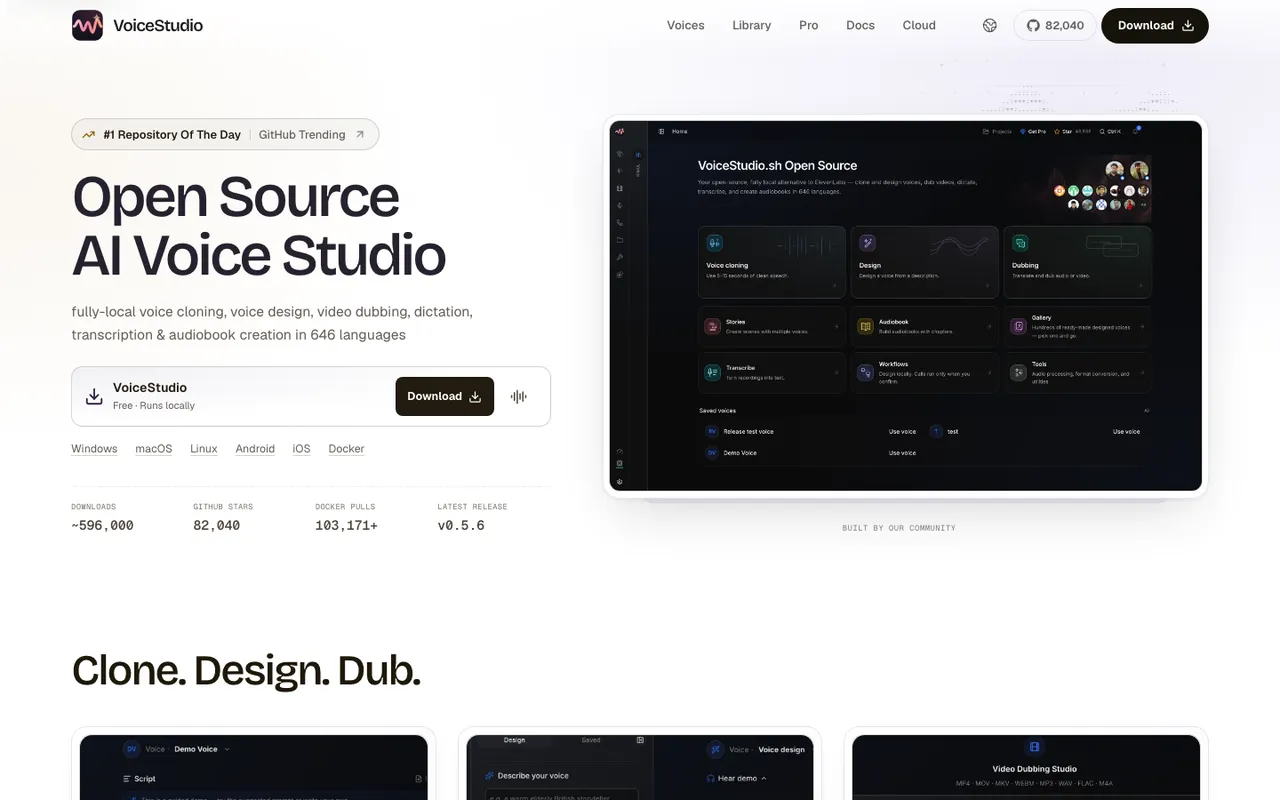
VoiceStudio homepage (voicestudio.sh), screenshot on 04/11/2026. Screenshot: OPCAIOS.
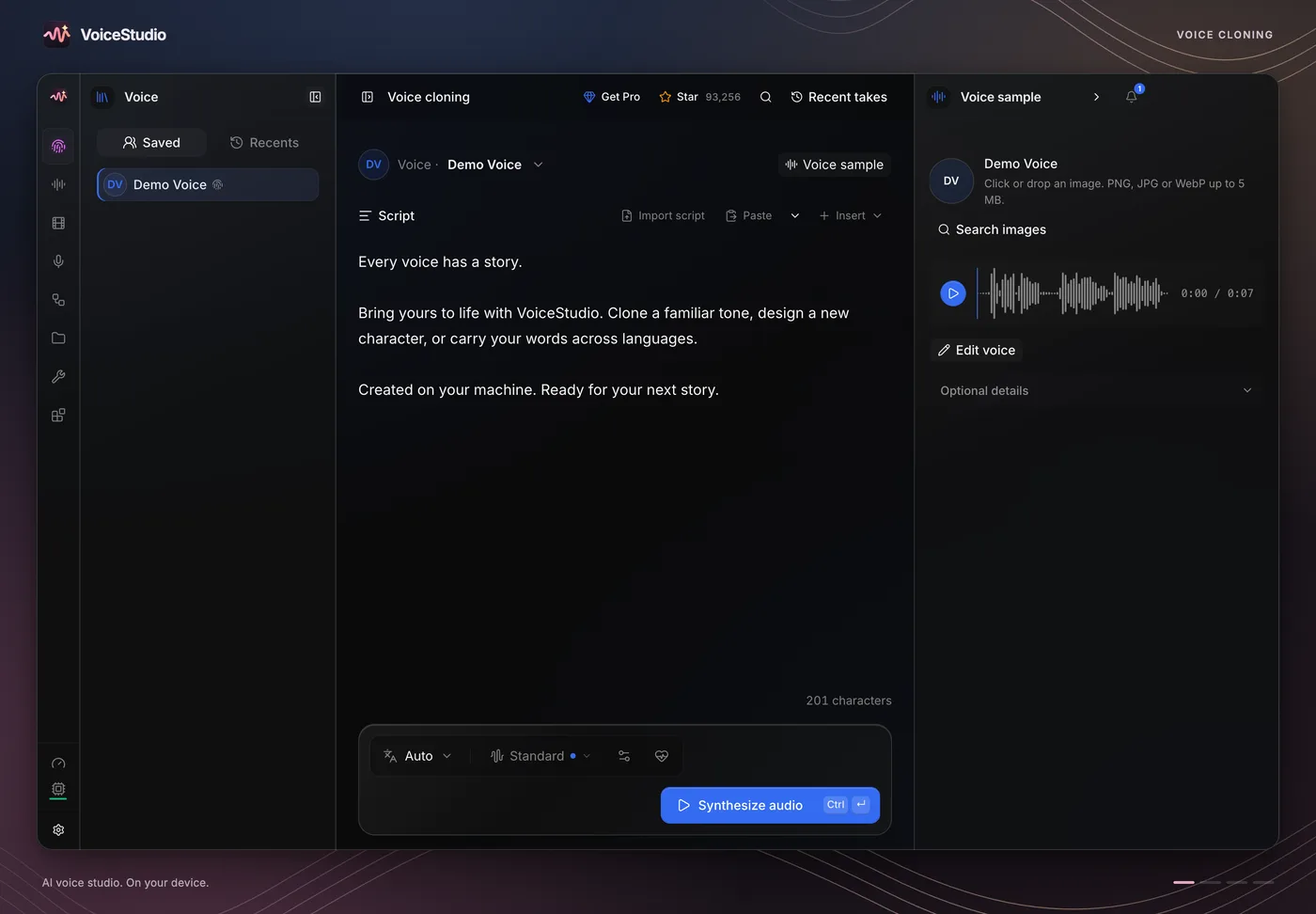
VoiceStudio interface. Image: debpalash/VoiceStudio GitHub README.
Strengths: install and use, has Vietnamese, voice stays on machine.
Limitations: AGPL-3.0 restricts you if you modify code and distribute over network. Very new project. Star count on homepage (82,040) differs from GitHub.
Read more: What is VoiceStudio?
3. ElevenLabs: best for stable paid service
ElevenLabs is a cloud-based AI voice service, closed-source, with fast (Instant) and professional (Professional) voice cloning. According to the pricing page elevenlabs.io (read on 04/11/2026), the Free tier at 0 USD has 10,000 credits per month. Starter tier at 6 USD/month (1 USD first month) has 30,000 credits and is the first tier with fast voice cloning. Creator tier at 22 USD/month (11 USD first month) adds professional cloning. The pricing page states commercial license starts with Starter, but the voice-cloning page states commercial use rights start "with Creator tier"; the two pages don't match. Pricing excludes tax and may change. The model documentation lists Vietnamese, for example in Flash v2.5. The voice-cloning page mentions a verification step to confirm you have rights to clone the voice.
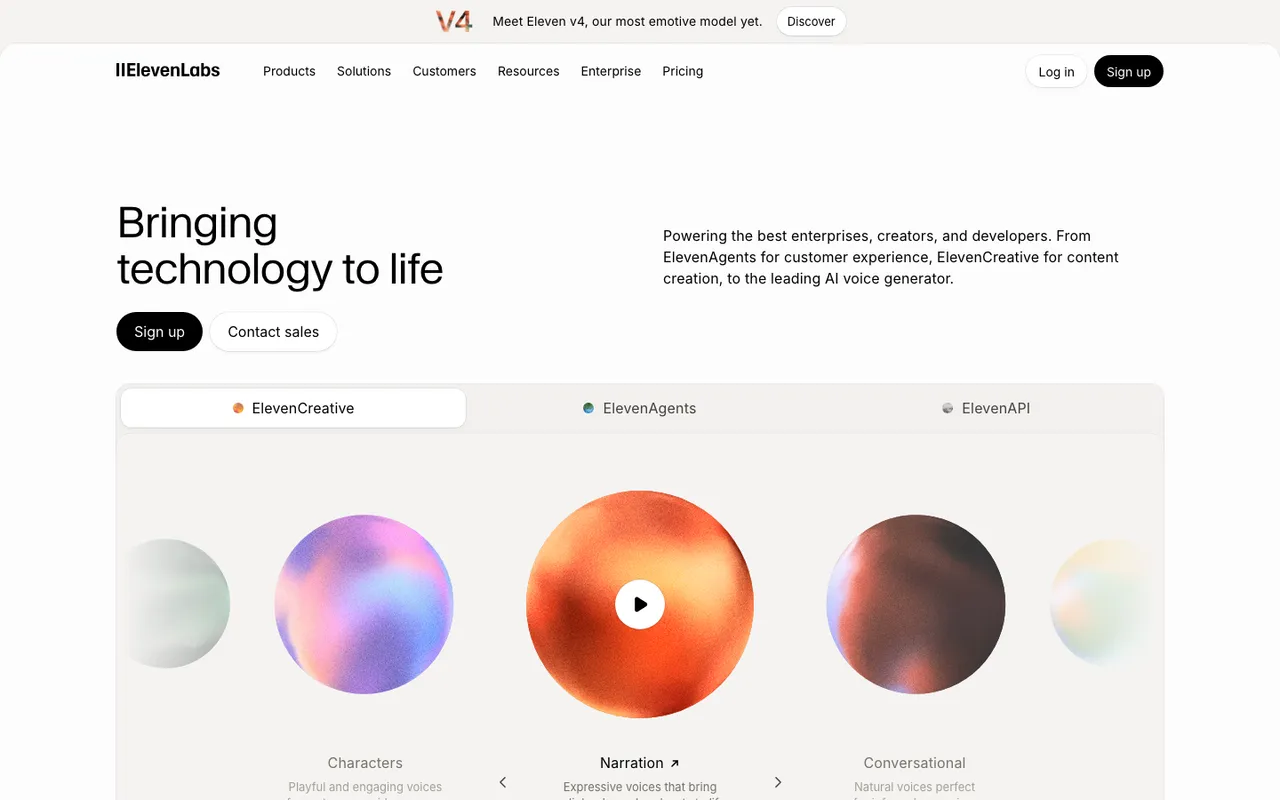
ElevenLabs homepage (elevenlabs.io), screenshot on 04/11/2026. Screenshot: OPCAIOS.
Strengths: no GPU needed, has Vietnamese, verification step for cloned voice rights.
Limitations: voice samples uploaded to cloud. Cost increases with character count. Commercial terms inconsistent between pages.
4. ZeroTTS: best for Vietnamese voice reading running on CPU
ZeroTTS is a text-to-speech model specialized for Vietnamese by zeroweight-ai, code and weights under MIT license. According to the GitHub API (read on 04/11/2026), the zeroweight-ai/ZeroTTS repository has 320 stars, created on 15/08/2026, with latest code push on 17/09/2026. The README states ZeroTTS runs faster than real-time on laptop CPU, weights around 900 MB, can read numbers and English words mixed in. The project self-reports fewer errors by over 4 times than the baseline open model, unverified. Importantly: the README clearly states the release has no voice cloning feature because the voice encoder is not released. To clone, you must upload your sample to platform.zeroweight.ai. We have not read the pricing for this platform.
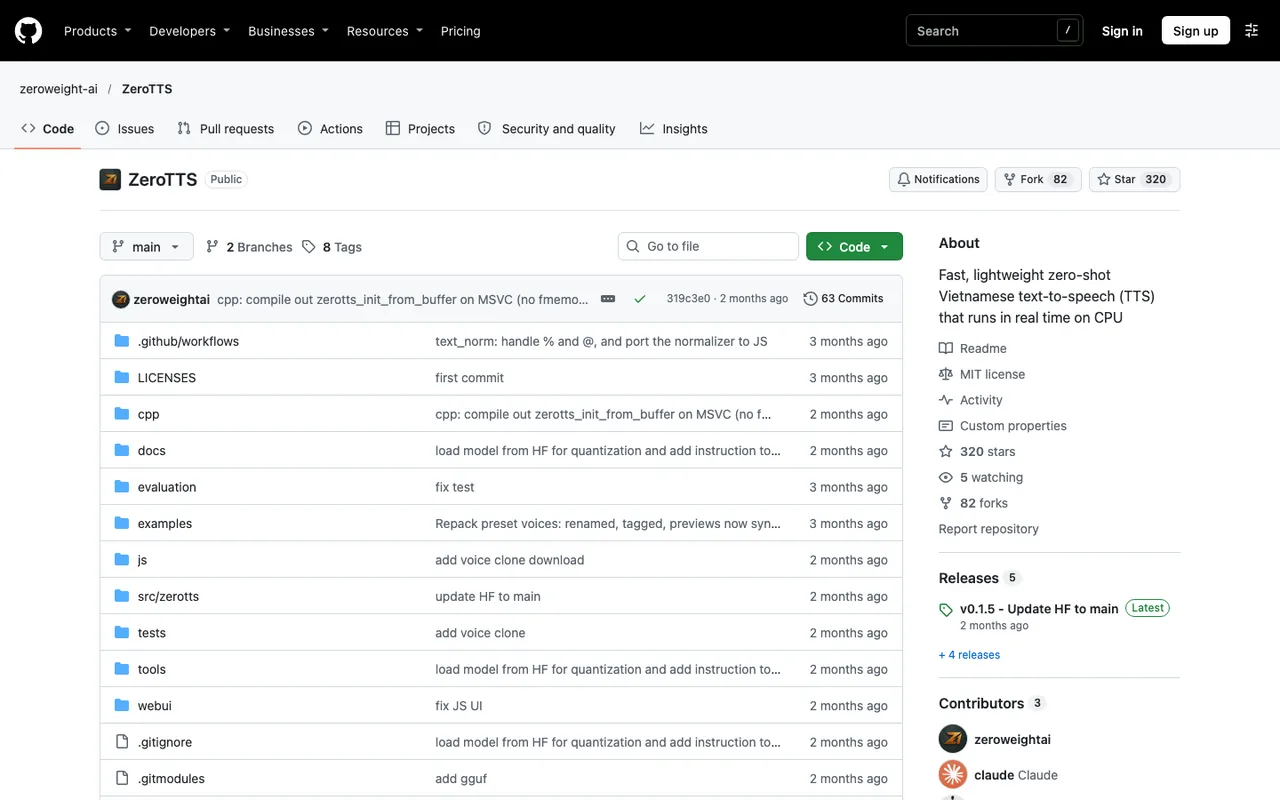
zeroweight-ai/ZeroTTS GitHub page, screenshot on 04/11/2026. Screenshot: OPCAIOS.
Strengths: built for Vietnamese, runs on CPU, install with pip install zerotts, has browser version.
Limitations: no local voice cloning. New project, few stars, few users to verify.
Read more: What is ZeroTTS?
5. Voicebox: best for voice studio integrated with AI agents
Voicebox is a local voice studio by jamiepine, licensed under MIT, self-described as an open alternative to both ElevenLabs and Wispr Flow in one application. According to the GitHub API (read on 04/11/2026), the jamiepine/voicebox repository has 59,381 stars, with latest code push on 07/10/2026. The README lists 8 TTS engines (Qwen3-TTS, Chatterbox, LuxTTS, Kokoro, HumeAI TADA...), voice cloning from a few seconds of audio and 23 languages. Voicebox also has speech-to-text based on Whisper and an MCP server for agents like Claude Code to speak with your created voice. Has builds for macOS, Windows and Docker; Linux requires self-building. Note: the README does not list Vietnamese among the voice generation engines.
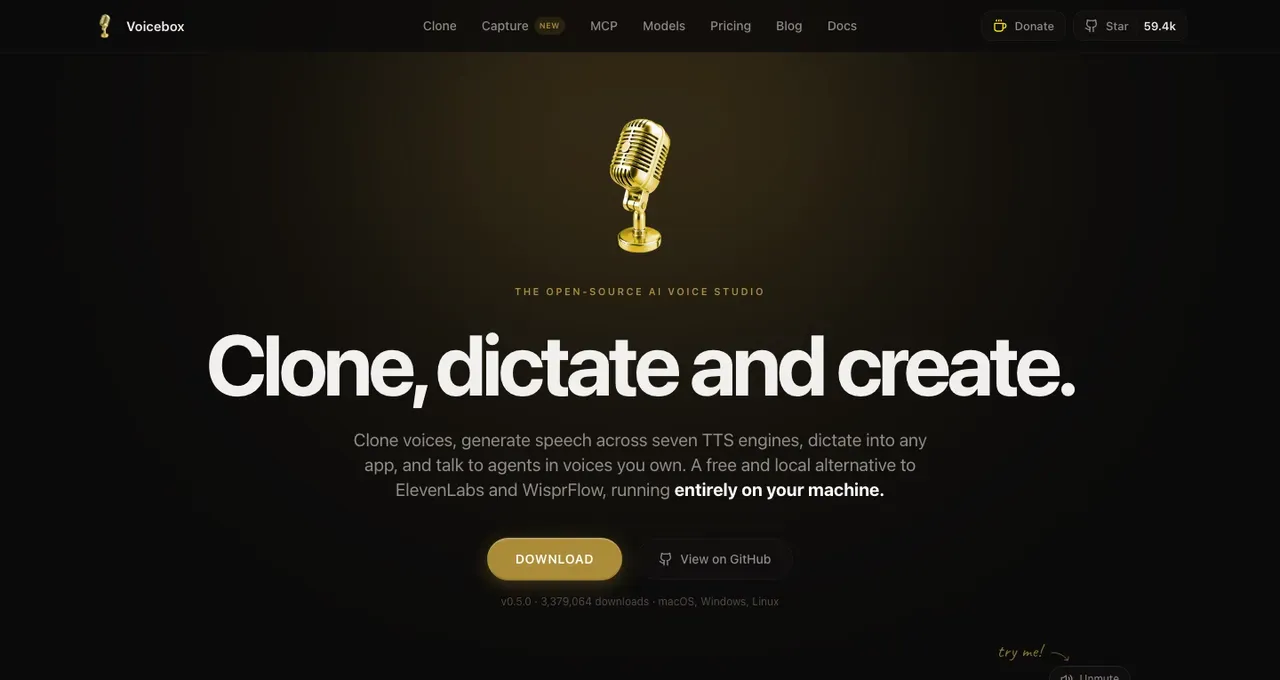
Voicebox homepage (voicebox.sh), screenshot on 04/11/2026. Screenshot: OPCAIOS.
Strengths: clean interface, many engines, integrates with AI agents via MCP.
Limitations: no Vietnamese documented in materials. Official demo images use voice profiles with real names; don't copy this without permission.
Read more: What is Voicebox?
6. Voice-Pro: best for video dubbing on Windows
Voice-Pro is a Gradio web application by ABUS group, combining YouTube video loading, voice separation, transcription, translation and text-to-speech. According to the GitHub API (read on 04/11/2026), the abus-aikorea/voice-pro repository has 13,397 stars, with latest code push on 13/07/2026; the LICENSE file is GPL-3.0, though metadata in the README states LGPL. Voice cloning uses F5-TTS, E2-TTS and CosyVoice; transcription uses Whisper. The README states the application runs well on Windows with NVIDIA GPU, unverified on Mac and Linux. More importantly, the README announces the team is temporarily pausing development and updates to Voice-Pro to focus on other products, while open-sourcing the entire codebase. The language list for the cloning model does not include Vietnamese.
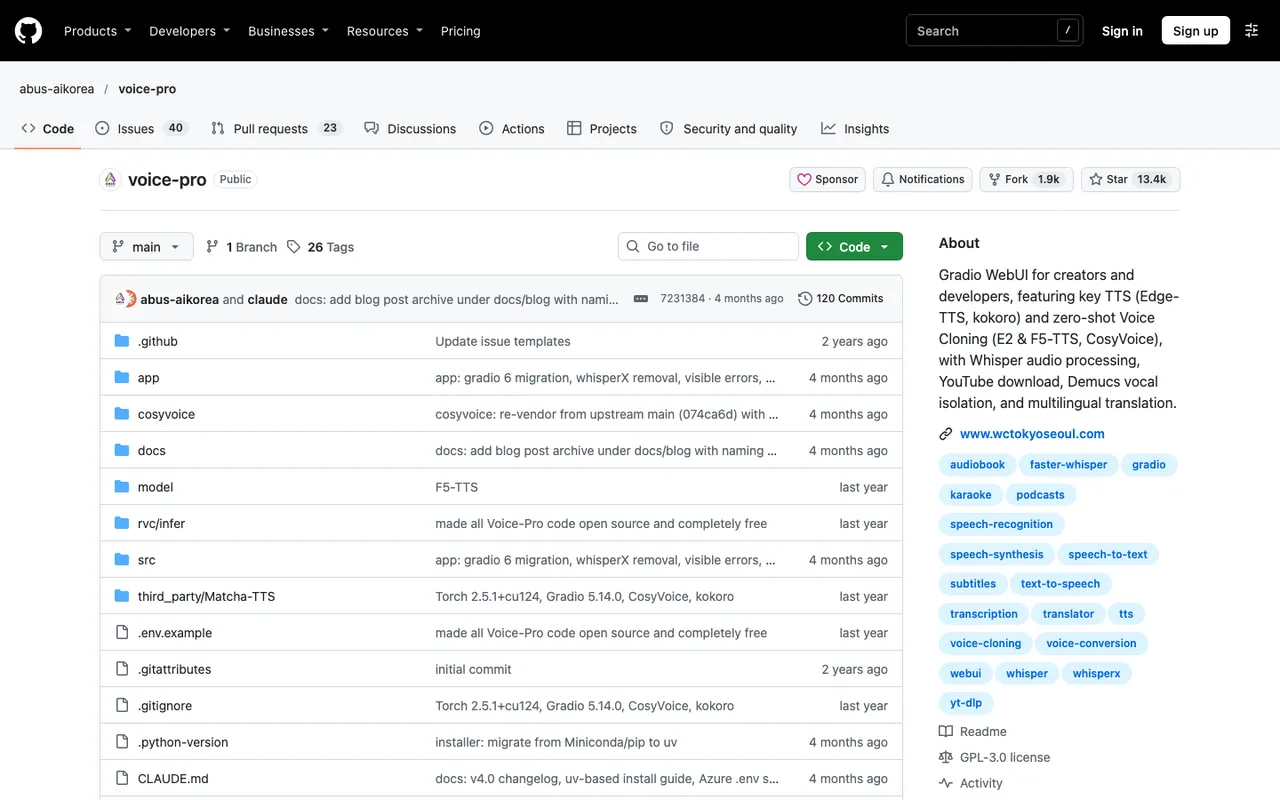
abus-aikorea/voice-pro GitHub page, screenshot on 04/11/2026. Screenshot: OPCAIOS.
Strengths: complete dubbing workflow in one interface, one-time install on Windows.
Limitations: development paused. No Vietnamese for voice cloning.
Read more: What is Voice-Pro?
7. VibeVoice: best for research, not production
VibeVoice is a family of open-source voice models by Microsoft, licensed under MIT, including text-to-speech (TTS) and speech-to-text (ASR) models. According to the GitHub API (read on 04/11/2026), the microsoft/VibeVoice repository has 55,136 stars, with latest code push on 08/10/2026. The README states VibeVoice-TTS generates conversations up to 90 minutes with up to 4 speakers, supporting English, Mandarin and some other languages. But on 05/09/2025, Microsoft noted it removed VibeVoice-TTS code from the repository after discovering the tool was misused. The README cautions against using VibeVoice for commercial applications without further testing due to deepfake risks. The VibeVoice-ASR section has Vietnamese, but that is transcription, not voice cloning.
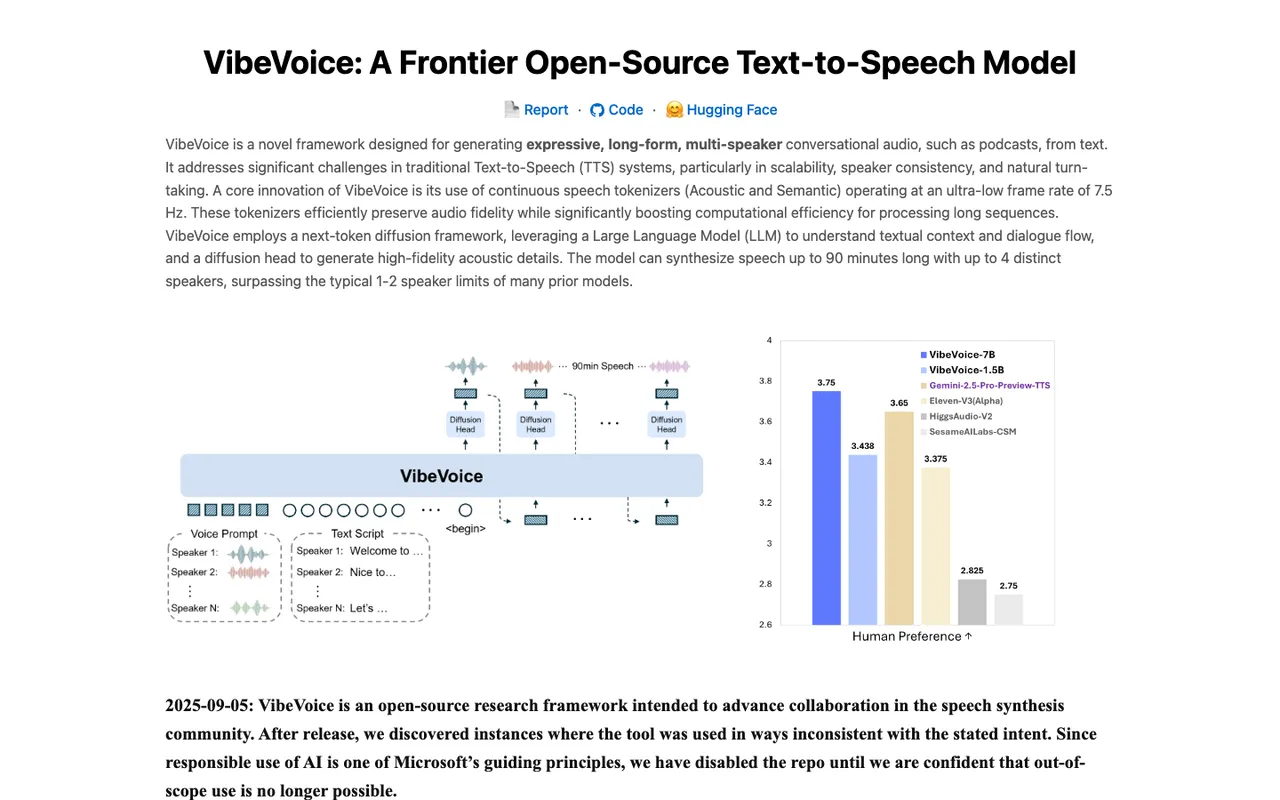
VibeVoice homepage (microsoft.github.io), screenshot on 04/11/2026. Screenshot: OPCAIOS.
Strengths: has technical reports, frank about risks.
Limitations: not for production. TTS has no Vietnamese. TTS code removed from repository.
Read more: What is VibeVoice?
Which Tool to Choose? Depending on Your Situation
I choose an AI voice cloning tool based on the hardware I have and my comfort level with sending voice samples to the cloud. The table below suggests the main choices for each common situation of solo content creators, according to official documentation.
| Situation | Suggestion | Reason |
|---|---|---|
| Clone my own voice for video, I have GPU | OmniVoice | Has Vietnamese, self-hosted |
| Don't know programming, want to run on my machine | VoiceStudio | Pre-installed application |
| No GPU, willing to pay | ElevenLabs | Cloud-based, has Vietnamese |
| Need pre-made Vietnamese reading voice, run on CPU | ZeroTTS | Specialized for Vietnamese, no GPU needed |
| Want AI character to speak in my own English voice | Voicebox | Has MCP server |
| Dub foreign videos on Windows | Voice-Pro | Combines voice separation, translation, voice creation |
Example (hypothetical): an online teacher wants to make 20 short videos in their own voice. First, record 1 minute of voice in a quiet room. Next, use VoiceStudio to create voice from script. Finally, listen back, fix mispronounced words and label the AI voice.
Ethics: Only Clone Voice With Consent
I should only clone my own voice, or the voice of someone who has clearly agreed, ideally in writing. This is a common principle of the projects themselves: OmniVoice bans unauthorized cloning and impersonation, Microsoft removed VibeVoice-TTS code due to abuse, ElevenLabs verifies permission before cloning.
- Ask first: clearly state the purpose, where it will be used, the duration; the person has the right to withdraw consent.
- No impersonation: don't create the voice of celebrities, colleagues, relatives.
- Label it: let listeners know it's an AI voice.
- No fraud: faking someone's voice to borrow money or confirm transactions is fraud.
Risks and General Notes
Besides ethics, voice cloning has risks around data, licensing, and costs. Voice samples are sensitive data; if leaked, bad actors can recreate your voice. The content below is for reference only, not legal advice.
- Personal data: voice can be considered personal data; cloud services keep voice samples on their servers.
- License: AGPL-3.0 and GPL-3.0 require sharing code when distributing; internal models may have separate terms.
- Commercial terms: carefully read which plan allows commercial use.
- Hidden costs: free code still needs GPU and several GB to store the model.
Read more: 5 data security rules for business when using AI.
OPCAIOS Experience
I use OmniVoice to clone the Vietnamese voice of my own operator in the talking-head video workflow, running on rented GPU servers. Lip-sync uses InfiniteTalk on Wan 2.1 via ComfyUI or LatentSync. I haven't measured quality by numbers.
Three takeaways. First, the output voice sounds quite natural when the sample is clean, no reverb, no background music. Next, a poor sample produces poor voice. Finally, only use your own voice. The other six tools I haven't used for real work yet.
Read more: Best AI tools to create talking-head videos, Best speech-to-text tools, Voice AI agent confirms orders, What is Remotion?
Frequently Asked Questions
The five questions below are what readers often ask when choosing a Vietnamese voice cloning tool. The answers are based on official documentation read on 04/11/2026 and OPCAIOS's real experience with OmniVoice; we do not measure quality by numbers.
Which AI voice cloning tools support Vietnamese?
According to official documentation read on 04/11/2026: OmniVoice has Vietnamese in its language list; VoiceStudio uses OmniVoice as the default engine; ElevenLabs lists Vietnamese in model documentation. ZeroTTS is made specifically for Vietnamese but its open version does not clone voices locally—you have to go through the company's platform. Voicebox, Voice-Pro, and VibeVoice's TTS part do not list Vietnamese.
Are there free voice cloning tools?
Yes. OmniVoice (Apache-2.0), VoiceStudio (AGPL-3.0), Voicebox (MIT), Voice-Pro (GPL-3.0), and ZeroTTS (MIT) are all free software. You still pay for hardware, especially GPU, or rent GPU servers by the hour. ElevenLabs has a free plan of 10,000 credits per month but voice cloning fast starts from the Starter plan at 6 USD/month (read on 04/11/2026, not including tax).
Does voice cloning need GPU?
It depends on the tool. OmniVoice and Voice-Pro run best on GPU; Voice-Pro's README clearly states it runs well on Windows with NVIDIA GPU. VoiceStudio has CPU mode on Windows and Linux, Metal mode on Mac. ZeroTTS runs on CPU but does not clone locally. ElevenLabs runs on the cloud so no GPU needed. OPCAIOS runs OmniVoice on a rented GPU server.
Is cloning someone else's voice legal?
We do not provide legal advice. The safety principle is to clone only your own voice or the voice of someone who has clearly agreed in writing, stating the purpose and duration. The projects themselves also ban misuse: OmniVoice forbids unauthorized cloning and impersonation, Microsoft removed VibeVoice-TTS code because it was misused. Impersonating to commit fraud is against the law.
Where should a beginner start voice cloning?
First, record a sample of your own voice, clean, no background music. Next, try VoiceStudio if you don't know programming, or OmniVoice if you know Python and have GPU. Then listen back, fix mispronounced words, and label the AI voice when you post. Finally, add the voice you created to your video or course workflow. If you want to learn systematically, you can check out OPCAIOS's AI application training course.
Sources: github.com/k2-fsa/OmniVoice, github.com/debpalash/VoiceStudio and voicestudio.sh, elevenlabs.io/pricing, elevenlabs.io/voice-cloning and ElevenLabs model documentation, github.com/zeroweight-ai/ZeroTTS, github.com/jamiepine/voicebox, github.com/abus-aikorea/voice-pro, github.com/microsoft/VibeVoice (read on 04/11/2026); not read/not verified: voice quality in Vietnamese of all tools, platform.zeroweight.ai pricing, Voice-Pro LICENSE file, exact commercial terms of ElevenLabs; prices and ratings may change. Experience is OPCAIOS's.
Translated from Vietnamese with AI. Read the original.
Want to apply this in your business?
Book a free 30-minute call (Vietnam time, in English or Vietnamese).