


What is erxes?
erxes is an open-source self-hosted platform developed by erxes Inc., calling itself an "Experience Operating System" (XOS): it combines CRM, multi-channel mailbox, sales workflow, automation, knowledge base and many industry-specific modules into a plugin-architecture system, aiming to replace HubSpot, Zendesk or Linear. According to GitHub API (read on 04/11/2026), the erxes/erxes repository has 4,108 stars, 1,331 forks, written in TypeScript, created on 11/11/2016, most recent code push on 03/11/2026, version 3.4.10 released the same day; core licensed under AGPLv3, some plugins under Enterprise license. The page erxes.io/pricing (read on 04/11/2026) lists the "Everything" package at 99 USD/month. This article starts with product structure, then pricing and licensing, then installation, finally when to use it.
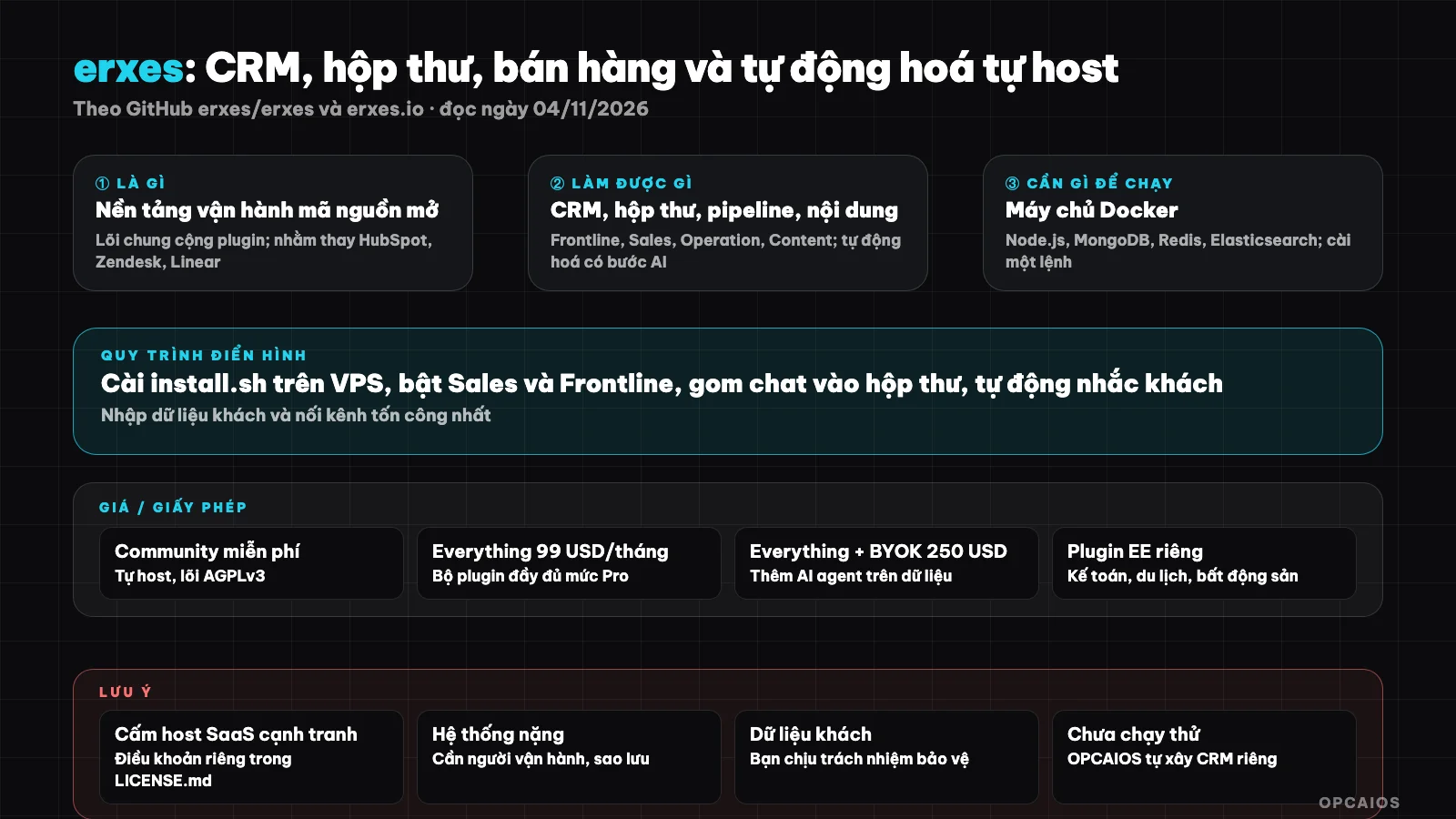
erxes comprises a shared core and attached plugins, self-hosted via Docker or run from source code. Diagram: OPCAIOS.
What is erxes and who created it?
erxes is an open-source business operating platform that bundles marketing, sales, customer care and operations tools into a system with a shared core and attached plugins. Users install it on their own server and only enable the modules they need.
The project belongs to erxes Inc. (the name always written lowercase per their convention), started on GitHub from November 2016, that is nearly 10 years as of 04/11/2026. The README (read on 04/11/2026) describes erxes as targeting SaaS providers, digital marketing agencies and developers who want to build products on an existing platform. The structure consists of two layers: first is the core, included with every installation, comprising mailbox, contacts (CRM), products, customer segments, automation and documents; next are plugins installed from the app marketplace like Frontline (multi-channel conversation, ticketing), Sales (lead capture via form, landing page, pop-up), Operation (tasks, cycles, team resources) and Content (headless website, e-commerce, knowledge base). Finally there are industry-specific plugin groups like Accounting, Tourism, Property, Team, Finance, labeled as Enterprise license only. The erxes.io page (read on 04/11/2026) emphasizes "AI-native" direction: AI agents connected via MCP, CLI or REST API, using your own model keys (OpenAI, Anthropic or self-hosted models). If unfamiliar with the concept, see What is CRM?.
What can erxes do?
erxes does what a combined HubSpot plus Zendesk plus typical task management tool usually does: manage customers, answer multiple channels in one mailbox, run sales pipeline, automate by conditions, and publish content and knowledge base.
According to README and erxes.io (read on 04/11/2026):
| Group | What it can do |
|---|---|
| Core | Customer and company contacts, products, segments, automation flows, documents |
| Frontline | Shared multi-channel mailbox, ticketing, tasks for support teams; AI suggests answers |
| Sales | Pipeline, forms, landing pages, pop-ups, embed in website; AI compose follow-up emails |
| Operation | Tasks, cycles, team resources, Linear-like |
| Content | Headless website, e-commerce, scheduling, knowledge base, help center |
| Automation | Drag-drop flows, with AI steps to classify, summarize, draft, decide (per erxes.io) |
| Industry plugins (EE) | Accounting and payroll, tourism, real estate, HR, banking |
| Extend | Create own plugins with pnpm create-plugin; customer portal, POS, Next.js widget |
The erxes.io page cites numbers on self-service rates or win rate increases; these are company-disclosed figures, not verified, so we don't quote them. Underlying technology per README: Node.js, TypeScript, Express, Apollo Server, tRPC, GraphQL Federation, MongoDB, Redis, BullMQ, Elasticsearch; interface React 18, micro-frontend, Tailwind 4.
Does erxes have a free version? Price, license and limits
erxes has a free Community edition for self-hosting, and monthly paid plans for full plugin bundles; the core is under AGPLv3 while Enterprise plugins have a separate license. Prices below are from erxes.io/pricing as of 04/11/2026, before tax, and subject to change.
| Plan / License | Details |
|---|---|
| Community | Free, self-hosted, open source; pricing page does not state specific limits |
| Everything | 99 USD/month: Sales, Frontline, Operation, Content, Loyalty, Accounting, Mongolian, Payment at Pro tier |
| Everything + BYOK | 250 USD/month: adds erxes Assistant Pro and AI agent on workspace data; "BYOK" is not defined on the pricing page |
| Enterprise, Embed, Platform, Infrastructure, Self service | Listed, no price shown |
| Core License | AGPLv3 (LICENSE.md): if you modify code and provide it over the network, you must open the modified part |
| EE License | Plugins with -ee suffix in the ee/ directory under a separate license in ee/LICENSE |
| Special Terms | LICENSE.md states erxes may not be hosted as a SaaS to compete with erxes Inc. |
Hidden costs of the free version: a server powerful enough to run MongoDB, Redis, Elasticsearch and many Node services (see What is a VPS?), maintenance time, and API keys for AI model if you turn on AI features. The pricing page does not clearly say whether the "Everything" plan is a service hosted by erxes or a license for self-hosting; we have not confirmed this. GitHub API marks the license as "NOASSERTION" because the license file is a combination, not a single standard license.
How do I install erxes?
erxes has three ways to install: a one-command Docker setup, installation on a server with a domain and automatic HTTPS, and running from source for developers. The fastest way according to the README (as of 04/11/2026) is a one-command install script, no source code or Node.js needed:
- First, install Docker on your machine (see What is Docker?).
- Next, run the install script:
curl -fsSL https://raw.githubusercontent.com/erxes/erxes/main/scripts/install.sh | bash
Then open http://localhost:3000. The pattern of "download script then run it immediately" gives the script power on your machine; read the script first, especially on a real server.
3. Install on a server with a domain:
curl -fsSL https://raw.githubusercontent.com/erxes/erxes/main/scripts/install.sh | bash -s -- --domain crm.example.com --plugins sales,frontline
Run the command again to upgrade or change plugins.
4. Finally, the way for developers: clone the repo, pnpm install, copy .env.example to .env, then run pnpm dev:core-api, pnpm dev:apis, pnpm dev:uis; the app is at http://localhost:3001. Requires Node.js 18 or later, pnpm 8 or later, MongoDB and Redis running.
We have not tested it ourselves; the steps above follow the official documentation. For a solo worker, the most time-consuming step is not installation but importing existing customer data and setting up channels.
Limits, risks, security and legal matters when using erxes
The risks of erxes lie in operational complexity, the AGPLv3 license with anti-SaaS terms, and you becoming responsible for your customers' personal data.
- System heaviness. A full erxes setup includes many Node services, MongoDB, Redis, Elasticsearch and micro-frontends. The repo has 964 open issues per GitHub API (as of 04/11/2026). A solo worker has to handle backups, updates and monitoring themselves.
- License. AGPLv3 requires you to open the code you modify if you provide it as a service over the network; using it unmodified internally runs into fewer issues. The term "may not host as a SaaS competing with erxes Inc." is a separate condition outside AGPL; if you want to sell a service based on erxes, ask a lawyer and erxes. This is for reference, not legal advice.
- Personal data. A CRM holds customer names, phone numbers, chat history. Self-hosting means you are responsible under Vietnam's personal data protection rules and GDPR if you have European customers; we have not cross-checked the originals. Turn on HTTPS, limit permissions, backup with encryption. See 5 data security rules when using AI.
- AI features. When you turn on AI reply writing or agents via MCP, customer conversation content goes to your model provider by your key; erxes.io says it masks identifiers and keeps audit logs, but we have not verified.
- Third-party channels. Connecting Facebook Messenger, Zalo or email must follow each platform's API terms; respect anti-spam rules when automating.
erxes versus other options
erxes is broader than most open-source CRMs because it combines email, website and operations, in exchange it is heavier. The table below is a general description, not a measurement:
| Option | Features | Good for |
|---|---|---|
| erxes | Core + plugins: CRM, email, sales, content, operations; AGPLv3 + EE | Want one system to replace multiple tools, have someone to operate it |
| Twenty CRM | Pure open-source CRM; see What is Twenty CRM? | Just need a lean CRM |
| HubSpot | Closed SaaS, fees scale with users; see What is HubSpot? | Don't want to self-host |
| Chatwoot | Open-source multi-channel inbox | Just need customer care |
| Build your own with AI agent | Small CRM in your own website | Solo person who already has a website and uses Claude Code or Codex |
When should you use erxes?
Use erxes when you have a team of a few people, need CRM, shared inbox and sales workflow in one place, want to keep data on your own server and have someone (or a supervised AI agent) to operate the infrastructure. Don't use it if you just need a simple customer list.
| Situation | Recommendation |
|---|---|
| Agency of 3 to 10 people, many chat channels | Use Community, enable Frontline and Sales |
| Solo service seller, dozens of customers | Too heavy; use Twenty or self-built CRM |
| Want to sell "CRM for customers" based on erxes | Read AGPL and anti-SaaS terms carefully, ask erxes |
| Need accounting, payroll, real estate | EE plugin, need Enterprise license |
| Want AI agent to read and write CRM | Use erxes MCP gateway with private model keys; see What is MCP? |
Example (hypothetical): a 6-person digital marketing agency installs erxes on a VPS, enables Frontline to consolidate Facebook messages and email into one inbox, enables Sales to track quotes, then builds an automation to send reminder emails 3 days after a customer hasn't replied.
OPCAIOS experience
We recently added erxes to our Repo list in the Tools section on opcaios.org after reading the README and checking that the repository is still actively maintained; we haven't tested it yet, so this section outlines the criteria we use to evaluate, not an assessment after use. We built our own CRM on the opcaios.org website and haven't used erxes, Twenty or Comp AI CRM. Four criteria:
- Is the repository actively maintained: very actively, version 3.4.10 as of 11/03/2026, project nearly 10 years old.
- License: AGPLv3 plus anti-SaaS terms; using internally is fine, planning to sell services requires careful consideration.
- Hidden costs: server needs enough to run MongoDB, Redis, Elasticsearch; for one person, maintenance cost exceeds money cost.
- Can it replace the tools you're already using: our self-built CRM is much lighter and directly integrated into the website; erxes is only worth considering when you need multi-channel inbox and a larger team.
Read more: What is CRM?, What is Twenty CRM?, Customer care on Zalo OA, Messenger with AI and shared inbox, What is n8n?, Best CRM for small business 2026.
Frequently Asked Questions
What is erxes?
erxes is an open-source self-hosted platform by erxes Inc. that combines CRM, multi-channel inbox, sales pipeline, automation, website and knowledge base into a single system with a common core and plugins, intended to replace HubSpot, Zendesk or Linear. According to GitHub (read on 04/11/2026), the repository has 4,108 stars, is written in TypeScript, started in 2016, and the latest version is 3.4.10.
Is erxes free?
There is a free Community edition, self-hosted, under AGPLv3. The erxes.io/pricing page (read on 04/11/2026) lists the Everything plan at 99 USD/month and Everything + BYOK at 250 USD/month, before tax, subject to change; industry-specific plugins require an Enterprise license. Hidden costs of the free edition include server, maintenance time, and AI model API keys if you use AI features.
Is erxes difficult to set up?
One-command setup with Docker according to the README is fairly quick: run the install.sh script then open localhost:3000; setting up on a server with a domain name adds --domain and --plugins flags. The difficulty lies in long-term operation: MongoDB backups, updates, monitoring Elasticsearch and configuring each channel. Developers can run from source code using pnpm with Node.js 18 or higher. We have not tested it yet.
How does erxes differ from HubSpot?
HubSpot is a closed SaaS, ready to use once set up, fees scale by number of users; data sits on HubSpot's servers. erxes is self-hosted, data sits on your servers, open code to modify and write plugins, but you manage the infrastructure yourself. This is a general description, not a measurement. Small businesses without technical staff usually find HubSpot a better fit; teams with developers and needing data control might consider erxes.
Is erxes suitable for people who can't code?
For daily use, yes: inbox, pipeline and automation all use drag-and-drop on the web interface. For setup and maintenance, no: you need Docker, a server, a domain name, backups. Solo workers who can't code could ask a developer to set it up initially, or use an AI agent like Claude Code to install and monitor it under your supervision. If you want to learn how to use AI agents to build and operate tools like this, see OPCAIOS's AI application training course.
Sources: GitHub erxes/erxes (README, LICENSE.md, API, release 3.4.10, read on 04/11/2026), erxes.io and erxes.io/pricing (read on 04/11/2026); not read/not verified: content of ee/LICENSE, whether Everything plan is a hosting service or self-hosting license, effectiveness figures published by erxes, star count and pricing may change. Not legal advice. Experience is OPCAIOS's.
Translated from Vietnamese with AI. Read the original.
Want to apply this in your business?
Book a free 30-minute call (Vietnam time, in English or Vietnamese).