


Which process automation tool should you choose? If you want to self-host and not pay per run, choose n8n: around 209,500 stars on GitHub, latest version n8n@2.46.4 released on 02/11/2026 (read on 04/11/2026). If you're just starting and need to connect many applications quickly, Zapier has over 9,000 apps and a free plan of 100 tasks/month. Need to balance price and power, then Make has a Core plan with 10,000 credit, 9 USD/month when paid yearly. Dify works well when your process revolves around chatbot and AI. Flowise was archived from 08/2026, should not be used for new projects. "Best" here is judged by price, self-hosting ability, difficulty, Vietnamese language, and update level. OPCAIOS actually uses n8n self-hosted; the other tools are read from documentation.
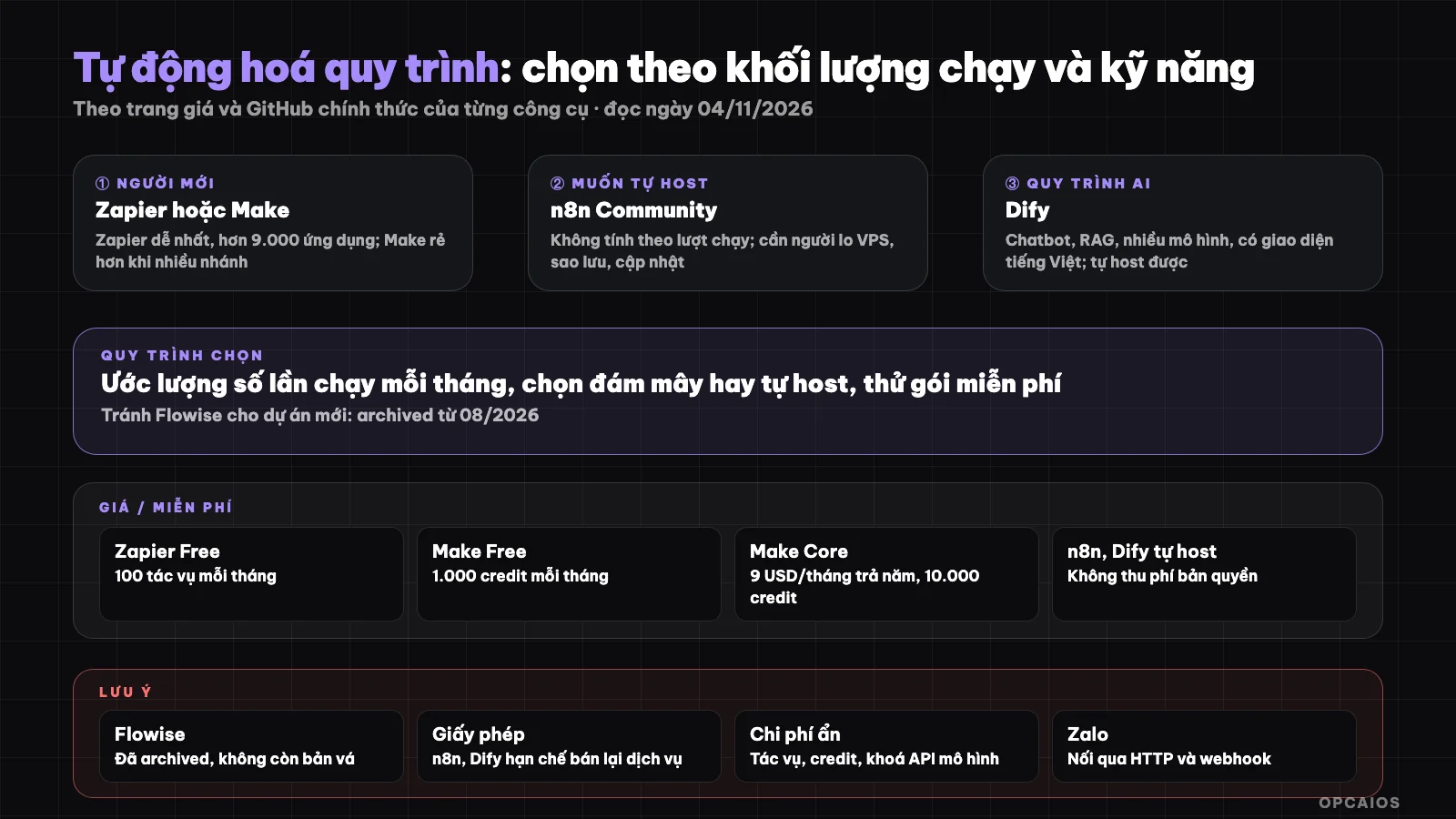
Three main needs lead to three groups of automation tools. Diagram: OPCAIOS.
Quick comparison table of 5 process automation tools
The table below compares 5 tools by needs, starting price read on 04/11/2026, self-hosting ability, Vietnamese language, and difficulty. n8n and Dify have free self-hosted license versions. Make and Zapier only run on the cloud. Flowise has stopped development.
Logos of tools in this post, taken from each project's official page.
| Tool | Best for | Starting price (read 04/11/2026) | Self-host | Vietnamese | Difficulty |
|---|---|---|---|---|---|
| n8n | Self-host, complex processes with code | Self-host Community; Cloud Starter 20 EUR/month paid yearly | Yes | Interface English only | Medium |
| Make | Balance price and power on cloud | Free 1,000 credit; Core 9 USD/month paid yearly (10,000 credit) | No | Not verified | Medium |
| Zapier | Beginners, connect most applications | Free 100 tasks; Pro from 19.99 USD/month paid yearly | No | Not verified | Easy |
| Dify | AI processes, chatbot, RAG | Free Sandbox; Professional 590 USD/year | Yes | Vietnamese interface available | Medium |
| Flowise | Not recommended for new projects | Source code still available, archived | Yes | Not seen | Medium |
What criteria did we use?
We scored 5 process automation tools by 5 practical criteria for solo workers and small businesses. Data read from official pages and GitHub on 04/11/2026. Only n8n is what OPCAIOS actually used.
- Pricing method: by task (Zapier), credit (Make), run count (n8n Cloud), AI message credit (Dify).
- Self-hosting: can it run on VPS, what does the license allow.
- Number of pre-built integrations: number self-reported by the company, not verified.
- Difficulty and Vietnamese: how much skill is needed; is the interface available in Vietnamese.
- Update level: date of code push, latest release, still active or archived.
Detailed assessment of each tool
Each tool below is described using the same framework: what it is, price, sourced figures, strengths and limitations. The order starts with the tool OPCAIOS actually uses, ending with the tool that is no longer being developed. If you're new to this, read where to start automation.
1. n8n: best if you want to self-host
n8n is a workflow automation platform by n8n GmbH (Germany), drag and drop nodes and insert code when needed. According to GitHub n8n-io/n8n (read 04/11/2026), the repository has around 209,500 stars, most recent code push on 04/11/2026, latest version n8n@2.46.4 released 02/11/2026. License is Sustainable Use License, a "fair-code" type: you can self-host and use for internal purposes, but it is not standard OSI open source. n8n.io publishes over 500 integrations, unverified. According to the pricing page, cloud Starter plan 20 EUR/month (2,500 runs), Pro 50 EUR/month (10,000 runs), paid annually; Business plan 667 EUR/month for self-hosted only. Source code has English language files only.
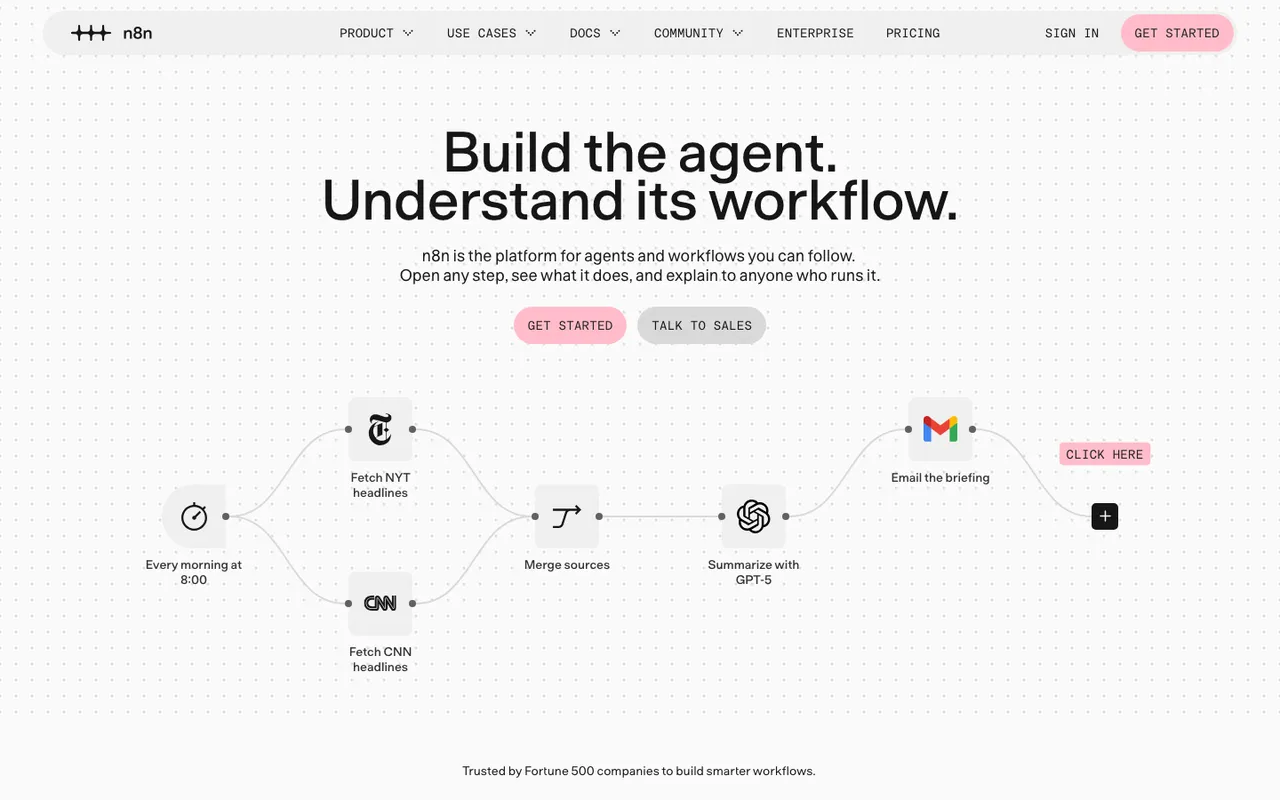
n8n homepage (n8n.io), captured 04/11/2026. Screenshot: OPCAIOS.
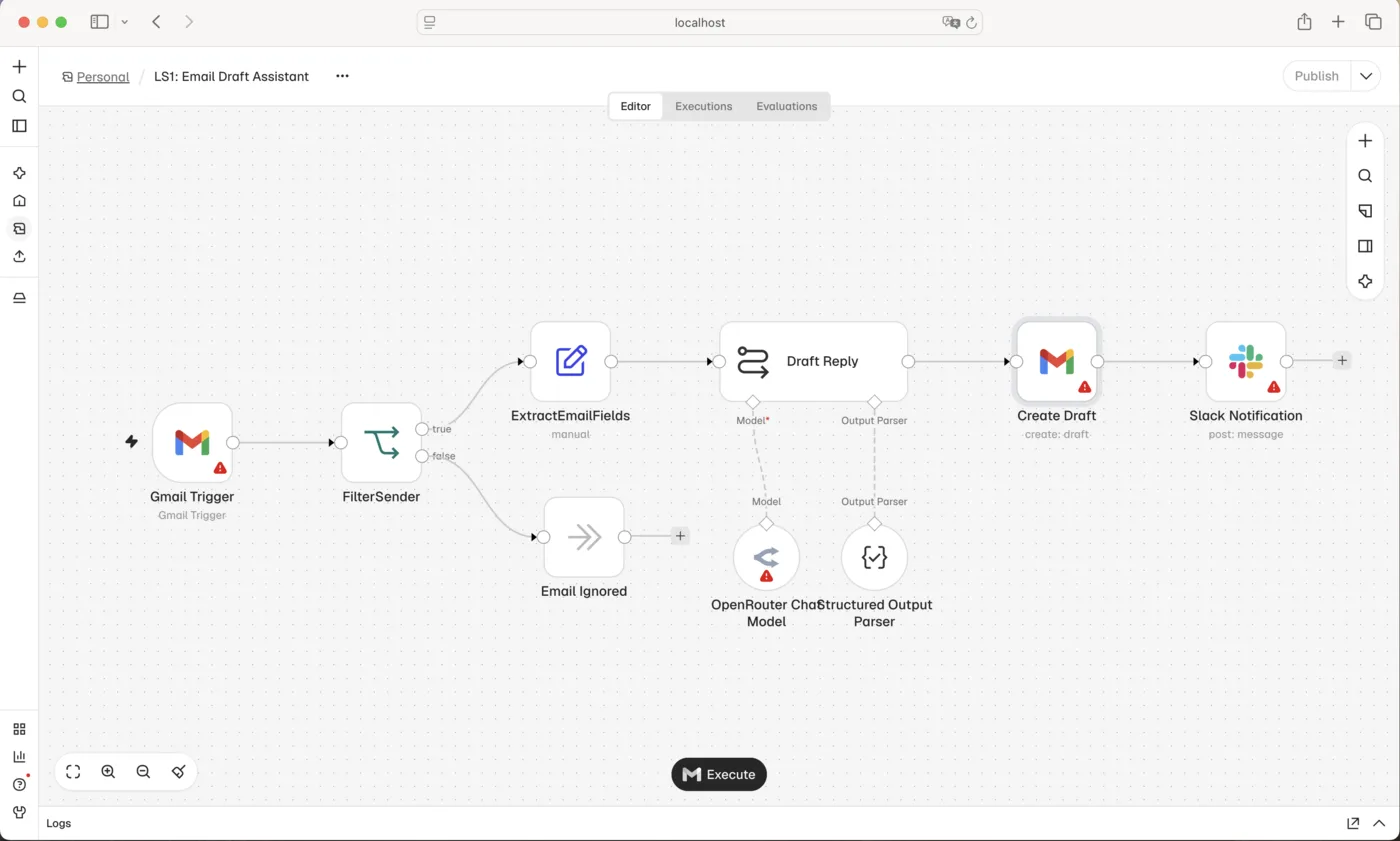
n8n interface. Image: GitHub n8n-io/n8n README.
Strengths: Self-hosted has no per-run fees. Can insert code. Has AI nodes and MCP. Very large community.
Limitations: Self-hosting requires managing updates, backups, security yourself. License is not OSI, restricts reselling n8n as a service. English interface only.
Read more: What is n8n? · Installing n8n on VPS
2. Make: best when you need balance between price and power on cloud
Make (formerly Integromat) is a drag-and-drop automation platform by Make (Czech Republic), drawing workflows as "scenarios" with branches and loops. Homepage make.com claims over 3,500 connected apps, unverified. Make charges by credit, AI modules consume credit based on processing volume. According to public pricing data that make.com/pricing downloads (read 04/11/2026, Vietnam location), Free plan has 1,000 credit/month; Core plan 10,000 credit/month costs 10.59 USD monthly or 108 USD/year (equivalent 9 USD/month); Pro plan 10,000 credit costs 18.82 USD/month. Companies under 20 employees can get 50% off Business plans. Make has no self-hosted version. We have not verified Make's Vietnamese interface.
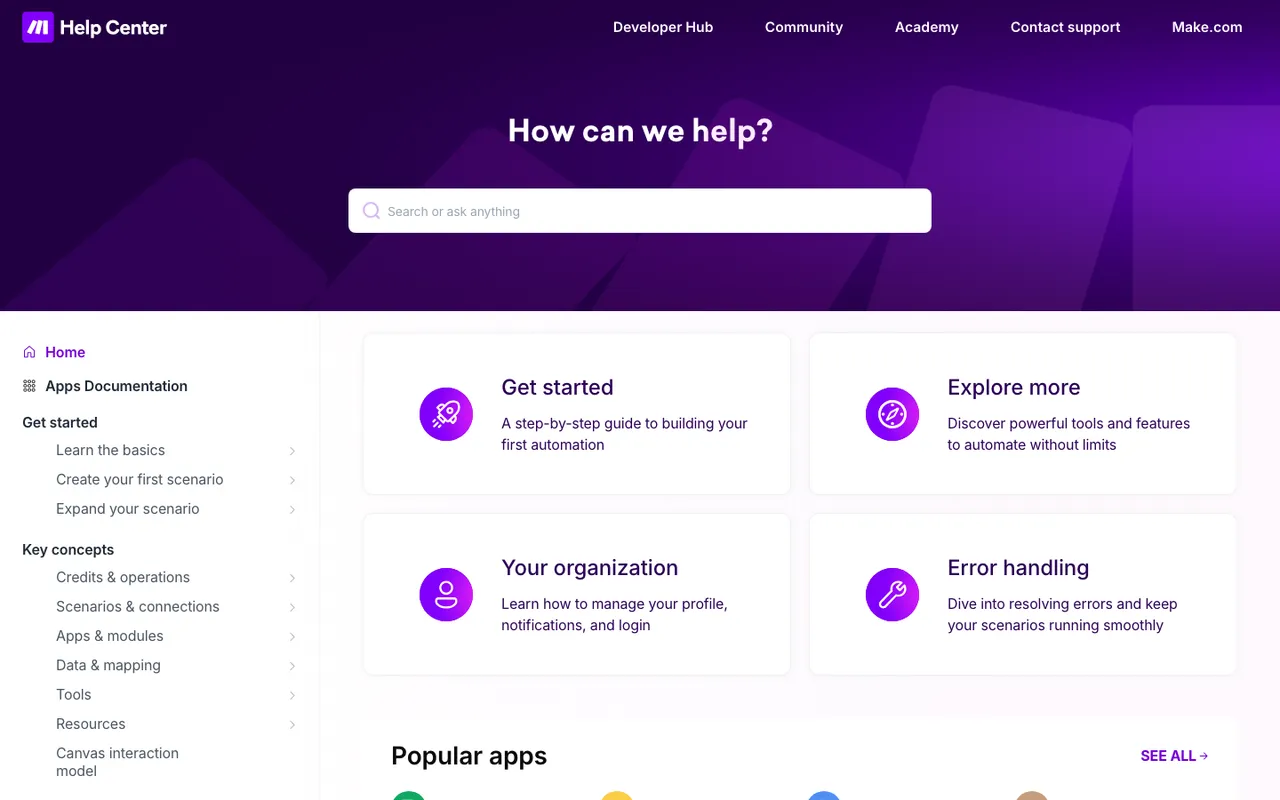
Make help center (help.make.com), captured 04/11/2026. The homepage make.com blocks automated browsers so we captured the official help page. Screenshot: OPCAIOS.
Strengths: Per-credit price lower than Zapier tasks at small usage levels. Can draw workflows with many branches. Has free plan.
Limitations: Hard to predict costs when using many AI modules. Not self-hosted. Steeper learning curve than Zapier.
Read more: What is Make?
3. Zapier: best for beginners needing to connect many apps
Zapier is a cloud automation service by Zapier (USA), connecting apps through "Zaps": one triggering event then actions. Homepage zapier.com claims over 9,000 apps, unverified. According to zapier.com/pricing (read 04/11/2026, USD, before tax): Free plan 100 tasks/month, only two-step Zaps, no webhooks; Professional plan from 19.99 USD/month annual billing or 29.99 USD monthly (750 tasks); Team plan from 69 USD/month annual billing (2,000 tasks). No self-hosted version. We have not verified Zapier's Vietnamese interface.
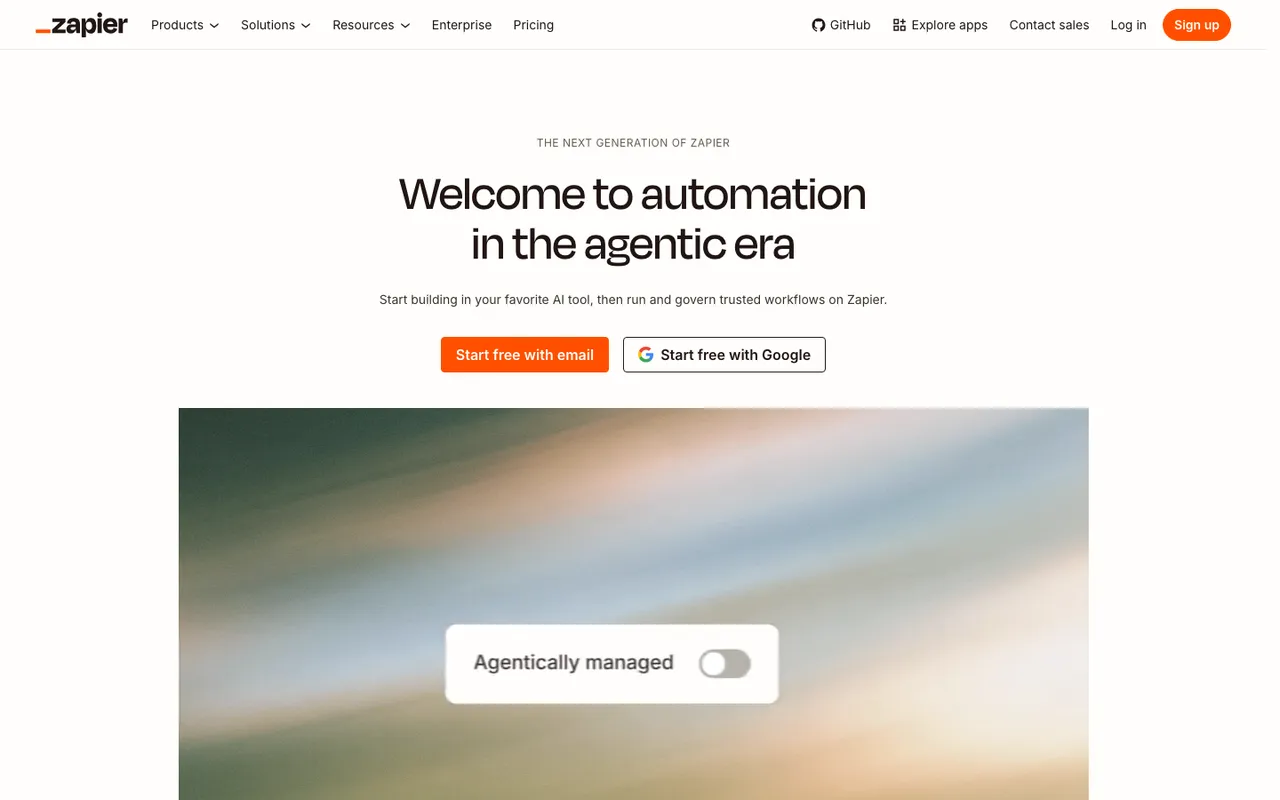
Zapier homepage (zapier.com), captured 04/11/2026. Screenshot: OPCAIOS.
Strengths: Easiest of the 5 tools. Most pre-connected apps. Has Copilot assistant to build Zaps with commands.
Limitations: Most expensive when running many tasks. Free plan has no webhooks. Not self-hosted.
Read more: What is Zapier? · What does trigger mean in Zapier?
4. Dify: best for workflows centered on AI and chatbots
Dify is a platform for building AI applications, agent workflows and RAG by LangGenius, running on cloud or self-hosted. According to GitHub langgenius/dify (read 04/11/2026), the repository has around 160,400 stars, most recent code push 04/11/2026, latest version 1.18.0 released 23/10/2026. License is Apache 2.0 with modifications: you can use commercially, but cannot use the source code to run multi-tenant environments without written permission, cannot remove the logo from the interface. According to dify.ai pricing page (read 04/11/2026), Sandbox plan is free with 200 message credits and 5 apps; Professional 590 USD/workspace/year; Team 1,590 USD/year; Community self-hosted version is free. Source code has Vietnamese interface (vi-VN marked as supported).
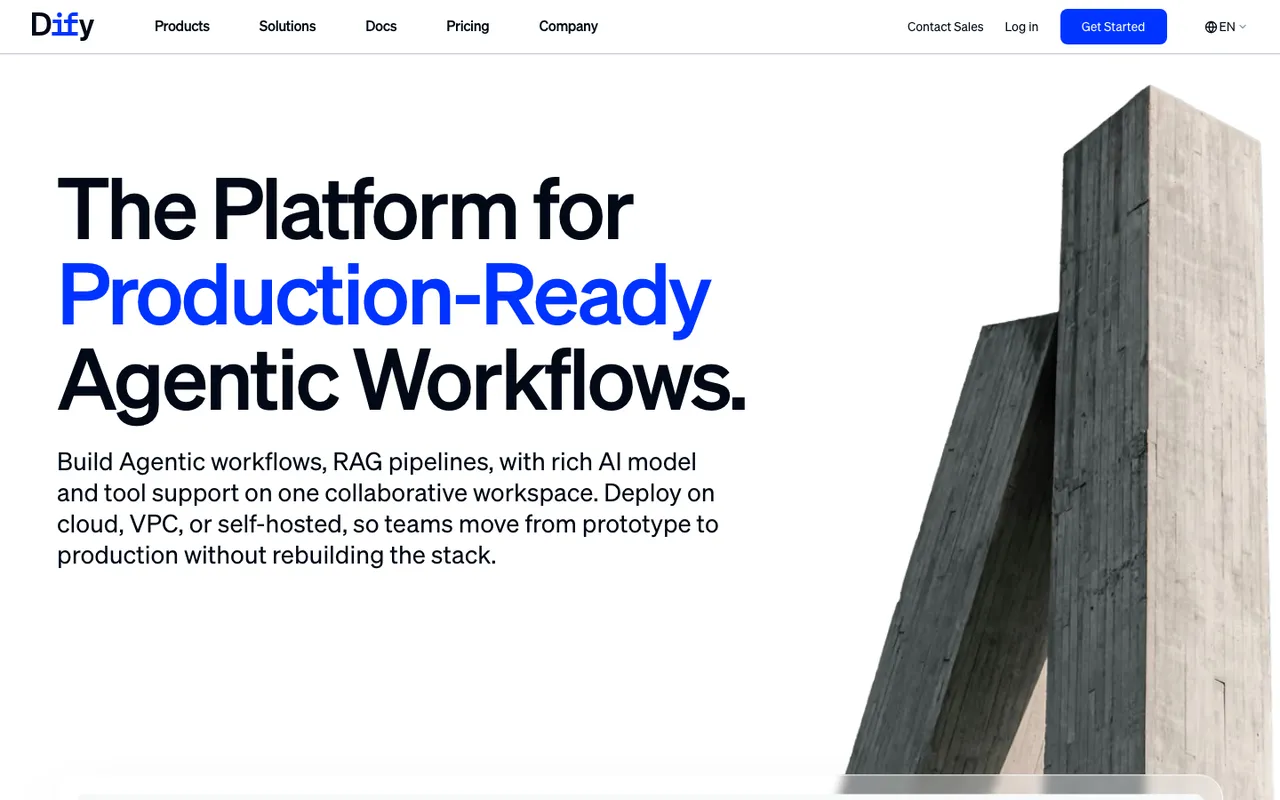
Dify homepage (dify.ai), captured 04/11/2026. Screenshot: OPCAIOS.
Strengths: Build RAG chatbots quickly. Supports many AI models. Has Vietnamese interface. Can self-host.
Limitations: Fewer business app connectors than n8n, Make, Zapier. License has conditions on multi-tenant and logo. You still pay for model API costs.
Read more: What is Dify? · AI RAG chatbot with Dify and Supabase
5. Flowise: archived, should not use for new projects
Flowise was a drag-and-drop tool for building AI agents and LLM chains by FlowiseAI, once very popular. According to GitHub FlowiseAI/Flowise (read 04/11/2026), the repository is now archived (read-only), last code push 13/08/2026, final version flowise@3.1.4 released 29/07/2026, around 55,500 stars. According to official announcement, Flowise stopped working from 29/07/2026, repository moved to archive in August 2026 (page flowiseai.com/sunset states 10/08, GitHub repository last updated 13/08), end of life 31/08/2026. Reason: developers moved to agent programming. Code still under Apache 2.0, team recommends forking if needed. Homepage still shows "We're sunsetting Flowise" banner along with cloud pricing table.
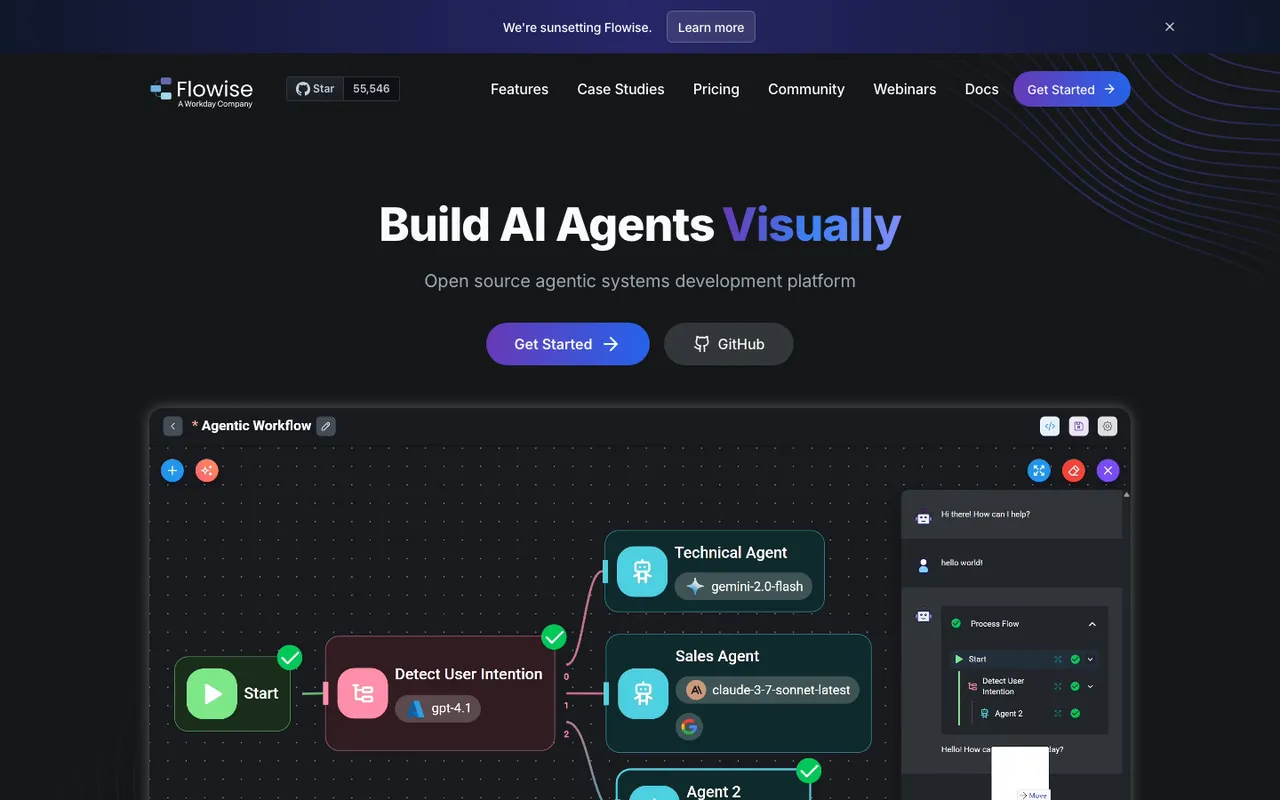
Flowise homepage (flowiseai.com), captured 04/11/2026. Screenshot: OPCAIOS.
Strengths: Source code still Apache 2.0, can be forked.
Limitations: No official security patches anymore. Does not accept new issues. High risk for new projects. Should migrate to Dify or n8n.
Read more: What is Flowise?
Which tool should you choose? By situation
The right process automation tool depends on volume, technical skill, and whether the process uses AI. The table below suggests tools by common situations. If a process runs tens of thousands of times monthly, compare cloud costs with self-hosted VPS.
| Situation | Suggestion | Why |
|---|---|---|
| Just starting, a few simple processes | Zapier Free | Easiest, connects most apps |
| Many-branch process, small budget, don't want to manage servers | Make | Core plan 10,000 credits, low price |
| Run many times daily, someone knows VPS | n8n self-hosted | No charge per run |
| Chatbot for customer care, answer questions from internal documents | Dify | Has RAG built-in, many models, Vietnamese interface |
| Already have Flowise system | Plan to switch to Dify or n8n | Flowise archived, end of life 31/08/2026 |
| Connect Zalo OA, Vietnam payment gateways | n8n or Make via HTTP and webhook | Connect any API; we haven't verified Zalo app availability |
Example (hypothetical): an online shop uses Zapier Free to send form orders to Google Sheets; when orders reach a few thousand monthly, switch to n8n self-hosted and push customers into the best CRM for small business.
Risks and general notes
The biggest risks of process automation are costs rising with volume, data leaking through outside services, and depending on projects that may stop. First, estimate monthly runs. Next, check which services your data passes through. Finally, always have a backup plan.
- Hidden costs: tasks and credits grow fast when processes have loops; Dify and n8n still need to pay for AI model API keys.
- Personal data: know which services customer data goes through and get customer consent. This is reference information, not legal advice.
- Self-hosted licenses: n8n uses Sustainable Use License, Dify uses Apache 2.0 with conditions; both restrict repackaging as a service for others.
- Project stops developing: Flowise is the clearest example by 2026. Export processes regularly. See plan to unplug when AI tools raise prices or crash.
- Security: API keys stored in tools are attack targets; self-hosting must patch updates.
OPCAIOS experience
OPCAIOS uses n8n self-hosted on private servers for automation processes, while the opcaios.org website is custom Next.js running on self-managed VPS (Node.js, pm2, nginx, behind CDN). We haven't used Make or Zapier for real work; Dify and Flowise we only write explanatory posts about.
Our lessons are three points. First, not every task needs automation tools: email sequences sent via SMTP or CRM with Zalo and Messenger inboxes, we write directly into the website with AI agents like Claude Code, Antigravity, Codex. Next, n8n works well for quick integrations and scheduled runs, for example like automatic weekly reports with n8n. Finally, self-hosting means managing backups and updates yourself; we haven't measured time savings yet.
Read more: Where to start automating · What is a webhook? · Monitor competitors with Firecrawl and n8n · Automate Tally form funnel, AI, personalized reports
Frequently Asked Questions
Which process automation tools are free?
There are three main free entry points. Zapier Free gives 100 tasks/month with two-step Zaps. Make Free gives 1,000 credits/month. Dify Sandbox gives 200 message credits and 5 apps. If you self-host, n8n Community and Dify Community charge no licensing fees, but you pay for server and admin time, according to pricing pages read on 04/11/2026.
Should a beginner choose n8n, Make, or Zapier?
A complete beginner should try Zapier first because it's easiest and connects the most apps. When your process needs branching, loops, or runs more than a few hundred times a month, Make is usually cheaper at the same volume. When someone knows VPS, or your process runs tens of thousands of times, self-hosted n8n avoids per-run fees. All three use the same trigger-then-action logic, so switching later isn't too hard. We haven't measured the learning time for each tool in numbers.
Can you still use Flowise?
Flowise still downloads and runs because the Apache 2.0 source code is still on GitHub, but the project is archived. Per the official announcement, the development team stopped features on 29/07/2026, moved the repository to archive in 08/2026, and ended end-of-life on 31/08/2026; the npm package and Docker images are marked unsupported. This means no more official security patches. If you're running Flowise, plan to switch to Dify for AI workflows or n8n for general automation. Don't start new projects with Flowise.
Can you automate Zalo?
Yes, but usually you have to connect it yourself via API. Zalo OA has an API to send and receive messages, so you can use HTTP Request nodes and webhooks in n8n or HTTP modules in Make to connect. We haven't verified that a Zalo app exists, officially in the catalog of n8n, Make, or Zapier. When connecting, follow Zalo's terms. See What is Zalo OA? and What is a Webhook? to understand how data flows.
Do you need to know programming to use automation tools?
It's not required. Zapier and Make are designed for non-coders: you pick apps, pick events, drag-and-drop actions. n8n and Dify can also drag-and-drop, but self-hosting requires knowing Docker, servers, backups; complex workflows are easier if you can read JSON. To learn how to build automated workflows properly, see OPCAIOS's AI application training course.
Source: n8n.io, n8n.io/pricing, GitHub n8n-io/n8n, make.com, make.com/pricing (public pricing data for Vietnam location), zapier.com, zapier.com/pricing, dify.ai/pricing, GitHub langgenius/dify, flowiseai.com, flowiseai.com/sunset, GitHub FlowiseAI/Flowise and "Future of Flowise" announcement (read 04/11/2026); not read/not verified: Vietnamese interface of Make and Zapier, n8n Cloud monthly pricing, Make Teams package price, Flowise cloud closure date, Zalo app available in catalogs; integration app numbers as published by vendors, not verified; prices and ratings may change. Experience is OPCAIOS's.
Translated from Vietnamese with AI. Read the original.
Want to apply this in your business?
Book a free 30-minute call (Vietnam time, in English or Vietnamese).